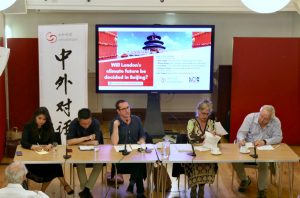
On 3 July, a panel of experts discussed China’s post-pandemic stimulus, as part of London Climate Action Week 2020. In China Dialogue’s first fully online event, the speakers shared their views on the country’s long-term relationship with coal, how it can break away from overseas investments that fall short of environmental standards, and show even greater leadership on overcoming the climate crisis.
Parts of the video and the quotes below have been edited for clarity.
Speakers:
Isabel Hilton (chair) – CEO, China Dialogue
Sam Geall – executive editor, China Dialogue
Li Shou – senior global policy advisor, Greenpeace East Asia
Yunnan Chen – senior research officer, Overseas Development Institute
Dr Chen Ji – principal and ETC China lead, Rocky Mountain Institute
Some interesting excerpts
Li Shuo:
05:09: A set of fiscal and monetary policy measures were introduced [at this year’s National People’s Congress] … which amount to about 6.4% of China’s GDP in 2019. It is quite a considerable package, but fairly modest compared to what happened in 2008/9 when China encountered the global financial crisis.
07:33: In the first five months of this year, we have seen in total 48GW of coal-fired power plants being added into the pipeline. To give everyone a sense, 48GW is more than the total coal fleet of Germany. The UK has less than 5GW of coal-fired power plants.
08:36: There are three factors that will determine the future environmental and climate trajectory in China: the economic situation; the “coal fever” – how that will unfold – can we stop it from happening further? And finally the overall geopolitical situation.
45:43: If you look at the domestic conditions in China, to go completely net zero in 30 years’ time, I think the conditions are still not there… We also need to focus on the short-term actions … So I would slightly prioritise NDC discussions ahead of the long-term strategy for 2050 net zero.
Chen Ji:
13:01: If China wants to achieve a green recovery, it needs to accelerate investment in zero-carbon electrification.
37:15: There are at least two misguided assertions [behind technical arguments in support of coal]. One is that the additional coal capacity is necessary for grid reliability and flexibility… The second is that new coal remains more economic… [In China] people argue that if you add up all these costs, it doesn’t make sense to build renewables instead of coal.
59:01: It would be better if the Chinese government still saw [the responsibility for addressing climate change] as a development problem [rather than an environmental one]. In that way it would be given much more priority.
Yunnan Chen:
16:01: There’s been this paradox where domestically there has been this growing rhetoric and turn towards a cleaner energy pathway, towards greater investment in renewables, and yet overseas this energy finance is still very much dominated by fossil fuels, particularly coal.
18:52: The immediate economic impact of Covid-19 is going to have quite negative impacts on future demand from developing countries for clean energy technology. It’s already treated with some scepticism: it’s seen as greater risk; it’s seen as higher cost. And on the supply side, it’s unlikely that China will be as active a financier as it was in the 2010s… as it will need to prioritise the domestic economy in the coming years.
19:40: There has to be two main shifts. Firstly, for developing countries, there has to be a move away from this “debt finance” that has characterised energy and infrastructure investments in the last 20 years, towards a more sustainable model […] And secondly, there has to be a policy and a cultural commitment away from fossil fuels.
54:33: China’s official financial institutions don’t yet have a very strong social and environmental framework to deal with [negative] impacts to the extent that the World Bank would […] and that needs to change.
Sam Geall:
24:13: China, to its credit, has stayed the course since Trump’s withdrawal [from the Paris Climate Agreement], but that puts the pressure even more on China to “walk the talk”.
26:08: In the US, we’ve seen economic concerns around Covid-19 have led to bailouts for fossil fuel and other carbon-intensive industries. In Europe, by contrast, we have the European Green Deal, looking to harness some of those synergies around a greener recovery. The question for China in this critical moment is, which way it can swing?
26:54: China needs to find partnerships in order to create this [green] recovery. I do think that China, more than ever, has an opportunity to burnish its environmental credentials, to benefit its most innovative industries, its leading low-carbon sectors, and to become a leading supplier of the technologies of the future and to help spur a greener recovery.
28:25: A key partnership [for China] could be, and should be, with the European Union.
50:30: We live in an increasingly globalised, interlinked world, yet the systems we need to deal with the risks associated with those, seem to be only getting weaker.
Copyright notice
This video is released under the Creative Commons Attribution Non-Commercial No Derivatives licence. For a copy of the video file, please contact: [email protected].

![A woman looks on as children study at the library in the char [image by: Rituparna Neog]](https://dialogue.earth/content/uploads/2020/08/20200701_144645-300x219.jpg)