Climate

Can Kashmir finally tackle its growing environmental crisis?

Episode four of The Third Pole Podcast explores whether the region’s new government can address long-overlooked challenges after years of political instability

The Third Pole Podcast, episode 4:

After six years of direct rule from New Delhi, a new administration came to power in the Indian union territory of Jammu and Kashmir in October 2024. In a region long marked by political instability and military conflict, the new government faces many challenges. The environment is undoubtably one of these, given the region’s high vulnerability to the impacts of climate change.

With glaciers melting, rivers becoming increasingly polluted, wetlands shrinking and rampant urbanisation, Kashmir’s ecosystems are strained and the livelihoods of local communities under threat. Despite all this, the manifestos of parties competing in last year’s election revealed a lack of focus on such issues.

In our fourth episode of The Third Pole Podcast, Srinagar-based journalist Auqib Javeed guides listeners through the region’s worsening environmental challenges. He highlights pressures from unregulated tourism, large infrastructure projects and declining fisheries, and explains how these changes are already affecting communities, and could have far-reaching impacts across South Asia.

Joining him is Omair Ahmad, Dialogue Earth’s former South Asia managing editor and greatly missed host of this podcast. Having covered Kashmir for much of his career, he explains how years of conflict, political instability, limited local powers and weak governance have compounded its environmental problems. He strikes a note of hope for the future though. Things can turn around, and key to this is empowering local players, such as panchayat members and municipal councillors, to implement solutions.

When a political conflict is militarised, environmental issues go to the bottom of the heap
Omair Ahmad, former South Asia managing editor, Dialogue Earth
A group of men in traditional attire have a conversation outdoors, with expansive fields and mountains in the background.
Auqib Javeed (front right) interviewing saffron farmers about the lack of water supply during a reporting assignment in Pampore, Jammu and Kashmir (Image: Faisal Bashir)

Guests

Auqib Javeed, independent journalist
Omair Ahmad, former South Asia managing editor, Dialogue Earth

Credits

Host: Shalinee Kumari
Producer: Shalinee Kumari
Audio edit and sound design: Sync Sound Sabha
Recording studio: Pindrop Media
Artwork: Sana Nasir
Thanks to: Lizi Hesling, Nanaui Amoros Silva, Chaia Dechen, Isa Lim, Sam Gelder

Music credits

“Alarm Cycle” by Blue Dot Sessions, licence: CC BY NC
“Borough” by Blue Dot Sessions, licence: CC BY NC

About the series

The Third Pole Podcast is a Dialogue Earth series focusing on climate change and the environment in the Himalayan watershed. It aims to create a space for beyond-the-article conversations with our journalists and field experts. At the same time, we also ask questions about the state of environmental journalism in South Asia: why it’s needed, what issues it should be looking at and what challenges it faces.


More from this series

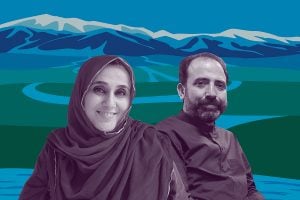
A man and woman sit next to each other, with the view of a mountain range in the background Podcast

After four decades of efforts, is the Ganga any cleaner?

Episode one of The Third Pole Podcast visits one of India’s most sacred rivers
A man and woman sit next to each other, with the view of a mountain range in the background Podcast

Can India use AI to predict extreme weather events?

Episode two of The Third Pole Podcast explores the challenges of AI-based weather forecasting
Podcast

Pakistan’s mountain languages under threat

Episode three of The Third Pole Podcast discusses the impact of climate change on Indigenous languages in the Himalayas
Cookies Settings

Dialogue Earth uses cookies to provide you with the best user experience possible. Cookie information is stored in your browser. It allows us to recognise you when you return to Dialogue Earth and helps us to understand which sections of the website you find useful.

Required Cookies

Required Cookies should be enabled at all times so that we can save your preferences for cookie settings.

Dialogue Earth - Dialogue Earth is an independent organisation dedicated to promoting a common understanding of the world's urgent environmental challenges. Read our privacy policy.

Cloudflare - Cloudflare is a service used for the purposes of increasing the security and performance of web sites and services. Read Cloudflare's privacy policy and terms of service.

Functional Cookies

Dialogue Earth uses several functional cookies to collect anonymous information such as the number of site visitors and the most popular pages. Keeping these cookies enabled helps us to improve our website.

Google Analytics - The Google Analytics cookies are used to gather anonymous information about how you use our websites. We use this information to improve our sites and report on the reach of our content. Read Google's privacy policy and terms of service.

Advertising Cookies

This website uses the following additional cookies:

Google Inc. - Google operates Google Ads, Display & Video 360, and Google Ad Manager. These services allow advertisers to plan, execute and analyze marketing programs with greater ease and efficiency, while enabling publishers to maximize their returns from online advertising. Note that you may see cookies placed by Google for advertising, including the opt out cookie, under the Google.com or DoubleClick.net domains.

Twitter - Twitter is a real-time information network that connects you to the latest stories, ideas, opinions and news about what you find interesting. Simply find the accounts you find compelling and follow the conversations.

Facebook Inc. - Facebook is an online social networking service. China Dialogue aims to help guide our readers to content that they are interested in, so they can continue to read more of what they enjoy. If you are a social media user, then we are able to do this through a pixel provided by Facebook, which allows Facebook to place cookies on your web browser. For example, when a Facebook user returns to Facebook from our site, Facebook can identify them as part of a group of China Dialogue readers, and deliver them marketing messages from us, i.e. more of our content on biodiversity. Data that can be obtained through this is limited to the URL of the pages that have been visited and the limited information a browser might pass on, such as its IP address. In addition to the cookie controls that we mentioned above, if you are a Facebook user you can opt out by following this link.

Linkedin - LinkedIn is a business- and employment-oriented social networking service that operates via websites and mobile apps.