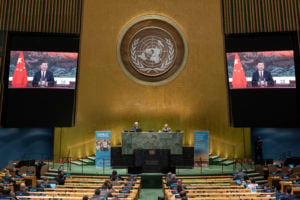
President Xi Jinping recently announced that China would achieve domestic carbon neutrality by 2060, signalling a clear direction for China’s economy and future energy investments. The new target should also be used to jump-start a cleaner growth pathway for the countries participating in China’s Belt and Road Initiative (BRI) through the export of technologies and policies necessary for decarbonisation.
The risk of more high-carbon infrastructure overseas
A recent study by Tsinghua University’s Institute of Energy, Environment and Economy (Tsinghua 3E) provides a roadmap for reaching carbon neutrality. It shows steep declines in domestic fossil fuel investments and use, with a 96% drop in coal use by 2050, 75% drop in fossil gas and 65% drop in oil. If the power sector and heavy industries do not proactively prepare for this transition, they may be tempted to pursue more high-carbon projects along the Belt and Road.
Of course, decisions over energy investments ultimately lie with the governments of BRI countries, where there is a need to address the financing gap for renewables and to counter favourable perceptions of coal, oil and gas. Most BRI nations do not have carbon-neutrality commitments and many see high-carbon infrastructure as required for economic growth, since that was how developed countries grew. China’s overseas lending has also generally flowed into fossil fuels rather than clean energy. As one indicator, only 2.3% of overseas energy lending from Chinese policy banks (China Development Bank and China Exim Bank) was for solar and wind between 2000 and 2018, while the rest was primarily for fossil fuels, large hydropower and nuclear.
At the very least, it’s time to end investments in new overseas coal plants
Plans for new coal plants in countries such as Bangladesh and Pakistan may result in overcapacity and new sources of carbon emissions unless power development plans are updated. Fortunately, recent government changes in Pakistan may support more renewable energy development. Bangladesh is reconsidering several planned coal plants, but there are worrying indications of a “dash for gas” rather than renewables – indicating the importance of national energy plans in determining the carbon content of planned BRI projects.
Chinese state-owned enterprises (SOEs) that negotiate large infrastructure projects with host countries hold a lot of the power and have more experience delivering fossil fuel infrastructure, skewing bilateral negotiations towards high-carbon projects. BRI countries must acknowledge the risks this puts on public budgets. National regulators should ask themselves: Why burn coal if you can develop clean power sources instead that do not increase air pollution and respiratory disease? Why not support electric cars and motorcycles and accompanying charging infrastructure, instead of relying on expensive imported oil? Any why invest in expensive gas infrastructure given the volatility of the global gas market?
China may not make the final decision, but it could stop fossil-fuel investments and incentivise SOEs to focus on renewables. It could mandate climate risk assessments for all BRI projects and introduce targets for low-carbon investments. This would support decarbonising the BRI and reduce the risks faced by Chinese SOEs and banks of over-investing in high-carbon projects and technology.
A clean growth scenario in line with carbon neutrality
China’s commitment to carbon neutrality is a market signal that its future domestic investments will prioritise clean energy. This should be a wake-up call for policymakers in BRI nations, who should respond by bolstering their low-carbon policies and clean energy targets. If China is moving away from coal, then why should other countries settle for dirtier, high-carbon options? If BRI countries show interest in a low-carbon pathway, then Chinese companies that lead in clean energy should pursue more technical training and exchanges with them. Chinese companies can help reduce the cost of wind and solar projects to meet the domestic targets set by BRI countries.
The potential for clean energy is huge. In Egypt and Oman, proposals for coal plants involving Chinese companies have stalled while renewable projects have succeeded. The Chinese company GCL signed a contract to build its first solar panel factory in Egypt in 2018. Chinese solar company Yaowei stated in 2019 that it will set up a solar panel production plant in Zimbabwe, increasing access to the African market. Chinese firms are constructing the massive 950 MW concentrated solar power (CSP) and pholtovoltaic (PV) hybrid project in the United Arab Emirates. Chinese SOEs have been involved in large renewables projects in Myanmar, Vietnam, Chile, Laos and the Philippines among others, and Chinese solar equipment is exported to dozens of other countries. Recent high-profile plans include Uganda’s 500 MW solar plant with China Gezhouba and Zambia’s 600 MW solar project with PowerChina.
As Vietnam’s government has designed policies to incentivise renewables development, Chinese companies have exported hundreds of millions of dollars’ worth of solar PV equipment to the country. The 600 MW Dau Tieng PV complex in Vietnam, the largest of its kind in Southeast Asia, will be developed by PowerChina, which also developed the 99 MW Bac Lieu offshore wind project, the 73 MW Soc Trang wind farm, the planned 550 MW Luning PV project, and the 24 MW Fuhlen wind farm – Vietnam’s first wind demonstration, in 2016. Several other large renewables deals have been signed in the last year.
Implications for the BRI
Countries should examine China’s new carbon neutrality goal and decide if they are ready to put their weight behind low-carbon technologies like solar and wind power. If they do not, they face high risks for debt and stranded assets from investing in fossil fuel infrastructure, even as China’s domestic market phases out such projects.
As China’s veteran climate negotiator Xie Zhenhua has said, “pollute first, clean up later” is not the development path of the future. China can share these lessons more widely, spurring cleaner investments in the BRI. At the very least, it’s time to end investments in new overseas coal plants as the environmental and climate costs far outweigh the benefits. China’s own recent draft guidelines for its green bonds catalogue excluded “clean coal” from eligibility for inclusion – a sign of what’s to come. BRI countries should reconsider energy projects that rely on technologies whose planned obsolescence date is now clear and join the vanguard for a decarbonised future. As countries update their Nationally Determined Contributions in readiness for the major climate conference next year, it will be interesting to see whether other developing countries follow China’s example and announce their own carbon neutrality targets, helping to promote the global transition to a cleaner, low-carbon future.


![Official figures state around 73.5% of the Madhupur Saal Forest land had been converted to different commercial purposes. The lucrative profit of mono-crop cultivation has led people to clear forest lands for banana and pineapple cultivation [image by: Prakash Bhuyan]](https://dialogue.earth/content/uploads/2020/11/13-300x240.jpg)