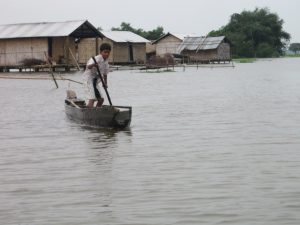
![<p>Abdul Mazid, the boatman on Assam that so many trust [image by Teresa Rehman]</p>](https://dialogue.earth/content/uploads/2016/10/abdul_mazid-768x576.jpg)
Ever-smiling Abdul Mazid is the essential link in many lives. Residents of six villages are dependent on Mazidor Nao (Mazid’s boat) to ferry people and goods up and down the Jia Bhoroli, a major tributary of the Brahmaputra river in Assam. He is dependent on a predictable flow of water in the river. Climate change is affecting that predictability.
Mazid, now 40, was just ten years old when he started plying his boat. “My father [also a boatman] was unwell once. He asked me to try being the helmsman in the boat. That is crucial. I did it well.” And he was hooked.
Mazid has transformed his ferry from a rowboat to one with a diesel engine. Earlier, he needed a crew of five. Now he needs two. Starting early – he has to drop children to school by 7 AM – Mazid makes up to a dozen trips a day, and ends up earning around INR 400 (USD 6). On weekly market days, though, he can earn thrice as much.
Climate change impacts
The rhythm of this life is increasingly disrupted by the impacts of climate change. Jia Bhoroli rises in the Tibetan Plateau, where faster melting of glaciers is leading to unexpected surges in the water flow down the river. Mazid says it has become more and more dangerous to take his ferry out on such days. The currents are stronger, and it is far more difficult to manoeuvre the boat. But Mazid is proud of his ability to do so, and his passengers trust him.
“Mazid understands the river,” says Dildar Hussain, a regular passenger. “People have faith in him. They feel safe when he is in charge though the river changes course every year.”
Climate change has also led to more cloudbursts and consequent flash floods. There are more landslides on the hills, and the water carries more silt when it comes down. The entire bed of the Jia Bhoroli has risen in recent years, says Mazid. So the river tops its banks more often. Mazid has lost his home and farm to such a flood, and has been forced to shift further inland. “I like it when the river is alive. But I don’t like it when it erodes the banks.”
Ferrying has been his family occupation, but the life is so tough that Mazid does not wish it on the next generation. His eyes shine when he talks of his daughter, now in college. “I want them to get a proper job. They should not slog like me.” His greatest regret is that he can never take a day off. There are too many people waiting for the ferry. Most of his passengers are daily wage labourers who have to work every day to get a meal. As for Mazid, “I get ten minutes to have a meal.”
Inland navigation
Most of the navigation in the Brahmaputra and its tributaries is by boats such as the one owned by Mazid. Till 1950, ships large and small plied regularly on the Brahmaputra and larger tributaries – Kolong, Kapil, Subansiri and others. Then a huge earthquake raised the beds of many rivers.
Many ships still plied till 1965, when a war between India and Pakistan led to the closure of the connection between the Brahmaputra and the sea. (Bangladesh was a part of Pakistan at that time). Now there is fresh impetus in inland navigation between India, Bangladesh and Nepal.
But for this to succeed, planners have to consider the ways in which the rivers are being transformed by climate change. Partha Jyoti Das, senior researcher at the Guwahati-based think tank Aaranyak, told thethirdpole.net, “It is time we go beyond traditional boat making. In fact, IITs [Indian Institutes of Technology] and design institutes can be utilised to make boats which can be more stable during high flood currents.”
But the smaller boats will not lose their relevance. They are the cheapest and fastest means of transport, especially during the floods that keep recurring in Assam. Residents of riverine islands are critically dependent on them, sometimes even to fetch drinking water.
Many of the boats now have diesel engines and have been given the onomatopoeic name bhut bhuti. “Bhut bhuti is the lifeline in western Assam, the main means of communication both in normal and flood times,” says Das. “I feel it’s important to promote country boats to add value, modernise, improvise and make them useful. Water transport is much cheaper and eco-friendly and climate friendly.”
It is not that cheap any more. A boat 20 feet long – which can carry 15 to 20 people – costs INR 25,000-30,000 (USD 375-4500. Still, “it’s a viable profession,” says Das. “They will never lose their value. People can think of capacity building and value addition of traditional boat makers. It’s important that technology is transferred to boat makers.”
The boat maker
The boat maker – who doubles as the boat repairman – is as crucial to local life as the boatman. As Mazid says, “My boat needs regular repair and maintenance. Tar is applied on the entire boat and I have to fix the cracks and holes.”
![Abdul Kalam, the boatmaker [image by Teresa Rehman]](/wp-content/uploads/2016/10/abdul_kalam.jpg)
Like Mazid, Kalam does not want his children to follow in his footsteps. Boat making is hard work. “I get body ache as I have to hit hard with a hammer and lift the heavy boat. But my boat is fool-proof. People trust my skills and I am invited by people from adjoining areas to come and build a boat. It’s an intricate skilled work. The measurements must match. I take up boat building as a contractual job. In order to make a 20-foot boat I need 6-7 days and it costs me around INR 7,000 (USD 105).”
He repairs boats the rest of the time. “I change rotten wood and fix holes. Earlier there were just two of us. Now there are three more. They all started as my helpers.” For Kalam, his most satisfying moment is when he completes his boat. He does not need to test it on water to ensure that it is perfect. “I look at the structure and decide it’s good.” But he waits for the boat to be launched before he takes the customary offering of a gamchha (hand towel) or a small sum of money.
Boat makers’ cooperative
In some parts of Assam, boat makers have come together to start cooperative societies. In Dhemaji, on the banks of the Brahmaputra in eastern Assam, Guna Kalita, 60, is Secretary, Pragati Nao Shilpa Samabay Samiti Limited. It has 20 boat makers as members. “We try to create means of livelihood through boat making,” Kalita says. “We are originally from Salmara in Majuli and boat making is our traditional craft. Most of us were displaced due to erosion.”
Setting up the cooperative in 2003 enabled the boat makers to get government grants and larger orders, including from NGOs. In an average year, the society gets orders to build 25-30 boats. “The demand goes up during floods,” says Kalita, another man who learnt boat making from his father.
The society plans to hold a workshop on boat making in an effort to keep this traditional craft alive. “We love the river,” says Tarun Chandra Kalita, founder member of the society. “It’s an unforgettable experience every time. We feel excited every time a boat is complete.”