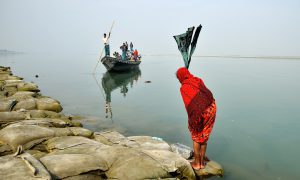
![<p>River water is life itself for the poor in the Sundarbans [image by Jody Valente]</p>](https://dialogue.earth/content/uploads/2017/03/Sundarbans-Jody-Valente-768x512.jpg)
It has been established by now that coastal Bangladesh is being seriously affected by climate change. It is now imperative to determine the exact ways in which it is being affected and to what extent, so that specific plans to adapt to the changes can be carried out.
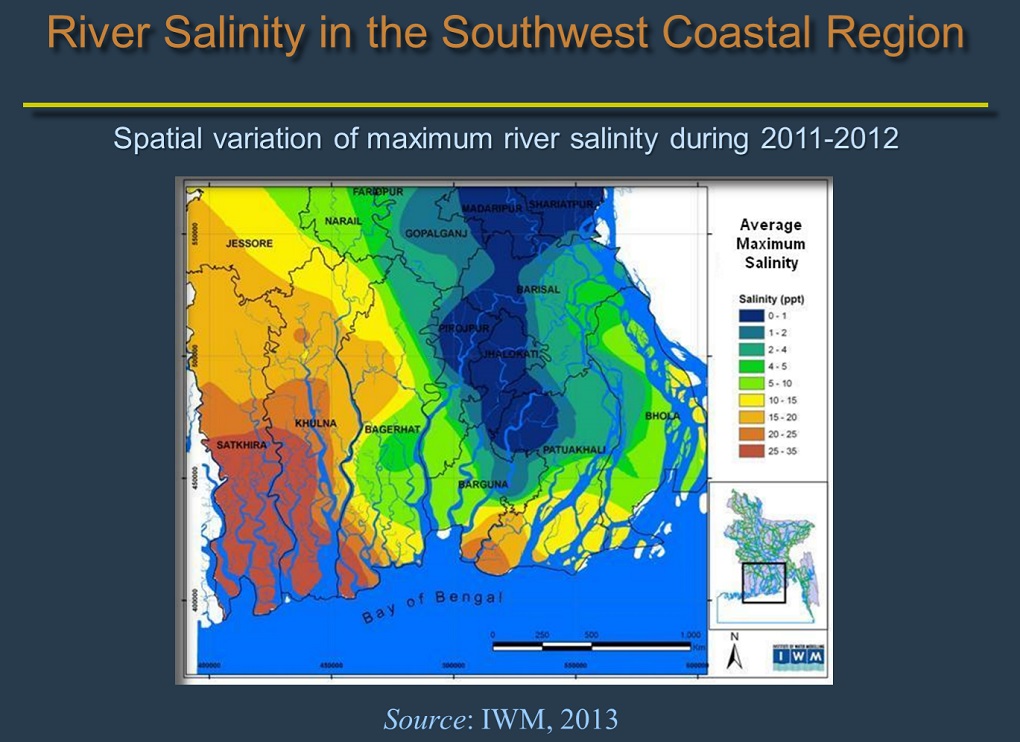
Studies conducted by the World Bank, Institute of Water Modelling and World Fish–Bangladesh between 2012 and 2016 have quantified the effects of increasing salinity in river waters in coastal Bangladesh, including the areas in and around the Sundarbans – the world’s largest mangrove forest that straddles the coast of Bangladesh and India.
The broad categories of climate change effects that hit coastal areas of Bangladesh are
- Change in temperature
- Change in rainfall
- Sea level rise
- Change in frequency and intensity of cyclones
- Storm surge
- Change in river salinity
- Change in soil salinity
The coastal areas are also affected by changes in freshwater supply from rivers upstream.
The only way to adapt to these changes is to understand each change in detail. While doing that, it has to be remembered that each change has various effects on the people, animals and plants that live in the Sundarbans. This makes climate change a cross-cutting theme whose analysis requires collaboration between experts of different disciplines.
The effect of changes in the salinity of river water in the coastal areas is the result of such an interdisciplinary study, where climate scientists, GIS experts, hydrologists, ecologists, engineers and economists worked together.
We know that river water salinity in coastal Bangladesh depends on volume of freshwater discharges from the upstream river systems; surface water runoff from rainfall; salinity of the Bay of Bengal near the coast; tidal dynamics of the coastal river system; climate-induced changes in sea level, temperature, rainfall and altered riverine flows from the Himalayas. All these are expected to affect the spread and intensity of salinization of river water in the coastal area. Saltwater intrusion is expected to worsen in low-lying coastal areas.
The challenge before the researchers was to quantify this effect. The study found that the expected increase in river salinity is likely to impact accessibility of drinking water, availability of water for dry-season irrigation, wild habitats of fresh water fish, other indigenous species and nutritional intake of the poor, especially of women and children. In the Sundarbans, a shift in mangrove species is expected from Heritiera fomes to Ceriops decandra and Excoecaria agallocha.
Degradation of water quality during non-monsoon months is already apparent, and further progressive degradation of river water in a changing climate is imminent. This will progressively impact the entire ecosystem, including that of the Sundarbans. Forestry and fishery based livelihoods of millions of inhabitants of the southwest coastal region of Bangladesh – including the Sundarbans Impact Region – will be affected.
Loss of freshwater zones
The increase in salinity is likely to hit the poor hardest. In southwest coastal Bangladesh, 9.9 million people live in poverty. Of them, 5.9 million extremely poor people cannot meet the basic needs of food expenditure. At present, 2.5 million poor (including 1.4 million extreme poor) in this part of Bangladesh are already suffering from shortage of drinking water and scarcity of water for irrigation for dry-season agriculture.
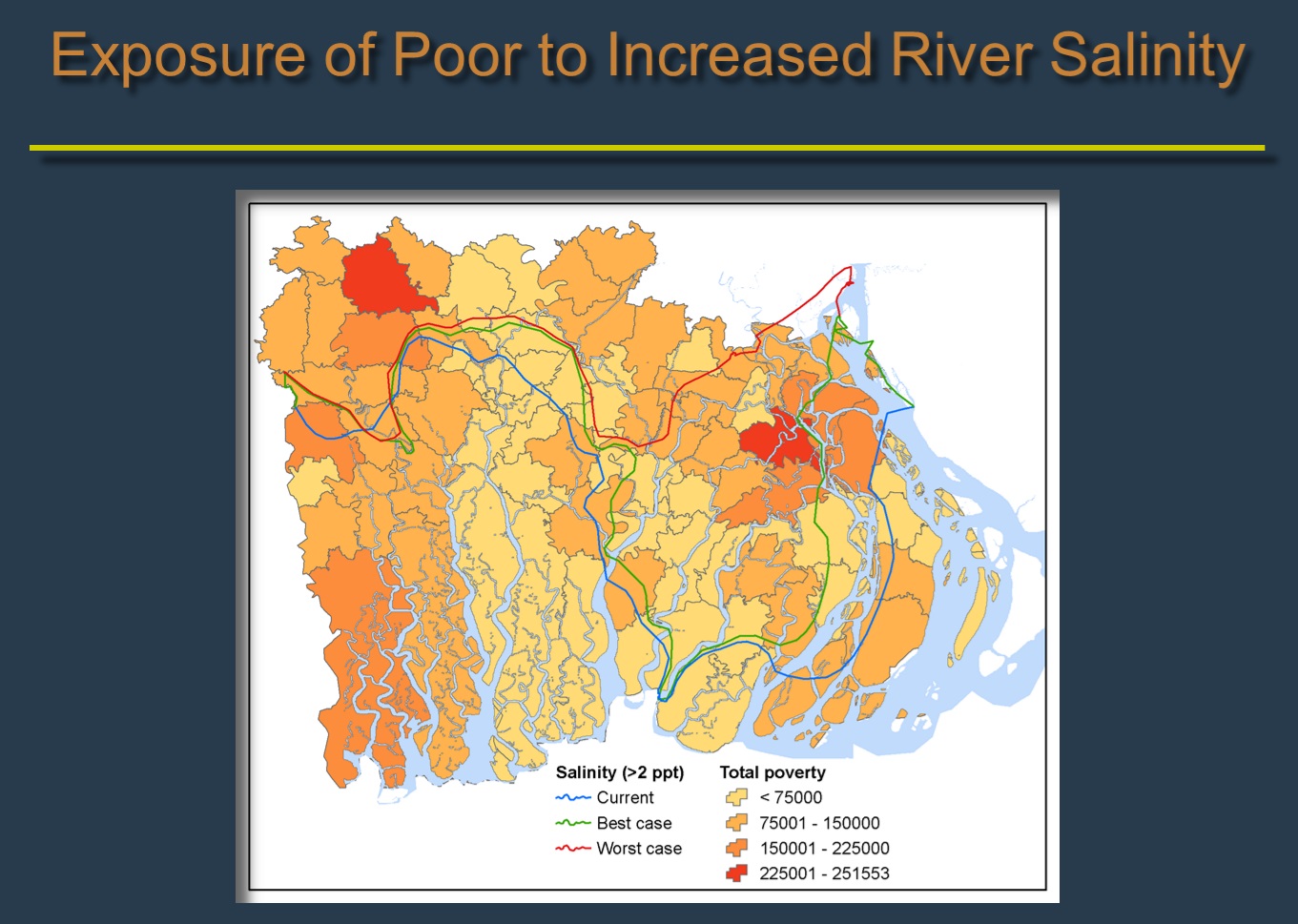
The studies indicate that even in the best future case, the livelihoods of 2.9 million poor and 1.7 million extremely poor would be adversely affected by increasing salinity of river water. In the worst future case for salinity incursion considered, there will be adverse impacts on 5.2 million poor and 3.2 million extremely poor people.
This means that river water will no longer be usable for agriculture in Barguna, Bhola, Jhalokati, Khulna, and Patuakhali districts in the worst case scenario. Tentulia river, which currently provides water to the Bhola irrigation project, will be non-operational, with estimated salinity exceeding 2 ppt.
The scarcity will be severe even in the best case scenario. For example, 98% of the rivers in Khulna and 97% in Bhola will be adversely affected. However, Bishkhali and Buriswar rivers, and the upstream stretch of the Baleswar river, are expected to remain functional for irrigation in the best case scenario, with estimated salinity lower than 2 ppt.
Here are the potential adaptation measures that can be taken:
- Desalinization of drinking water
- Widespread use of saline resistant crops
- Expansion of Tilapia farming
- Expansion of honey production
- Expansion of crab culture
- Precautionary measures before construction of buildings
With a virtual certainty that the sea level rise will continue beyond 2100 even if greenhouse gas emissions are stabilised today, the ecosystem is likely to alter significantly in the future. Families in coastal Bangladesh, especially inhabitants of the Sundarbans Impact Zone, are already on the “front line” of climate change. Already, economic necessity is driving more working-age adults to seek outside earnings in households threatened by salinization, particularly those that are relatively isolated from market centres.
For sustainable poverty alleviation, it is imperative for policymakers to begin planning to cope with the potential poverty trap that climate change may create. Implementation of new policies takes time. Therefore, the time for the policymakers and development partners to prepare and implement policies that reduce vulnerability to climate change is now.