Climate change in Uttarakhand will increasingly force people to abandon farming at high altitudes and move to the plains over the next 30 years. A new study on the state in the middle of the Himalayan range by the Germany-based Potsdam Institute for Climate Impact Research (PIK) and The Energy and Resources Institute (TERI) in New Delhi has forecast the worst impacts will be in higher elevations. This may accelerate the trend of people migrating and leaving land fallow.
Uttarakhand, a state in northern India that covers an area bigger than Costa Rica, may be 1.6-1.9 degrees Celsius warmer by 2050. Its residents are already experiencing the impacts of climate change, such as changing temperatures, upward-moving snowlines, receding glaciers, erratic rainfall, reduction of snow in winter, changed cropping seasons, shifting cultivation zones for certain crops, and drying up of perennial streams, as pointed out in the state government’s action plan on climate change (SAPCC).
The majority of people in Uttarakhand live in rural areas; 71% depend on rainfed agriculture, practised through terrace farming on hill slopes.
The TERI-PIK study found that districts at higher elevations, including Uttarkashi, Chamoli, Rudraprayag and Pithoragarh, are warming fastest. Saurabh Bhardwaj, a climate scientist at TERI and a co-author of the study, said: “Our analysis projects that the state’s average annual maximum temperature is likely to increase by 1.6 C under the medium warming RCP 4.5 pathway and by 1.9C under the higher warming RCP 8.5 scenario pathway in the near future (2021-2050).”
RCP stands for ‘representative concentration pathway’. Scientists use RCPs to model how differing concentrations of greenhouse gases in the atmosphere will change in the future because of human activities.
RCP 8.5 assumes a very high level of future concentrations, due to unsuccessful efforts to curb emissions. RCP 4.5 is based on a medium level, likely to result in a 2C-3C global temperature rise.
Climate change hits farming
Existing pressures on farming include a decrease in land held per person, lack of irrigation infrastructure, crop depredation by animals like wild boars or monkeys, and a waning interest in farming among young people. Climate change is adding to these.
A vulnerability and risk assessment done for the SAPCC identified three ways climate change may impact agriculture: increased water stress, increased risk of floods and changes in crop yields. Almora, Champawat, Pauri Garhwal and Tehri Garhwal are the districts likely to experience high water stress, it said.
Himani Upadhyay of PIK and lead author of the study said: “More extreme temperatures can increase evaporation and evapotranspiration losses, which can cause water stress that would impact crop growth and yields, increase the susceptibility of crops to pests and diseases, and increase irrigation requirements. The increased intensity of rainfall events can lead to flooding, causing crop losses and disruptions in transport and access to markets to sell agricultural goods. Changes in temperature and rainfall can affect crop water demand, productivity and thereby yields.”
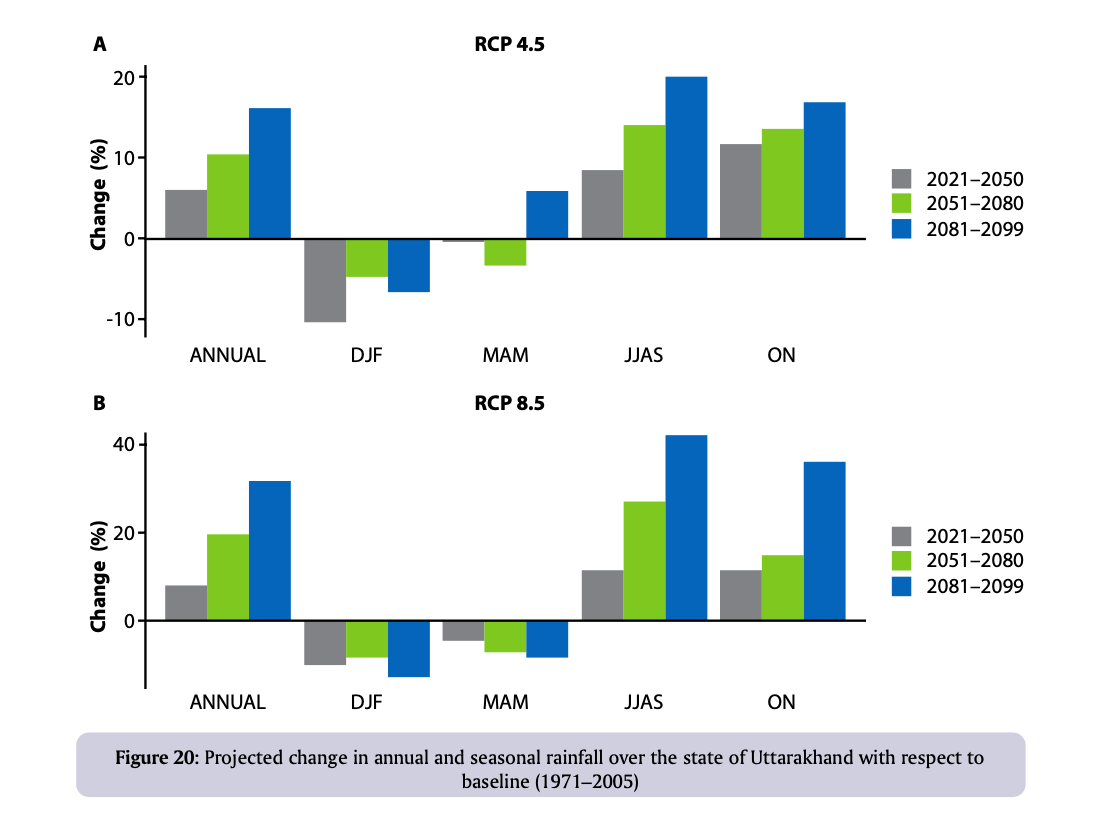
The study indicates that increased water stress could further reduce crop yields under both RCP 4.5 and RCP 8.5 scenarios, adding to existing outmigration pressures. There will be more frequent droughts, fewer rainy days but heavier rainfall on those days, and less rain or snow in winters.
Ghost villages
India’s last census in 2011 put the number of migrants in Uttarakhand at more than 4 million – about 40% of the population. The TERI-PIK study does not attempt to calculate the number of people who might be on the move by 2050. The authors explained this would require data on migration, climate variables and decision-making at household level – which is not available. They also said out that such projections “are controversial and do not help the cause of migrants”.
According to the Rural Development and Migration Commission, Uttarakhand, the inability to diversify livelihoods in rural areas is the biggest factor pushing outmigration (50%), followed by lack of educational institutions (15%) and healthcare facilities (9%).
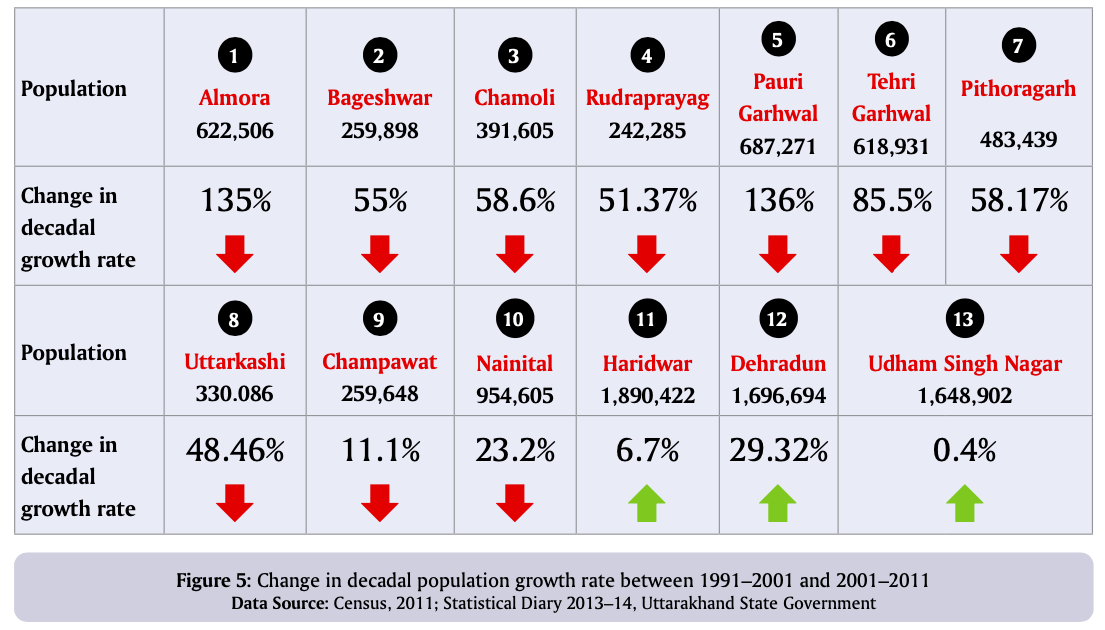
Because of migration, an increasing number of villages in Uttarakhand are uninhabited. According to a 2018 survey by the commission, 734 villages in the state have become uninhabited since 2011. These villages are spread across all 13 districts and are often referred to as ghost villages.
Most of the migration to the plains in Uttarakhand is of young people. The data shows that 29% are 25 years old or younger, 42% are 26-35 and 29% are over 35.
“Climate change is functioning as a risk modifier influencing existing population movements in Uttarakhand,” Upadhyay added. “It has led to further decline in agricultural productivity over the last two decades, adding to outmigration pressures.”
Picture beyond Uttarakhand
Across the Indian Himalayas, there will be a similar rise in temperature to that projected in Uttarakhand. Bhardwaj of TERI pointed out that, as has happened historically, the Hindu-Kush Himalayan region will warm more than the rest of India and global average. “Hence, mountainous areas are more vulnerable,” he said.
62.9 million
Number of people in Bangladesh, India, Sri Lanka, Nepal and Pakistan who may be forced to migrate by 2050 due to climate disasters, according to a recent report
The study’s authors said that, with regards to migration, certain factors make Uttarakhand “unique”. According to Upadhyay, these include the state having 10 hill and three plains districts, and the majority of the migration being internal.
The policy response
Ajay Mathur, who was head of TERI when the study was conducted, said: “The transition management strategy should lead to policy changes that integrate migrants and make conditions such that the adverse impacts of climate change do not kill livelihoods but sustain them. Migration has to be considered as a choice to increase both resilience and livelihoods of local populations.”
“We should identify the places in Uttarakhand that will have favourable living conditions by the end of the century and keep them alive and sustained,” said Hans Joachim Schellnhuber, director emeritus at PIK. “It’s a big challenge for both governance and communities.”
The report identifies three main areas of action for policymakers: preparing for demographic changes resulting from migration; creating alternative livelihood options in the hill districts (at higher elevations) to revitalise the economy; and revisiting the SAPCC as well as the state’s agricultural policies.
Upadhyay said: “Farmers need support to increase and improve their sources of income. They could be provided education and training to update their farming practices and diversify their crops. Farmers could be assisted with the development of irrigation channels and rainwater-harvesting structures, the provision of better-quality seed, information on crop and animal insurance, improved access and connectivity to markets.”
Schellnhuber noted: “If we can control global warming within 2C, we can manage the challenges that will arise.” Current steps to control greenhouse gases emissions are moving the world towards warming of 3C or more above pre-industrial levels.