For the first time, countries have agreed to transition away from fossil fuels to avert the worst consequences of the climate crisis. The deal made at this year’s United Nations climate change summit, COP28, calls for countries to shift their energy systems in a “just and orderly manner”, but includes loopholes that could affect emissions reductions.
Sultan Al Jaber, the summit’s president, and CEO of the Abu Dhabi National Oil Company, said the oil and gas sector was “stepping up for the first time” to deliver ambitious goals. “We have the basis to make transformation happen. It’s a balanced and historic package to accelerate climate action,” he added.
Countries met for two weeks in Dubai to conclude the Global Stocktake, intended to evaluate progress on climate action and to outline what more is needed to limit global warming to 1.5C – the high ambition target included in the 2015 Paris Agreement. Global average temperature has already increased by 1.2C since pre-industrial times.
COP28 had a strong start on day one with the operationalisation and capitalisation of the loss and damage fund, a global financial package to compensate the most vulnerable nations for climate change impacts. Developed countries pledged US$700 million to the fund, though this is less than 0.5% of the estimated losses facing developing countries each year.
The future of fossil fuels
Negotiations had stalled when countries could not agree on language in the COP28 agreement on the future of fossil fuels. More than 100 nations were pushing for strong language to “phase out” oil, gas and coal use. They were met with opposition from OPEC, the umbrella organisation of major fossil fuel producing and exporting countries. It argued that the world should focus on reducing emissions rather than phasing out all fossil fuels.
The protracted discussions led the summit to conclude a full day later than expected. The final text “calls on” countries to “Accelerat[e] efforts globally towards net zero emission energy systems, utilizing zero- and low-carbon fuels well before or by around mid-century.” It mentions phasing out “inefficient” fossil subsidies that “do not address energy poverty or just transitions”.

The text recognises the need to reduce other greenhouse gases, such as methane, and the role that “low-carbon” fuels, such as natural gas, can play in facilitating the energy transition, which was questioned by campaigners.
“Economic realities will kill some of the false solutions that this text still gives room to, such as CCS [carbon capture and storage] and so called ‘transition fuels’, but these cannot be allowed to distract from the job at hand,” said Linda Kalcher, executive director of Strategic Perspectives, a European thinktank.
Countries are also asked in the text to triple renewable energy capacity and double the annual rate of energy efficiency improvements by 2030. But the target doesn’t mention how this should happen or give clarity on the financial support needed for developing countries to achieve it.
Lacking climate finance
Insufficient climate finance was one of the main issues of contention across the two weeks. Joab Okanda, senior climate advisor at Christian Aid, said: “There is a gaping hole on climate finance to actually fund the transition from dirty to clean energy in developing countries. Without that, we risk the global shift being much slower.”
The agreement urges countries to more than double their climate finance for adaptation to developing countries by 2025 and ensure they meet the existing goal of US$100 billion per year. It also calls for reform of international financial institutions.
Climate finance is expected to be a major theme of next year’s climate conference, when agreement is set to be reached on a new, quantifiable target for the amount of financial support developed countries will provide to developing countries to help them mitigate and adapt to climate change.
Harjeet Singh, head of global political strategy at Climate Action Network International, said: “Final outcomes fall disappointingly short of compelling wealthy nations to fulfil their financial responsibilities.”
“While parties did not achieve as strong a Global Goal on Adaptation framework as vulnerable countries wanted, there is now a pathway forward to improve adaptation actions, marking the beginning of a formal coordinated global effort for adaptation and resilience,” said Ana Mulio Alvarez, a researcher at environmental thinktank E3G.
Pushing an agreement through
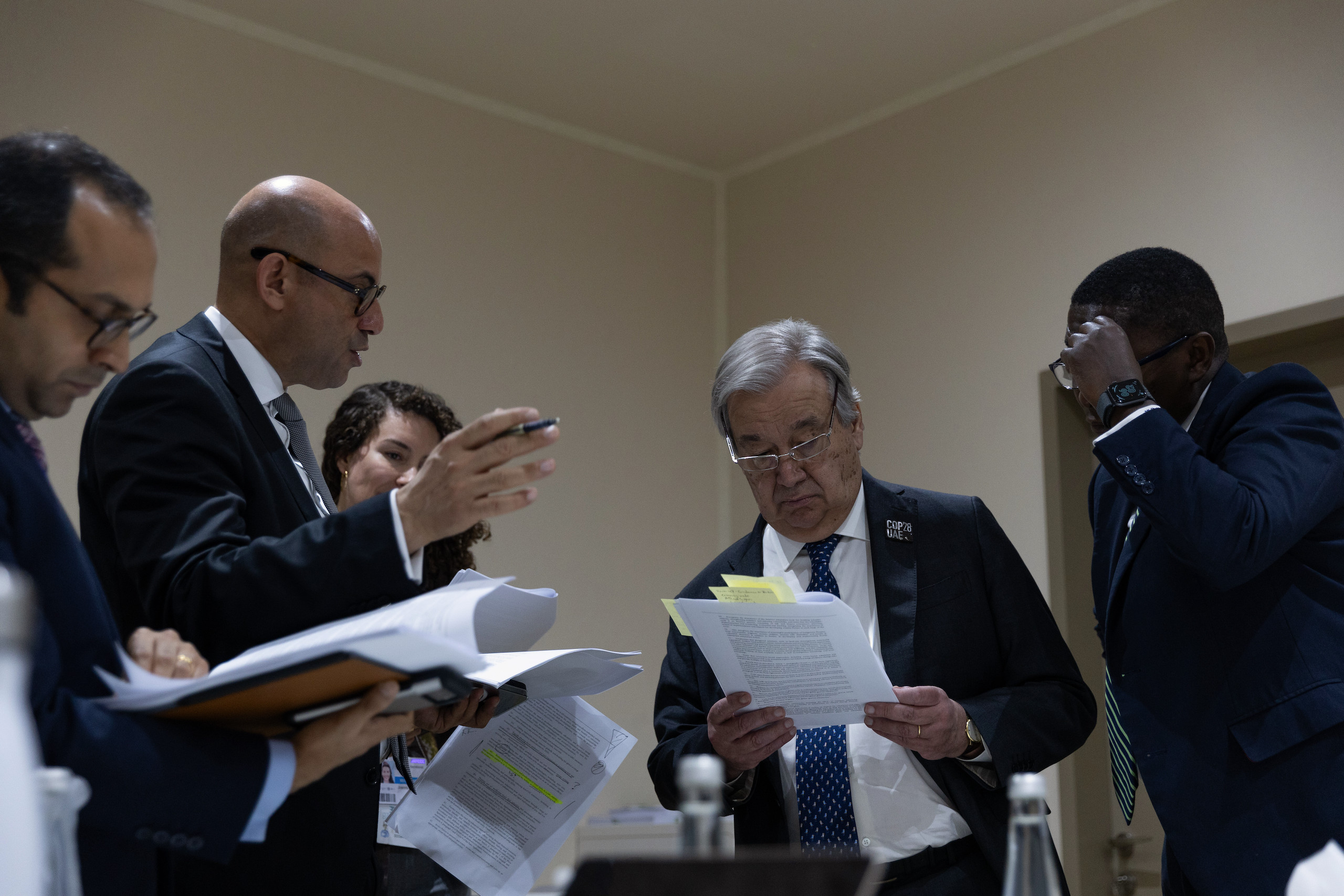
The resolution was a compromise reached after hours of patient negotiations extending into two sleepless nights for thousands of government delegates, and there were hugs on the dais when it was adopted at the final plenary without any country making a formal objection.
However, Anne Rasmussen, Samoa’s natural resources and environment minister, complained that the agreement had been gavelled before its delegates had even arrived in the room, preventing any chance to object. She called the agreement an “incremental advancement over business as usual, when what we really need is an exponential step change in our actions.”

She drew loud cheers when she said: “It’s not enough to reference science, then not do what science asks us to do.” Al Jaber’s response: “We understand your concerns”.
For Simon Stiell, executive secretary of the UN Framework Convention on Climate Change (UNFCCC), COP28 delivered “some genuine strides forward” but he warned that countries are still far from the finish line. “We must get on with the job of putting the Paris Agreement at full work. We needed this COP to send crystal clear signals on many fronts.”
He also defended the multilateral process itself, which has come under repeated attack for failing to deliver climate action commensurate with what the science shows is necessary: “Without COPs, we’d be headed to 5C. We’re currently headed to just under 3C,” he said. Although he conceded that “COP28 needed to move the needle further”.
Arunabha Ghosh, CEO of the New Delhi-based Council on Energy, Environment and Water, said: “The urgency of the climate crisis demands immediate reforms be made to the COP process to ensure that accountability, implementation, and climate justice become central to all efforts. Otherwise, future COPs risk becoming obsolete.”
China and the US may have further methane and energy-related news soon. US Climate Envoy John Kerry said the US and China intend to update their long-term strategies and invite other countries to do the same. “We’ve reached the starting line, if not the finish line,” he said.
The urgency of the climate crisis demands immediate reforms be made to the COP processArunabha Ghosh, Council on Energy, Environment and Water
Liu Zhenmin, senior advisor to the Chinese special envoy for climate change, told Reuters on Wednesday that the proposed COP28 climate deal “is not perfect. Some issues still remain.”
When asked if China would consider phasing out coal, climate envoy Xie Zhenhua’s response was in line with China’s previously stated position: “We will strictly control coal consumption before 2025. After 2025, we will gradually reduce it. We will also not build new coal-fired power plants overseas, as we have already announced.”
Similarly, Zhao Yingmin, China’s vice minister for ecology and environment reiterated China’s longstanding position: “Developed countries have an unshakeable historical responsibility for climate change and must take the lead to materialise net zero as soon as possible.”
He added that the promotion of the energy transition should fully respect the capabilities and national conditions of different countries, and should not implement a “one-size-fits-all” transition requirement for countries.
Hosting of the climate change conference rotates among five regional groups. Next year’s talks will take place in November 2024 in Azerbaijan, a country that derives two thirds of its income from oil and gas. So discussions on energy transition are likely to continue to take centre stage. Then it will be Latin America’s turn, with Brazil hosting COP30 in the city of Belem in 2025, where countries will be expected to submit new climate plans.