


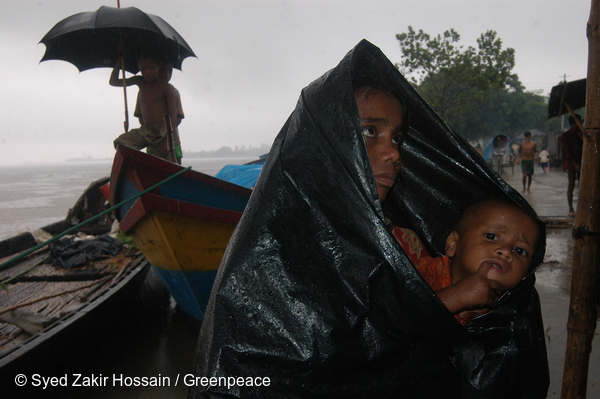

A cyclone that hit the Bangladesh coast late on July 30 has led to heavy rain in large parts of the country, plus adjacent areas in India and Myanmar. Resultant floods have already killed over 180 people – the largest number in the Indian state of West Bengal.
The cyclone petered out once it moved inland, so there were few casualties due to strong winds. But it led to very heavy rainfall over a large area straddling three countries.
Also read: Cyclone peters out after crossing Bangladesh coast
West Bengal’s minister for disaster management Javed Ahmad Khan said 69 people had been killed in the southern parts of the state. “More than 1.8 million people in 5,600 villages have been affected by the flooding, nearly 1.1 million have been moved to camps,” he added.
The deaths have been due to collapsing walls, drowning, electrocution and lightning strikes.
Cyclone-induced heavy rainfall caused a number of landslides in the hilly state of Manipur in north-eastern India. One landslide in a village called Joumol killed at least 10 people on August 2, while eight are still missing. Men from India’s National Disaster Relief Force reached the remote village on the border with Myanmar within a day and rescued three more peeople trapped inside buried homes.
Five people have been killed due to flood-related incidents in Odisha, another Indian state which saw heavy rainfall in the wake of Cyclone Komen. State government officials said over 400,000 people had been affected, and 1,574 of them had to be rescued from marooned homes. Seven relief camps have been set up and 132 boats pressed into service for rescue operations.
There were fewer casualties in Bangladesh, because the authorities had issued repeated warnings, and many residents of coastal villages had moved to cyclone shelters. Still, the consequent flooding caused serious economic damage, especially in the Chittagong Hill Tracts.
After crossing the coast, Komen weakened into a monsoon depression and moved west, towards India. Still, the tail of the twister brought heavy rainfall to Myanmar, where the authorities were caught unprepared. Local media reported at least 46 deaths, mainly in western and central parts of the country. Chinese news agency Xinhua reported the destruction of around 17,000 homes. An official in the social welfare ministry said 13 of the country’s 14 provinces had been affected by floods and landslides.
The Myanmar government has declared a state of emergency in four western provinces and has appealed for international aid. Many areas were still cut off on August 4, but the World Food Programme (WFP) had started providing food rations to 47,800 people. Its spokesperson said WFP would have to reach around 150,000 people once roads were restored. UN children’s agency UNICEF is distributing water purification and hygiene kits.
Other floods
Heavy rainfall unrelated to Cyclone Komen has also killed around 200 more people in Nepal, Pakistan and other parts of India.
The latest death toll in Pakistan is 118, according to Ahmed Kamal, spokesman for Pakistan’s National Disaster Management Agency. Most of the deaths are due to flash floods in mountain areas of northern Pakistan, the Khyber Pakhtunkhwa province. The provincial authorities have reported 59 deaths so far.
Kamal added that an estimated 850,000 people had been affected by floods around the country and nearly 3,000 homes have collapsed or have been damaged. Overall, around 800,000 people in 2,275 villages have been affected.
Earlier, in mid-July, the town of Chitral in Khyber Pakhtunkhwa had already been affected by flooding – with the destruction of a power station and several bridges. The far north region of Gilgit Baltistan had also seen flash floods kill five people and affect 175 villages.
Landslides caused by heavy rain have also taken their toll in western Nepal, though authorities said the casualty figure was no higher than during other monsoons.
In two usually-arid states in western India – Gujarat and Rajasthan – heavy rain has led to 109 deaths in the past one week. In Gujarat, an estimated four million people are still marooned in their homes, and the government is dropping food to them from helicopters. In Rajasthan over 600 people in danger of being swept away by flash floods have been rescued.