![<p>Robina Saleem sitting on a wheel chair in her three-room straw bale home on outskirts of Rawalpindi city in Pakistan’s Punjab province [image by Aamir Saeed]</p>](https://dialogue.earth/content/uploads/2016/05/Robina-Saleem-sitting-on-a-wheel-chair-in-her-three-room-straw-bale-home-on-outskirts-of-Rawalpindi-city-in-Pakistans-Punjab-province-768x576.jpg)
Robina Saleem lost her home and ability to walk when she was buried under rubble when a strong 7.6 magnitude earthquake struck her hometown in Pakistan’s Azad Jammu and Kashmir (AJK), in October 2005. Her life will never be the same again, but she was lucky to get a new house in 2013 built from straw bale by Pakistan Straw Bale and Appropriate Building (PAKSBAB), a non-profit organisation, on the outskirts of Rawalpindi city in Pakistan’s Punjab province.
“This house is energy efficient and quite comfortable in both summer and winter unlike our past home that was made of brick and mortar,” said Saleem, aged 52, sitting in a wheelchair.
Her straw bale home stands amid traditional red bricks houses and appears to withstand erratic weather as well as cement structures. She lives with her husband and three children, and has become a strong advocate for the straw bale houses, especially in the hilly areas prone to earthquakes. “If I was living in a straw bale home at the time of 2005 earthquake, I’m sure I wouldn’t have broken my spinal cord,” she said.
An answer to earthquakes
Pakistan is one of the most vulnerable countries to earthquakes, with over 215 earthquakes in 2015 alone, according to Earthquake Track.
Did you know…
Pakistan suffered economic losses of around USD 5.2 billion in the 2005 earthquake, according to a World Bank report. The quake left around 2.8 million people homeless and killed at least 73,000 people.
To build these homes, straw, a natural by-product of farming is collected and baled, and then fitted into a frame before being rendered with earthen or lime stucco. A timber frame is built to reinforce the walls and support the roof.
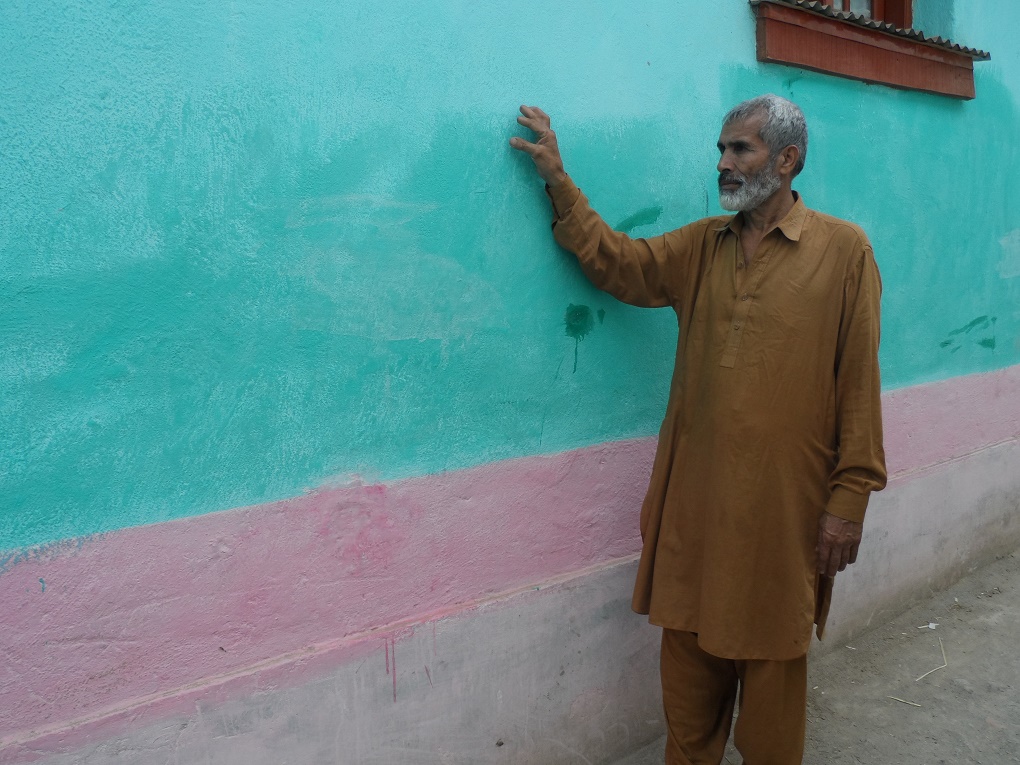
PAKSBAB have built 40 straw homes for earthquake victims in different areas of Pakistan and received encouraging feedback from the residents, Darcey Messner Donovan, chief executive officer told thethirdpole.net. “Our unique straw bale construction method uses local and renewable materials to build affordable homes that are extremely earthquake resistant and energy efficient,” she said.
The cost of construction, including materials and labour, is between PKR 500-600 (US $4.70-5.70) per square foot, depending on the complexity of the design, availability of local materials and the economy of scale. This compares favourably with the cost of construction of middle income homes in Pakistan, which is PKR 1,500 – 1,700, or three times as much. In posh localities, of course, the prices are much higher. “We believe it is a very promising technology which could grow through outreach and training,” she said, adding that she is working with some Pakistani parliamentarians and non-profit organisations to re-launch the project soon.
Our unique straw bale construction method uses local and renewable materials to build affordable homes that are extremely earthquake resistant and energy efficient.Darcey Messner Donovan
PAKSBAB has trained over 70 local builders so far in Pakistan, but has halted its operations for the time being due to lack of funds since the organisation was building straw bale homes for free, Donovan said. “Our biggest hurdle has been securing funding for our projects. We’ve accomplished a lot with a couple of small grants and donations from family and friends, but it’s time to take it to the next level,” she said.
No interest from the government or society
Despite being energy efficient and heat resistant, as well as relatively cheap and easy to build, straw bale homes have not taken off in Pakistan because of government apathy and people’s suspicion about their durability and resilience in the face of earthquakes, floods and landslides.
The government’s apathy towards constructing earthquake prone and green buildings increases the risks to life and property in case of earthquakes and other natural disasters. It also exacerbates the environmental degradation of the construction industry, said Muneeb Haider, senior architect and head of technical development at Pakistan Green Building Council, a non-profit organisation which aims to build efficient green buildings and communities.
He said that using straw bale material to build homes helps cut carbon emissions and people cope with heat waves and other extreme weather conditions. “The straw bale homes are environment friendly too as their material naturally biodegrades unlike the brick and mortar buildings,” Haider said.
Status conscious at the cost of being environmental conscious
Most people in Pakistan will still need convincing straw houses are better than cement, Haider admits. “People in both urban and rural areas of Pakistan are status conscious and they feel the straw and mud houses are good only for poor. It is unfortunate that concrete multi-story buildings are fast becoming a status symbol in our society,” he said.
Bilal Anwar, senior manager at Centre for Climate Research and Development, an independent research institute at COMSATS University, says straw bale technique can empower people in disaster prone areas who could rebuild their houses themselves with the right training.
The displacement and subsequent rehabilitation of large number of victims from earthquakes and other natural disasters causes further environmental degradation, therefore the use of straw bale homes can help preserve the environment and cut economic losses too, Anwar said.
“The disaster management authorities need to realise importance of the green buildings like straw bale homes and should promote them with help of the locals, architects and green campaigners”.