
Climate

Eight months on, Kashmir’s flood trauma still to recede

It will be another year of losses and debt for farmers in India’s Kashmir Valley where some fields continue to be under water after the floods of September 2014
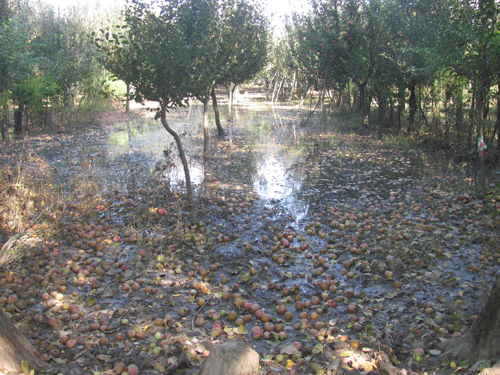
<p>An apple orchard in Kashmir waterlogged by floods in autumn 2014 (Image by Athar Parvaiz)</p>

An apple orchard in Kashmir waterlogged by floods in autumn 2014 (Image by Athar Parvaiz)

 Eight months after floods left more than 200 dead and washed away hundreds of acres of land, farmers in India’s Kashmir Valley are looking at another year of losses with some fields still under water and others so sodden that the cost of ploughing them has more than doubled.

The fact that many are still waiting for the promised government compensation has only added to the desperation of farmers, still recovering from the September 2014 floods, Kashmir’s worst in six decades. More than 50 villages, mostly in south Kashmir, were devastated as the surging waters from the tributaries of the Jhelum inundated fields of paddy and maize and orchards.

That story of ruin continues for many subsistence farmers with last year’s crops lost and no produce this year either as their fields are still submerged.

“Now we are feeling the real impact of the flood. All the resources we had have been exhausted,” said Jabbar Shah, a farmer in Shahtalpora village, barely 20 kilometres from Srinagar, the summer capital of Jammu and Kashmir state.

With their fields being transformed into a large water body, farmers in the area have given up all hope and have resorted to fishing in the waters. They say their repeated demands for government action did lead to officials visiting the area and ordering dewatering of the fields. However, only 25% of the cultivable land has been dewatered so far. The remaining 75%, amounting to about 500 acres, cannot be cultivated this year.

The rates for ploughing the land that can be salvaged have spiraled from Rs.250 (US$4) last year to Rs.600 ( US$10) this year. Last year’s crop, which remained unharvested, makes  ploughing difficult and therefore the escalation in cost.

“Before the floods, we used to work as labourers to earn extra money when we had some time off from our fields. But now earning daily wages has become compulsory for us. Otherwise our families will starve,” said Shah.

The story in Kulgam is no different.

Ghulam Mohammad Mir, a subsistence farmer in the south Kashmir area, is amongst those who lost his crop last year and his 1.5 acres of paddy land. Except for 200 kg of rice, he has not received any assistance from the government.

Mir, who is in his early 50s and is the father of three daughters, sold off his herd of seven cattle because there was no fodder for them. With no fields and no cattle either, Mir now works as a labourer to feed his family.

Apple growers in the state have also suffered heavy damages with many losing their entire production last year and many trees damaged.

Eight months on, the plight of the farmers and the challenges before them has attracted little attention from the government. Much of the media and the government too focused on the damage to houses and businesses in Srinagar, neglecting farmers.

Official estimates had put the losses of agricultural products at Rs.30,750 million ($500 million) with standing crops destroyed in over 300,500 hectares. The estimates add that hundreds of acres of land have been washed away by floods and 3,811 hectares of land rendered uncultivable.

With the scale of losses this big, why should farmers be neglected so? Agricultural production of Jammu and Kashmir generates an annual turnover of Rs.2,000 crore ($320 million). Of this, the share of the apple industry alone is Rs.1,200 crore 193 million). The sector also provides direct and indirect employment to more than 500,000 people.

Cookies Settings

Dialogue Earth uses cookies to provide you with the best user experience possible. Cookie information is stored in your browser. It allows us to recognise you when you return to Dialogue Earth and helps us to understand which sections of the website you find useful.

Required Cookies

Required Cookies should be enabled at all times so that we can save your preferences for cookie settings.

Dialogue Earth - Dialogue Earth is an independent organisation dedicated to promoting a common understanding of the world's urgent environmental challenges. Read our privacy policy.

Cloudflare - Cloudflare is a service used for the purposes of increasing the security and performance of web sites and services. Read Cloudflare's privacy policy and terms of service.

Functional Cookies

Dialogue Earth uses several functional cookies to collect anonymous information such as the number of site visitors and the most popular pages. Keeping these cookies enabled helps us to improve our website.

Google Analytics - The Google Analytics cookies are used to gather anonymous information about how you use our websites. We use this information to improve our sites and report on the reach of our content. Read Google's privacy policy and terms of service.

Advertising Cookies

This website uses the following additional cookies:

Google Inc. - Google operates Google Ads, Display & Video 360, and Google Ad Manager. These services allow advertisers to plan, execute and analyze marketing programs with greater ease and efficiency, while enabling publishers to maximize their returns from online advertising. Note that you may see cookies placed by Google for advertising, including the opt out cookie, under the Google.com or DoubleClick.net domains.

Twitter - Twitter is a real-time information network that connects you to the latest stories, ideas, opinions and news about what you find interesting. Simply find the accounts you find compelling and follow the conversations.

Facebook Inc. - Facebook is an online social networking service. China Dialogue aims to help guide our readers to content that they are interested in, so they can continue to read more of what they enjoy. If you are a social media user, then we are able to do this through a pixel provided by Facebook, which allows Facebook to place cookies on your web browser. For example, when a Facebook user returns to Facebook from our site, Facebook can identify them as part of a group of China Dialogue readers, and deliver them marketing messages from us, i.e. more of our content on biodiversity. Data that can be obtained through this is limited to the URL of the pages that have been visited and the limited information a browser might pass on, such as its IP address. In addition to the cookie controls that we mentioned above, if you are a Facebook user you can opt out by following this link.

Linkedin - LinkedIn is a business- and employment-oriented social networking service that operates via websites and mobile apps.