


India’s main opposition party has made sweeping promises to safeguard the environment in its 2014 election manifesto, but is short on specifics
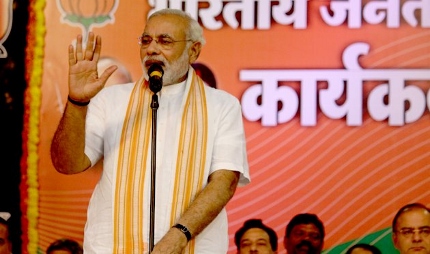
India’s main opposition Bharatiya Janata Party (BJP) has reiterated its commitment to the potentially disastrous plan to interlink the rivers of the country. Unveiling its much-delayed manifesto for the 2014 general elections in New Delhi on Monday, the party, tipped by opinion pollsters to head the next government, also promised to launch a rural irrigation scheme with the motto of providing water to every farm.
The interlinking of rivers was the pet plan of former prime minister Atal Bihari Vajpayee when the BJP headed India’s National Democratic Alliance government from 1999 to 2004. The plan envisages a gargantuan series of canals, pumps and reservoirs to shift water from the Brahmaputra and lower Ganga basins in eastern India to water scarce regions of western and central India. It was criticised by scientists and pilloried by environmentalists from the very beginning for its plan to alter the natural flow of water, for the waterlogging and salinity such a massive water transfer scheme would cause and for ignoring the water requirements of downstream Bangladesh in transboundary river basins.
The plan found mention in the party’s 2009 manifesto though it was more or less buried once the BJP lost power in 2004. It was never officially dropped by the Congress-led government that succeeded it ̶ one canal in central India is being built, and the Supreme Court did ask a few months back what happened to the scheme.
Of the three national-level political parties in the running for the 2014, the BJP is the only one to take overt note of climate change. In its manifesto, the party says, “We will take climate change mitigation initiatives with all seriousness and work with the global community and institutions in this regard.” In concrete terms, it promises to promote carbon credits.
The BJP has also committed itself “to serious endeavours for creating a global awareness regarding the conservation of Himalayas”. It says it will launch a National Mission on Himalayas, though there is one already. The party has also promised to create a Himalayan Sustainability Fund, a central university dedicated to Himalayan technology. It says it will give “due importance to the programmes devised to arrest the melting of Himalayan glaciers from which most of the rivers in north India originate”.
Narendra Modi’s poor track record on environment
Environment experts were not impressed by the BJP manifesto, with some of them criticising the track record of Narendra Modi, chief minister of the state of Gujarat and BJP’s prime ministerial candidate.
Himanshu Thakkar, convenor of the South Asia Network on Dams, Rivers and People, said, “On the issue of natural resource management issue, the only natural resources they have listed are coal and minerals. Water resources, biodiversity and forests, which are the most important, don’t even get listed.”
Talking about the promises in the manifesto to clean the Ganga, Thakkar said, “They have said they are committed to ensure the cleanliness, purity and uninterrupted flow of the Ganga on priority. But this is ignoring the key threats to the Ganga – dams and mega projects, urban pollution and industrial pollution.”
Mahesh Pandya from the NGO Paryavaran Mitra has been tracking the climate change mitigation initiatives in Gujarat for years. The activist – based in the Gujarat capital Ahmedabad – told thethirdpole.net, “The carbon credit scheme is nothing but a tool to get a handsome amount of money from abroad to industries. Narendra Modi has claimed that he is the first person to set up a state climate change department in Asia but in reality nothing has been done. This climate change department that was started in 2010 in Gujarat doesn’t have a single full-time employee. Gujarat has not even finalised its state action plan on climate change yet. In fact, one of the first companies (Gujarat Flurochemical) in Gujarat to get carbon credits has not even fulfilled its environmental obligations. It hasn’t even submitted its compliance report on its website which is mandatory under environmental laws. Yet the Modi government has taken no action against it.”
Faiyaz Khudsar, a wildlife biologist who has worked in the Kuno Wildlife Sanctuary in Madhya Pradesh – a forest restored as an alternate home for wild Asiatic lions – asked, “Is the BJP serious about saving wildlife, considering that the Narendra Modi-led Gujarat government was strongly opposed to translocating Asiatic lions to Madhya Pradesh against all scientific reasons.” Gir forest in Gujarat is the only home of the Asiatic wild lion today.
The BJP manifesto says the wastelands of the country will be used for social forestry. “What do you mean by social forestry?” Khudsar asked. “Earlier, massive degradation of forests had taken place in the name of social forestry where exotic species like babool and eucalyptus were planted on a large scale which is a major threat to the native species.”
With reporting by Juhi Chaudhary