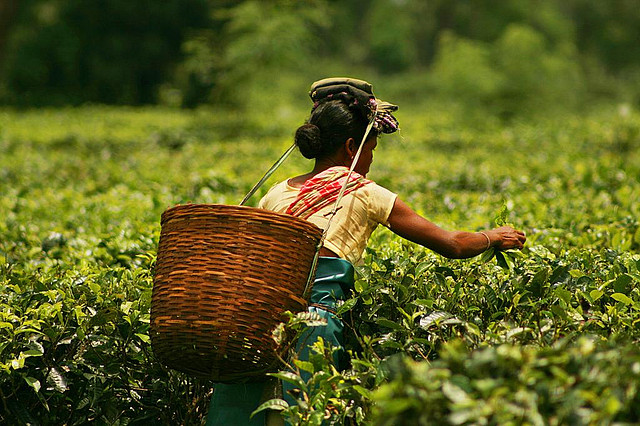
Acres of rolling greens, endless rows of orderly tree shrubs broken by tall, leafy trees, women with bamboo baskets slung on their backs busy plucking tea leaves… To the unsuspecting eye, it is all normal at the Koomsong Tea Estate, one of the many tea gardens in northeast India’s Assam state, famous the world over for its tea.
But things are not as idyllic as they seem with erratic weather changes, irregular rainfall and rising temperatures turning out to be major causes of worry for tea planters, not just in Koomsong but across the state. According to one estimate, there could be a 10% drop in production this year.
Assam produces almost half of India’s tea and growers are getting progressively more stressed about the changing climatic conditions over the last decade and wondering how best to fight it.
Typically, rain in northeast India starts at the end of March. In a normal year, tea estates would have completed 30% of their annual production by the end of June. The next round generally continues from July through November-December, accounting for the rest of the production.
But the last years have seen unequal rainfall distribution, which also means heavy rainfall in a month followed by an unusual dry spell. The rising temperature is another cause of worry. The meticulous records maintained at Koomsong, for instance, reveal that temperatures in June have being inching up – from a maximum temperature of 33.16 degrees Celsius in 1996, 33.92 degrees Celsius in 2003 to 34.26 degrees Celsius in 2013. There has also been a lot of variation in annual precipitation figures and average per month precipitation, especially in those critical days during the first or second harvest. The heavy rainfall washes away top soil in the tea gardens while dry spells lead to an increase in pests.
“In fact, more than erratic rainfall, it is the rising temperature that is affecting our production. Rising atmospheric temperature increases soil temperature and the soil gets dry faster,” said Vivek Seth, senior manager at Koomsong.
Seth says one should not to be fooled by data showing increase in annual production. That is only because the area under cultivation has increased over the years. However, yield per hectare has steadily declined. Koomsong’s area has increased from 529 hectares in 1985 to 707 hectares in 2013, while production per hectare has fallen from 2755 kg to 2047 kg per hectare.
The tea industry is worried.
According to government data, a few showers in February ensured a good crop in March but rainfall in March and April was scanty. There was just 71 mm rain from January-April against the crop requirement of around 310 mm for this period, leading to extremely dry and arid conditions. Rainfall in Upper Assam was down by 49% while it was down by 25% in Lower Assam. “The drought resulted in an estimated 25-30% loss of crops in Assam in April and May,” said S. Soundararajan, the Kolkata-based director at the Tea Board of India, a body under the union commerce and industry ministry.
Forced to adapt
The extreme variation in climate – disturbing the trend of generally high and equally distributed precipitation – has forced tea growers to adapt to changes. Turning to irrigation to minimise the adverse impact of rising temperatures and erratic rainfall patterns is one option and increasing areas of shade is another.
It is here that the Tea Research Association’s (TRA) Tocklai Experimentation Station in the Assam town of Jorhat steps in. “We provide rainfall and temperature data, we provide remedial measures such as how to combat or mitigate drought using irrigation methods. It can be sprinkler or drip. Then we advise on the use of various indigenous plants for fighting pests and also guide on various pest control measures,” said TRA director Dr N. Muralidharan.
Another long-term measure is the development of a drought-resistant tea shrub species.
Tea growers have started taking measures to fight the effects of climate change with help from Tocklai. As has been done by several tea estates in the area, Koomsong has also started creating its own micro-climate. This includes planting tall trees in between and along the edges of the plantation to protect tea shrubs and reduce air temperature. More than 30,000 trees were planted this year alone. Another measure is to use a formulation of local herbs and plants rather than chemical pesticides.
Seth said he hasn’t started irrigation yet, given the huge size of tea gardens (tea estates are generally spread over areas upwards of 300 hectares). “Irrigation cannot be a substitute for rainfalls. It can only help reduce our losses.”
Irrigation, however, is increasingly being looked at as an option. The central government offers a subsidy for setting up irrigation systems, said Soundararajan.
Government failing to protect tea growers
A continuing problem is that the tea crop cannot be insured. The premiums are too high due to the vast tracts under cultivation.
Government agencies have restricted their support to providing subsidies for irrigation and/or helping with pesticides. But there is simply no compensation in the event of a major hailstorm, for instance. A massive hailstorm on May 14, 2012 hit Koomsong, resulting in severe damages. Production could recover only in August.
Despite the central allocation of a separate fund for climate change in this year’s budget, there are no funds for Assam’s tea industry. Stating that climate change was a reality that all must face together, finance minister Arun Jaitley had announced in this year’s budget speech, “Agriculture as an activity is most prone to the vagaries of climate change. To meet this challenge, I propose to establish a ‘National Adaptation Fund’ for climate change. As an initial sum, an amount of Rs.100 crore will be transferred to the Fund.”
But none of this is coming to Assam’s tea gardens. Rajib Barooah, chairperson of the Assam Tea Planters Association (ATPA), said “We receive no compensation whatsoever in case of losses due to climatic changes. For instance, if the government declares a drought the agriculture sector – for instance paddy in Assam – gets the benefits but not the tea industry. Possibly because we come under the commerce ministry and not the agriculture ministry.”
Now that this is a recurring occurrence, the industry plans to come together to present a joint front, he said. “We are going to put up a demand to both the ministries. We have several other associations and this is a problem for all (so) the entire industry will have to come together.”