


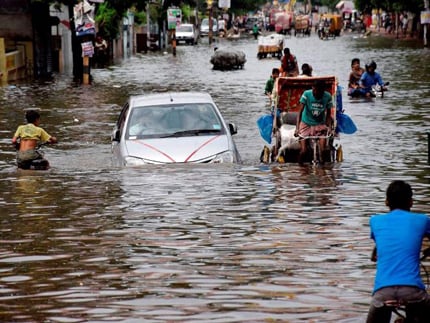
The recent floods in India following incessant, extreme rain are not only a manifestation of climate change but also bode ill for groundwater levels that are dipping at an alarming rate, say experts.
The increased instances of floods imply decreased groundwater recharge capacity, explained Bhupendra Nath Goswami, former director of the Indian Institute of Tropical Meteorology (IITM), Pune.
The Groundwater Foundation defines groundwater as the water found underground in the cracks and spaces in soil, sand and rock. It is stored in and moves slowly through geologic formations of soil, sand and rocks called aquifers.
“Extreme rain events are of small spatial scale and of short duration in time. The increasing trend of these events means increased run-off and less scope for groundwater recharge,” he said, citing studies done by his group.
“It is the weak and moderate rain events that are responsible for groundwater recharge. The decreasing trend of such events implies decreased groundwater recharge capacity,” Goswami told an international conference on climate change and sustainable development in Mumbai in August.
The latest round of flood devastation was witnessed in the Himalayan state of Jammu and Kashmir in September. At least 280 people were killed, thousands stranded and property worth millions of rupees destroyed.
India’s northern states of Uttar Pradesh and Uttarakhand and Bihar and Bengal towards the east were similarly struck in August.
The increasing intensity of monsoon rains that unleash devastating floods in some parts of India are a manifestation of the rising extreme weather events in India due to climate change, said Sunita Narain, director of the Centre for Science and Environment, a Delhi-based non government organisation.
Ground observations tally with climate models that predict an increase in extreme events in the country due to rising temperatures.
India’s total annual rainfall has been decreasing since 1941. But there has been a concomitant rise in the intensity of extreme weather events over the past several years, Goswami said.
River and streamflow is projected to increase in the late monsoon season and more efficient local and large-scale water resources management measures may be needed, states a preliminary analysis of modelling projections for some Indian rivers, the Mahanadi, Ganga and Brahmaputra river basins.
The study was conducted by a group of researchers headed by Vimal Mishra of the Indian Institute of Technology (IIT), Gandhinagar.
Mishra , assistant professor at the department of civil engineering in the institute, told the Mumbai conference that global models examining the effects of climate change, population and economic growth on water availability by 2025 predict that “climate change alone will bring water scarcity to many places”.
“In the absence of concerted action to save water, the combination of population growth and climate change will create scarcity far and wide.”
The major reason for concern is India’s excessive use of groundwater for both its urban needs and agriculture in many parts. India has 18% of the world’s people, but only 4% of global water resources.
In a recent report to the ministry of water resources, India’s Central Ground Water Board (CGWB) said that 56% of 10,219 wells it analysed across the country showed decline in water levels in 2013, compared to average levels in the preceding decade from 2003-12.
Water scarcity looms in India
The water resources ministry, which shared the CGWB data with the Indian parliament in July, said annual per capita water availability in India had declined from 6,042 cubic metres in 1947 to 1,545 cubic metres in 2011. It is expected to further reduce to 1,340 cubic meters by 2025 and 1,140 by 2050.
India would need 1,180 billion cubic metres (BCM) of water annually by 2050. It currently only has 1,123 BCM of ‘usable’ water, of which 61% comes from surface water resources and remaining 39% from groundwater resources, according to the CGWB data.
“Today, India is the largest user of the groundwater in the world with almost 90% being used for drinking water and almost 60-70% for irrigation,” said Himanshu Kulkarni, executive director of a Pune-based non-profit organisation Advanced Center for Water Resources Development and Management (ACWADAM).
He was speaking at a workshop on effective water management through habitat development organised by the Aga Khan Foundation, Mumbai, in August.
India’s groundwater crisis arises from over-exploitation of its aquifers and mismanagement of resources, Kulkarni, who was chair of the working group on groundwater for India’s 12th Five-Year Plan, said.
The Aga Khan workshop heard several case studies of overuse of groundwater in Indian urban settlements, such as Vasai-Virar area of Mumbai and Agra, where several upcoming settlements don’t have access to piped water supply from local municipalities and make do with borewells.
In India, groundwater accounts for 48% of urban water supply, and dependence on groundwater is especially rising in areas developing on the outskirts of cities, Prashant Hedao, a researcher at the Centre for Ecological Studies, Indian Institute of Science, Bangalore, told the workshop.
Almost 1.1.billion of India’s 1.25 billion people use groundwater in one form or the other. “Unfortunately, most of them are not aware of it,” Hedao said.
Some organisations are working with local communities to improve groundwater recharge. Kulkarni’s ACWADAM, for example, has come up with a set of community-based protocols for local aquifer management.
The Aga Khan Foundation’s rural support programme is also working on water conservation techniques and has introduced low-cost technologies of groundwater recharge and water conservation in saline areas.
An example is the coastal region of Gujarat where saline water has encroached into fresh water areas. The foundation has built dozens of irrigation and groundwater recharge systems, promoted micro-irrigation devices such as drips and sprinklers and worked to manage the critical water resources in river basins. This includes the construction of over 1,300 check dams and irrigation tanks and other watershed management measures.
The foundation has also rejuvenated 4,000 drinking water supply sources, 200 percolation wells and over 10,000 roof-top rain water harvesting structures. These initiatives are being looped back to its overarching climate change mitigation and adaptation programme.
Similarly, its planning and building services unit will be working to restore the Nirmal lake in the Vasai-Virar area and suggest alternative water conservation and sanitation measures in peri-urban settlements. It is already working on rainwater harvesting in Jammu and Kashmir and in peri-urban settlements and wastewater management in Gujarat.