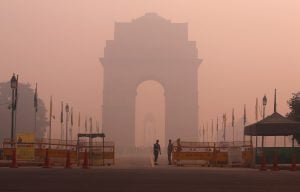
![<p>The burning of crop residue in Punjab and Haryana is creating serious air pollution hazard over northern India [image by: Richardt Radek Larsen]</p>](https://dialogue.earth/content/uploads/2017/11/BasketTTP-768x443.jpg)

After degrading rich farmland through the reckless use of chemical fertilisers, and depleting aquifers by overusing groundwater, agricultural practices in India’s bread basket are now largely responsible for the foul haze hanging over Delhi and swathes of northern India and Pakistan.
The widespread burning of crop residue in Punjab and Haryana in mid-October has contributed significantly to the catastrophic levels of air pollution in the capital, which has shut schools and led to a public health emergency.
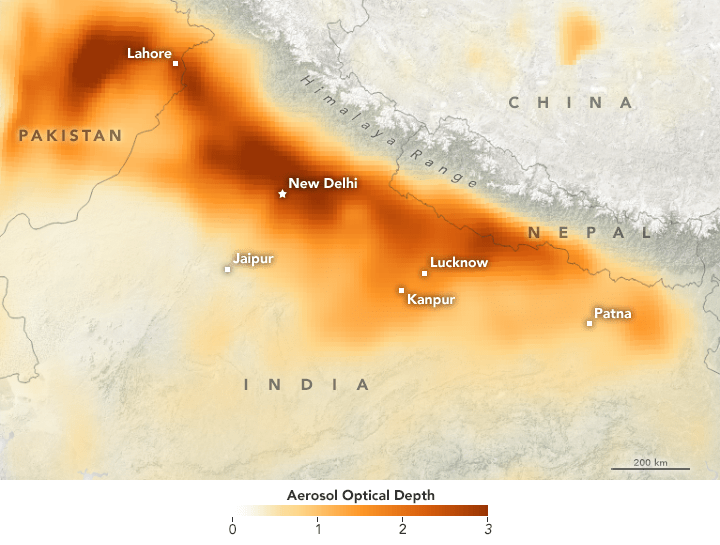
The latest images released by NASA show how a thick haze has settled over large parts of northern India and Pakistan. With the arrival of cooler weather in November, the smoke mixed with fog, dust and industrial pollution to form the smog, NASA said. The lack of wind, which usually helps to disperse air pollution, worsened the problem for several days in November, which has become an annual occurrence in the country.

The development has refocused the importance of charting out ways to implement sustainable agricultural practices to combat global warming, a prime concern at the UN climate summit being held in Bonn. Scientists and grassroots experts have started deliberating on how to realign farming that adapts to a changing climate without compromising on food security.
India produces 550 million tonnes of crop residue every year, with Uttar Pradesh, Punjab and Haryana being the highest producers. A 2012 study estimated that Punjab and Haryana burnt about 80% of its rice residue, while Uttar Pradesh burnt 25%.
“We can no longer ignore how climate change is affecting agriculture,” said Kirit N. Shelat, executive chairman of National Council for Climate Change, Sustainable Development and Public Leadership, at the Bonn summit. “We need to adopt and adapt farming practices accordingly.”
As climate change pushes heat and humidity to new extremes, agriculture in India – the single largest occupation – has to adapt to the changing reality. Practices adopted during the Green Revolution, first implemented in Punjab, Haryana and western Uttar Pradesh and ensured food security for the entire nation, are no longer sustainable. Agriculture in Punjab, in particular, is facing a crisis.
An evergreen revolution?
The ‘father of Green Revolution’, M.S. Swaminathan, has been advocating for what he terms the Evergreen Revolution which, he says, implies productivity improvement in perpetuity without ecological and social harm.
“The evergreen revolution involves the integration of ecological principles in technology development and dissemination,” he said. “The major problems associated with the Green Revolution are related to environmental factors like depletion and pollution of groundwater, soil erosion and loss of biodiversity. It is these deficiencies that can be remedied through the evergreen revolution pathway.”
Agriculture contributes 18% of India’s GDP but provides employment to more than 50% of the workforce, according to World Bank data. The sector contributed to 60% of female and 43% of male employment in 2014.
Even before the effects of climate change have made deep inroads, India’s farming sector is battling with a severe crisis. Growth in the sector has stagnated in the past 10 years and falling incomes have plunged farmers into deep distress. More than 12,000 farmer suicides have been reported every year since 2013 and official surveys reveal that 42% of farmers are ready to quit. Around 700 million Indians depend on farming to make a living.
See: Climate change imperils India’s food security
Agriculture practices in India need to change and adapt urgently. As part of the cause – and solutions to – climate change, it is central to any debate on global warming and extreme weather events, according to the Climate Change, Agriculture and Food Security research programme of CGIAR.
“While there are many innovations for climate actions in agriculture, change has to come from within,” CCAFS said. “Farmers have to be willing to change their farming practices for transforming agriculture under climate change.”
“The agricultural community is mobilising like never before and solutions to speed and scale up already exist,” said Martin Frick, chief of policy and programme coordination at the UNFCCC. “These solutions offer government, business and farmers immediate opportunities to grow agriculture without mortgaging its future. Action now sows the seeds for the sustainable harvests of the future.”