


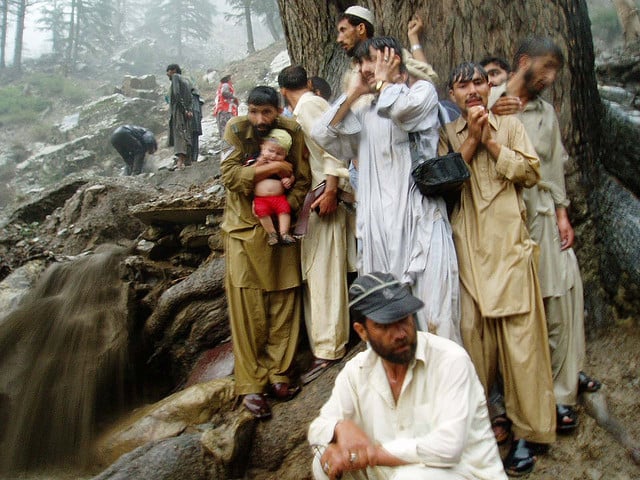
A humanitarian crisis is unfolding in Pakistan’s mountainous Chitral valley bordering Afghanistan, where flash floods and glacial lake outburst floods have killed three people, destroyed houses and swept away roads and infrastructure.
Chitral valley, the largest district of Khyber Pakhtunkhwa province with a population of half a million, is situated in the heart of the Hindu Kush mountain range in northwest Pakistan.
It is one of the regions most vulnerable to climate change in Pakistan and has a long history of flooding. However, the intensity and frequency of such events has risen in recent years.
Last week, flash floods in the Chitral river triggered by heavy rains swept away major roads, power stations, irrigation and water systems, leaving an estimated 250,000 people stranded.
Experts say the disaster was also caused by glacier lake outburst floods (GLOFs) – a sudden release of water stored either within a glacier or dammed by a glacier – which occurred following a prolonged heat wave in the region.
Officials say three people have drowned and thousands of people have been evacuated to safer places. However, independent source claim there may have been more deaths.
With the valley cut off from the rest of the country, supplies such as medicine and petrol are running dangerously low in local markets.
Locals say it will take months, even years, to repair the damage after flood water washed away bridges, irrigation channels and power stations.
Authorities have yet to repair infrastructure damaged by monsoon rains last year.
Thousands of people who were returning to their hometowns for the summer holiday and to celebrate Eid ul-Fitr are still stuck en route. People were coming from across the country and even from aboard. The bad weather has added to their worries, with fears that more rain could exacerbate the situation.
Unprecedented destruction
A former provincial minister and opposition member in the provincial assembly, Saleem Khan, said the magnitude of the flash floods is unprecedented.
“Entire valleys in the district have been cut off completely, triggering a humanitarian situation,” said Khan.
“More than half of the population of the district has been cut off from rest of the country,” said Ameenul Haq, deputy commissioner of Chitral.
About 70% of water supply channels have been destroyed and people have been left with no water for drinking or irrigation.
The floods also washed away power stations and cut off electricity supplies, plunging the entire district into darkness. Phone services have stopped working and there has been no communication with villages in upper Chitral, including the Yarkhun and Laspur valleys, for the past three days.
Glacier lakes: a growing danger
According to the provincial disaster management authority, flash floods hit different parts of Chitral district at midnight on July 16, causing extensive damage.
There have been three confirmed glacial lake outburst flood events, said Hamid Ahmed, manager of the Pakistan GLOF project. These events have devastated local areas despite efforts by his organisation to mitigate such disasters.
A heat wave in Chitral during the last week of June and first week of July– with temperatures soaring to 42 degrees centigrade– caused glaciers to melt and form lakes, explained Ahmed. These lakes swelled and broke their banks when sudden heavy rain descended on the mountains.
The Bindo-Gol glacier lake, northwest of Chitral town at an altitude of about 4,572 metres, has burst its bank. Reshun glacier in Reshun valley (4,100 metres) and Oxhoor glacier (4,300 metres) in Gharam Chashma have also burst, causing havoc in Karimabad town. Community members have reported one further event, but this is yet to be confirmed by officials.
Chitral is home to about 542 glaciers covering nearly 13% of the district. An estimated 40% of the district’s population is vulnerable to the potential threat of GLOFs.
Fortunately the loss of human life this time has been very low. Since the Bindo Gol glacier lake burst its banks in 2010, Ahmed and the Pakistan GLOF project has worked hard to increase awareness of the risks and construct walls to protect areas at risk, particularly in Gharam Chashma town.
These efforts succeeded in mitigating the damage caused this time. “There are still many glaciers and huge lakes in different parts of Chitral, which are a potential threat to the population and the area,” said Ahmad.
Poor emergency response
The provincial and district administration have been criticised for their slow response to what locals say is “the worst disaster in Chitral’s history.” Roads and infrastructure have not been repaired and relief is not reaching those most in need.
The government and military is taking all possible measures to reach affected areas, said deputy commissioner Ameenul Haq, who is also the head of district disaster management authority. Some relief supplies have been sent by helicopter, he said, but reaching stranded people in remote areas remains a major challenge.