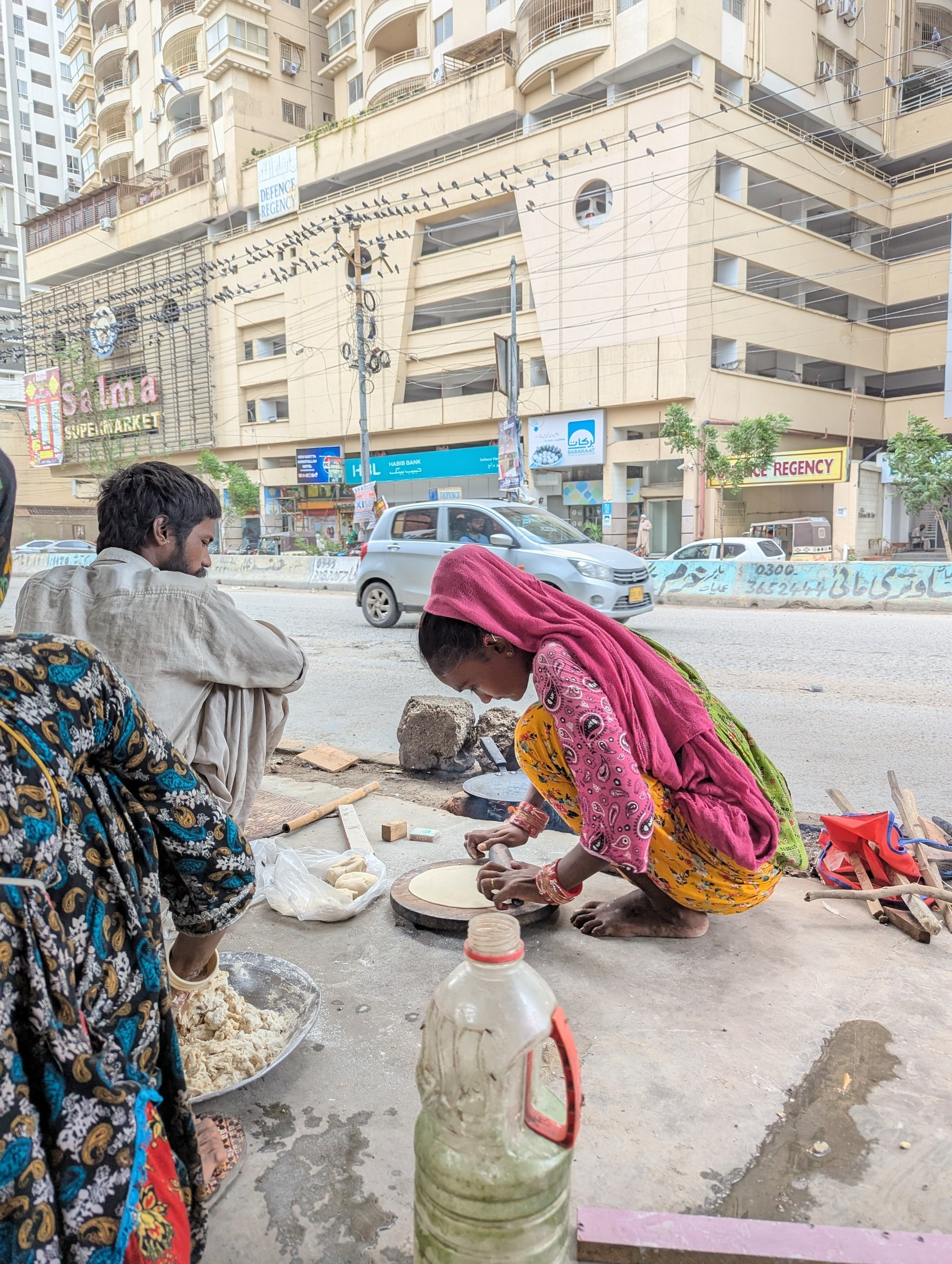
For Mithu, 30, and the twenty members of his extended family, home is beneath the KPT Interchange Flyover in Karachi, Pakistan’s largest city of 20 million. They migrated from Tando Allahyar, 200 kilometres northeast, in search of better opportunities. Unlike people living in high-rise apartments and office developments nearby, they have no real shelter from the elements.
On a sweltering late July day, as his sister Soutri made rotis on a makeshift red brick stove, Mithu wiped the sweat from his brow. “We must go to empty plots to relieve ourselves or bathe, even in this heat. We carry water here in containers from nearby colonies,” he said. “What will the government do for us? We have no faith in the government to help us in either heatwave or rains.”
Mithu’s family, like many others, are missing from any official statistics. Asma Ghayoor, director of information technology at the Sindh Building Control Authority, told Dialogue Earth: “You will not find any numbers, data, or plans about the homeless or displaced. At best, they might serve as potential voters near elections. Other than that, their issues are largely ignored.”
Homeless people, obviously, suffer the mostSardar Sarfaraz, chief meteorologist
Amber Alibhai, general secretary of Shehri-Citizens for a Better Environment (CBE), a not-for-profit organisation established in 1988, described the homeless as “the invisible people of this megacity.” At times of climate-induced disasters such as floods, police may intervene, she said, but even police stations lack adequate space, so the homeless are usually just moved to another location. “In order to be able to monitor them and collect data, NADRA [the National Database and Registration Authority] needs to be brought on board.”
Muhammad Toheed an urban planner and the associate director at Karachi Urban Lab, highlighted the challenges of supporting the homeless. “Without knowing the exact number of homeless individuals and their locations, it is difficult to allocate resources, plan emergency responses and implement long-term solutions to address their needs,” he said. These issues extend beyond extreme heat events. Some civil society organisations suggest that Pakistan has an overall homeless population of around 20 million, or 9% of its population, but no specific information for cities like Karachi exists even in the civil society sector and there is little data to back this up.
Despite existing laws dealing with the homeless, like the Sindh Vagrancy Ordinance 1958 and its 1983 amendment, Alibhai said the Karachi Metropolitan Corporation (KMC) has effectively “abdicated its responsibilities.” She added that when climate-induced disasters occur, such as heatwaves or urban flooding, those affected are left to rely on the mercy of charitable individuals.
Rauf Farooqui, who formerly served as its administrator, the most senior executive post for the city and its surrounding areas between 2013-2015, told Dialogue Earth that there are no official provisions for the homeless. “At most, we would take them to the police for temporary shelter, or to the Edhi Foundation,” he says.
With no protections in place, Karachi’s homeless were exposed to brutal heat this summer, as temperatures remained 4-6C above average in the weeks of 23-30 June and 16-23 July, said Sardar Sarfaraz, chief meteorologist at the Pakistan Meteorological Department. “Since the mid-1990s, temperatures in Pakistan have seen a continuous rise. Homeless people, obviously, suffer the most,” he added.
Muhammad Amin, in charge of the control room at the Edhi Foundation, a social organisation serving Pakistan’s marginalised communities, reported a significant increase in mortality. “From June 15 to 30, we received 1,540 bodies,” at their mortuaries, a threefold rise compared to the “average load of 35-40 bodies that we receive daily”, though he cautioned that these could not all be clearly attributed to heat. Nonetheless, the high number of deaths reported by civil society organisations raised questions about the official government number of 49 deaths during the eight-day heatwave at the end of June this year.
Ahmer, who asked not to reveal his full name, a doctor who works in the emergency room of Karachi Adventist Hospital in the densely populated area of Saddar in Karachi, said they received all sorts of heat-related cases this year. “Heat stroke, hyperthermia, low blood pressure, vertigo – we received examples of all of these problems, particularly in people who have no proper roof or shade,” he said, adding that as the monsoon rains continue the hospital will be inundated with gastroenteritis patients due to contaminated water. “As far as homeless people are concerned, I have not come across any special arrangements or initiatives for them. They are unregistered citizens for all practical purposes.”
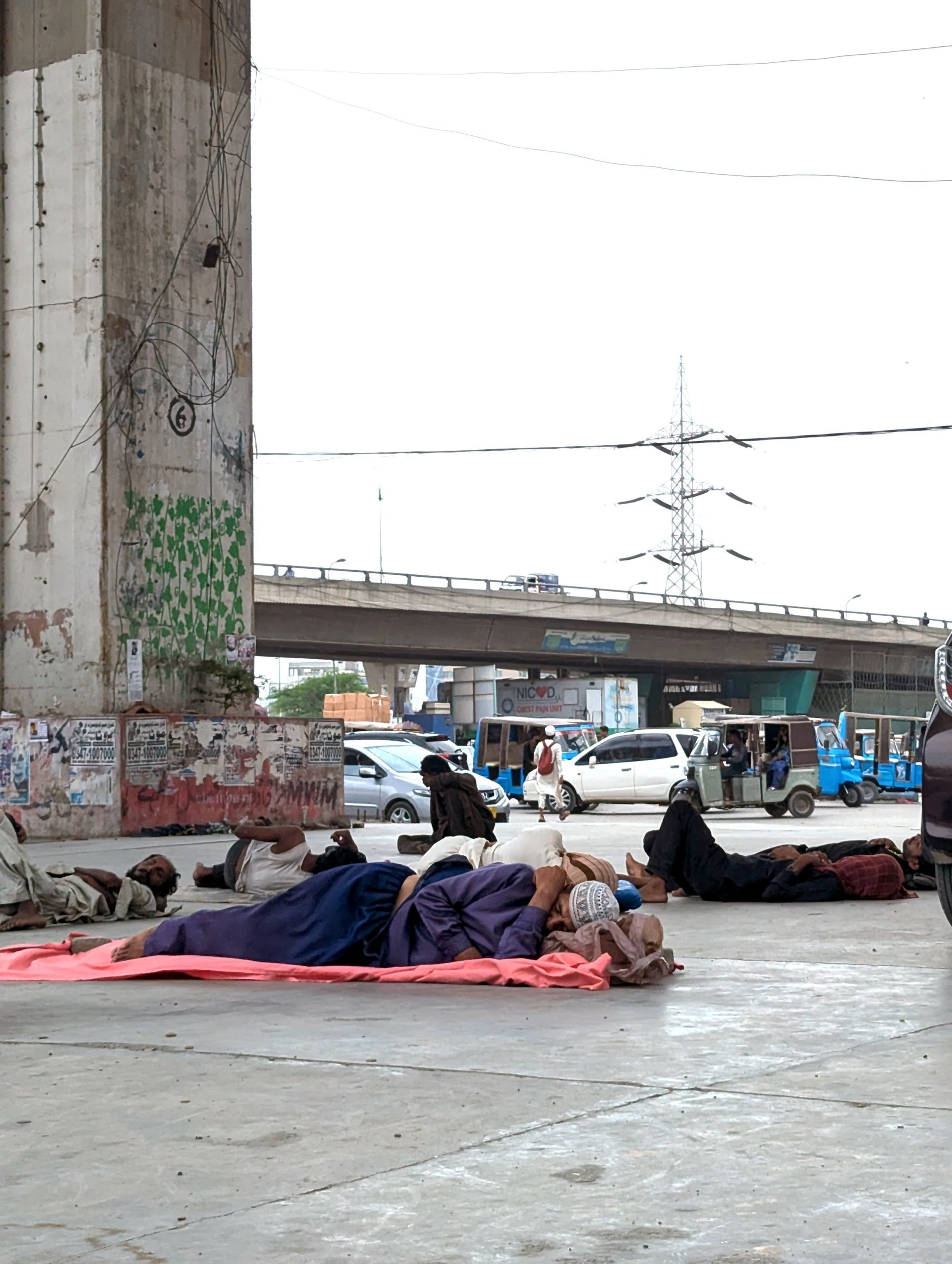
Syed Salman Shah, director general at the Provincial Disaster Management Authority (PDMA) Sindh, reflected on the aftermath of the 2015 heatwave in Karachi, which prompted the creation of a heatwave management plan. Their assessment “showed that homeless people or street dwellers were the most effected demographic in heatwaves,” he said. The 2015 heatwave, which coincided with Ramadan, drew many to Karachi from all over Pakistan seeking charity assistance, exacerbating the situation. “These are people who usually don’t have homes and squat in unofficial settlements, makeshift tents, or under flyovers,” he added. For 2024, the plan included providing temporary shelters to the homeless specifically during heatwaves by repurposing buildings like marriage halls and government offices.
According to Shah, while government departments had worked to mitigate the impact felt by citizens ahead of this year’s heatwave, it proved to be unexpectedly long. “The PDMA issues frequent heatwave alerts and daily situation reports, but no one knows the exact number of homeless people in Karachi,” he said, although he expected the actual number of people in Karachi to be high, as there is a constant influx of people moving to the city in search of a better life.
Ironically, efforts to manage flooding, such as an anti-encroachment drive three years ago to clear buildings illegally built over drains, inadvertently increased the number of homeless in the city. In April, the Supreme Court directed the provincial government to rehouse people rendered homeless by the demolitions.
Zahid Farooq, joint director of the Urban Resource Centre, a civil society institution that monitors the city’s infrastructure projects, noted the widespread impact of such policies. “The Gujjar and Orangi Nullah evacuations left 6,900 housing units demolished, and each unit could possibly be housing more than one family. After getting displaced they go to some relatives’ place… who are equally poor,” he said. With a significant portion of the population already living in cramped conditions, the influx of displaced relatives only exacerbates the overcrowding in small, congested houses or makeshift shelters. This increased density amplifies the impact of climate events like heatwaves or heavy rains, he said. “It is not just their homes that are broken [by house demolitions]. Their livelihood and social identity and connections are scattered, too,” Farooq added.
The plight of homeless women is particularly severe, according to Neha Mankani, a local midwife running mental health clinics for underserved communities. “Homeless women in Karachi face disproportionate health risks during floods and heatwaves. Contaminated floodwaters increase their susceptibility to infections, skin diseases and mental health issues due to displacement and trauma,” she said. “Additionally, crowded displacement camps during these times can exacerbate their vulnerability to sexual violence. Unstable food sources, further impacted by extreme weather, lead to malnutrition and gastrointestinal problems.”
Mankani emphasised the need for targeted interventions to protect women’s health during heatwaves, highlighting their limited access to safe water and sanitation, which heightens risks of dehydration, urinary tract infections and complications in pregnancy, including premature labour and pregnancy loss. “It’s crucial to recognise that women, especially those without adequate shelter, are unequally affected by heat, underscoring the need for targeted interventions and support systems to protect their health and well-being,” she said.