


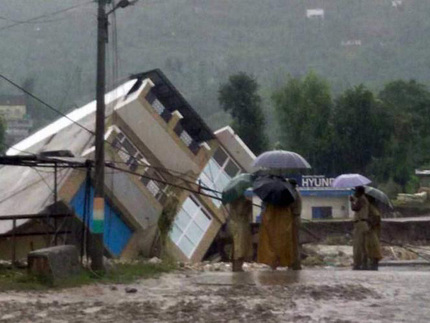

As Sindh braces for floods, large areas around the city of Jhang have already been submerged. The flow of water in the Jhelum and the Chenab – which meet near Jhang – exceeded the carrying capacity of the Trimmu head-works. As a result, more than 300 villages in Athara Hazari and Ahmad Pur Sial tehsils (sub-divisions of a district) were inundated by over 20 feet of water. Standing crops on more than 100,000 acres of farmlands were destroyed.
According to official estimates around 700,000 inhabitants of Jhang district have been affected, with a significant number without shelter.
While a major part of Jhang city has been saved by breaching parts of the Trimmu head-works, road links from Jhang to Chiniot, Sargodha, Shorkot, Multan, Bhakkar, Layyah, Dera Ghazi Khan, Dera Ismail Khan, Khushab and Mianwali have been destroyed.
Ahmad Kamal, spokesperson of Pakistan’s National Disaster Management Authority (NDMA), said: “Trimmu has been saved at a high cost. Five districts of Punjab — Sialkot, Gujranwala, Jhelum, Hafizabad and Narowal – have been swamped where a population of 150,000 has been affected.” He added that over a million people have been affected across the country.
Chaudhary Muhammad Aslam Kamboh, engineer at the Trimmu head-works, said standing crops of rice, sugarcane and fodder on 88,895 acres were destroyed in Jhang and adjacent areas.
“According to its design, the total capacity of Trimmu is 640,000 cusecs (cubic feet per second) but this was reduced to 600,000 cusecs as de-silting of the head-works was not carried out for several years,” he said. “At present, about 531,000 cusecs of floodwater is passing through the head-works and it is feared that the floodwater will damage Trimmu severely.”
A torrent of 810,000 cusecs in the Chenab hit Trimmu after devastating Marala, Khanki and Qadirabad. Kamboh said the flood situation at Trimmu would persist until Friday.
A flood emergency has been announced in the surrounding localities of Jhang towards Multan. The Provincial Disaster Management Authority has urged people living along the riverine belt of the Chenab to evacuate as floodwater approaches Multan. Over 33,000 people have been evacuated already.
As the floodwaters reached southern Punjab, army helicopters and boats were on standby at the Panjnad head-works – the confluence of the Indus and its five major tributaries Jhelum, Chenab, Ravi, Beas and Sutlej. This is an area where residents of 35 villages on the banks of Chenab and Sutlej are under threat – 600,000-700,000 cusecs of floodwater is expected to pass through the head-works between Friday and Monday.
Then it is Multan’s turn to face the wrath of the angry waters. Authorities fear breaches at Muhammadwala and Sher Shah (railway) bridges. If that happens, the floodwaters will affect Multan district, though the city should be safe.
The breach near Muhammadwala head-works seems imminent because of the faulty design of the bridge. Irrigation department officials told the newspaper Dawn that the bridge had been built by diverting the river six kilometres, and that was the point where the water pressure was increasing.
Meanwhile, Pakistan’s Flood Forecasting Division (FFD) has predicted high flood in the river Ravi at Sidhnai on Friday and Saturday. The discharge at this point was 62,528 cusecs at 4 pm on Thursday and was expected to rise to 70,000 cusecs. Ravi joins the Chenab near Ahmadpur Sial. The waters then head to Multan.
The authorities said flooding in the Ravi would add to the peak in Chenab, creating more problems in the region.
Further downstream in Sindh, the FFD forecast high to very high flood (600,000 to 700,000 cusecs) in Indus at Guddu on Monday, and at the Sukkur barrage between Tuesday and Wednesday. Officials said peaks could inundate Muzaffargarh, Rahimyar Khan, Rajanpur, Jacobabad, Ghotki, Shikarpur and Sukkur districts.
Sindh Chief Minister Syed Qaim Ali Shah has already expressed his dissatisfaction over the performance of the irrigation department and the Sindh Irrigation and Drainage Authority in the strengthening of dykes and clearing all waterways to avert floods.
Visiting the Katcho Bhindi protective embankment in Ghotki on Wednesday, Shah showed his displeasure and ordered strengthening of the embankment within four days. He also directed the district administration to evacuate ‘katcha’ (riverbed) communities, cautioning them to establish the relief camps at some distance from the embankments.
Ahmed Junaid Memon, chief engineer at the Sukkur barrage, reportedly told the chief minister that over 150,000 katcha residents from Khairpur, Kingri, Gambat and Sobho Dero talukas would be affected by the flood.
Anger in India
Upstream in India, meanwhile, the floodwaters started to recede in the Kashmir valley and adjoining areas in the Jammu region. Residents of Jammu are livid as they feel relief and rescue efforts have been concentrated in the valley, while a larger number of people may have been killed in Poonch and Rajouri areas of the Jammu region.
As the waters recede, bodies are being found beneath collapsed houses or on roads no longer flooded. The death toll – over 200 at last count – is rising.
Nearly half a million people in Jammu and Kashmir are still unable to get out of their marooned homes. But many of them no longer wish to be rescued, as they fear their homes may be looted in their absence. They want food, drinking water, medicines and blankets instead. The army has accordingly rejigged the focus of its operations, while the state government continues to remain largely paralysed.
With no electricity and with almost all telecommunications still dysfunctional, Chief Minister Omar Abdullah admitted that he had not been able to get in touch even with his senior officials in the first days of the floods. He claimed that the situation was improving.
India’s Home Minister Rajnath Singh told the media on Friday that around 130,000 people had been rescued so far in Jammu and Kashmir. Apart from cities and towns, 700-odd villages in the state had been completely inundated, he said. Even as the minister was speaking in New Delhi, reports were coming that a village with 40 houses in the Rajouri area of Jammu had been wiped out by a landslide, and there was no sign of any survivors.
As rescuers fan out and more such incidents come to light, on both sides of the disputed Kashmir border between India and Pakistan, the immediate worry is about spread of water-borne diseases. As autumn approaches in the Himalayas, the next worry is about finding suitable accommodation for those rendered homeless.
Authorities are now giving no thought to the human activities that have worsened the flood damage manifold, but they will have to start working on those areas soon, if such disasters are not to be repeated. Due to climate change, such bouts of heavy rain as led to these floods are becoming more frequent and more severe.