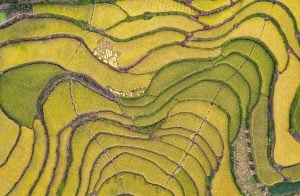
The weather has been strange these past two years, says Mr Hong, who grows rice and other crops in eastern Sichuan, south-west China.
He usually starts transplanting his rice seedlings a little after mid-April. That is, during the “Grain Rain” – the sixth of 24 solar seasons that mark China’s traditional lunisolar calendar. But in 2025 he had to wait until the last day of May.
The paddy fields must be inundated for rice seedlings to take root successfully but Mr Hong’s village had experienced a dry spring. The previous spring he could not even plant the seedlings in the first place, never mind transplant them, he said.
High temperatures and heatwaves are also making his work in the fields tougher. In late June 2025, the day we met, a downpour ended a weeklong heatwave. The temperature fell from 39C to 29C. Not waiting for the rain to stop, he pulled on his rubber boots and went out to plant sweet potatoes during the cooler weather.
Mr Hong is not alone in being perplexed. Higher than usual rainfall in the north-west of Inner Mongolia has farmers there worried about their honeydew melon harvest. Too much rain during the harvest means the melons are of lower quality and more likely to split.
In Henan, a major agricultural province in central China, some areas saw over 40 days of persistent autumn rains between September and October 2025, slowing the harvest. Generally, when you get to “Frost Descent” – the 18th solar season, which started on 23 October last year – the harvest is more or less done and it’s time to start planting the winter wheat. Last year, though, continuous wet weather has disrupted the usual agricultural rhythms.
China’s farmers have long used the 24 solar seasons to time their work in the fields. However, climate change is shifting the seasons and stages of crop growth. It is also bringing extreme weather and leaving farmers unable to rely on traditional timings and crop choices.
China is working to respond to this through top-level policy design. But both farmers and experts agree there is an information gap between that macro-level work and grassroots implementation. Increasing climate resilience in agricultural practices also needs to consider real economic problems.
Scattered policy not helping farmers
The government has long been aware of the risks of climate change. The first official mention of adapting to it came in 1994, and since 2010 there have been three national strategy documents on that process. In 2022, the National Climate Change Adaptation Strategy 2035 restated that there should be a shift from reactive adaptation to proactively improving climate resilience.
The strategy lays out what this means for agriculture: preventing and managing climate-related changes to ecosystems; stronger protection of soils; greater use of technology like drought-resistant crop strains; and researching “new materials” for water management that can cope with extreme conditions.
China published an urban action plan for adapting to climate change back in 2016. There is still no equivalent for rural areas – only scattered mentions in different departmental documents.
Government departments are taking climate adaptation into account when drafting policies but not necessarily putting those measures under a climate change heading. That is according to a report from Foodthink, a Chinese media outlet focusing on agriculture. Back in Sichuan, Mr Hong is not up to date with the latest changes in national policy. He does know, however, that the weather is changing and he needs to respond. During the dry spring of 2024, he planted soybeans rather than rice in his 2 mu (0.13 hectares) of rice fields. Last year, he was able to source from a local charity rice seeds that grow on dry land rather than in paddies. These he planted on a small section of his land.
Not every farmer is taking action like Mr Hong. While top-level policies may be changing, individual farmers are not necessarily sure how to respond to extreme weather.
A 2025 Greenpeace report on climate adaptation in agriculture found small-scale farmers in China’s Shaanxi, Chongqing and Hebei regions are also facing climate-related challenges. When farmers in Hebei were asked how they were responding to hotter, drier weather, they usually replied “leaving it up to fate”. Doing nothing may feel like the easiest and cheapest choice.
This is due to a lack of specific agricultural policy, or to policy being scattered across different documents. There is also the aforementioned lack of connection between grassroots implementation and top-level policy.
At the local government level, there are obvious failures of understanding climate adaptation and its importance, and an inability to set relevant policy. This is according to 2022 research from the Institute of Environment and Sustainable Development in Agriculture, part of the Chinese Academy of Agricultural Sciences. “Even with strong political will, there is a lack of levers to pull and no methodology to guide the allocation of resources, hindering policy implementation,” the report stated.
This matches my own observations. When working to popularise climate adaptation tech for agriculture with local governmental organisations and non-profit institutions, I found local governments to be more worried about food output than climate adaptation.
Two policies, two problems
How farmers adapt to climate change is related to the structure of the labour force and where their money comes from.
The rural population is ageing and most farmers are now quite old. That population tends to learn about extreme weather events later and so is less able to respond. These farmers also have only small amounts of land and view farming as a side job. Usually, their household income is supplemented by remittances from family members working elsewhere in China.
This means there is money on hand to help cope with the impacts of extreme weather, and risks can be reduced by simply planting less land. Liu Juan, an associate professor at the China Agricultural University who contributed to the Greenpeace report, describes this as “adaptation by contraction” – farmers reduce exposure to climate risks by reducing their production for market.
This contrasts with “adaptation by expansion”, commonly used by larger cooperatives or medium-sized enterprises. Such professional farmers, who grow fruit and veg commercially, find it easier to get funding or guarantees from local government when hit by extreme weather.
Larger farms can more likely afford to upgrade their equipment to help cope with extreme weather. They may for example put up greenhouses or hail netting, or install irrigation systems or combined watering and fertilising solutions. Such equipment is expensive though, sometimes costing millions of yuan.
Liu Juan thinks larger producers are actually less resilient than their smaller counterparts because inputs and labour costs are higher. That all requires more profitable business models and crop choices. When climate disaster strikes, she says, they “suffer more”.
This year, Liu Juan’s work took her to an eco-farm in Hebei that has been facing a dilemma. It runs an eco-tourism business alongside its farming but the past four years have seen a string of climate disasters: summer floods in 2021 and 2023, a hailstorm and cold snap in the winter of 2023, and more flooding this summer. Infrastructure including greenhouses, roads, bridges and a ski slope were damaged.
“After a disaster, some repairs are prioritised over others,” she notes. In this case, the local government took some time to repair those roads local to the farm, because the area was not considered a top priority.
Agricultural insurance
Progress on “agricultural climate insurance”, a financial tool for adaptation, has been slow in China.
In 2021, the Ministry of Finance issued a notice on subsidies for premiums for agricultural insurance. In 2022, the National Climate Change Adaptation Strategy 2035 called for more widespread use of “weather index insurance”, which pays out when the intensity of a given type of weather event reaches a certain threshold. It also called for exploring catastrophe insurance for agriculture but such explorations remain at very early stages.
There are also differences in what crops are insurable and the payout conditions across different regions. One Shaanxi apple-growing cooperative pays their premiums as required, but can only make a claim if a certain area of their land is affected. The eco-farm in Hebei had government-backed insurance, only to discover that damage to equipment was not covered.
Currently, these insurance policies offer only limited coverage. Factors that are harder to value, such as labour and land costs, are not included. For example, the Ministry of Finance’s document on premium subsidies, mentioned above, says farming insurance only covers agricultural inputs like seeds and fertiliser during crop growing.
The nature of climate change – high risk, damaging and unpredictable – means commercial insurers find designing agricultural insurance policies challenging.
“One payout can’t be allowed to bankrupt the company,” Li Juan points out. Designing these insurance products requires financial support from government and, more importantly, a consideration of the interests of a wider range of stakeholders. “When we talk about insurance, we can’t talk only about insurance. There’s a more fundamental issue: which organisations or actors should be sharing the burden.”
Farmers cannot take all the risks
The inadequacy of current adaptation options and the challenges of implementing agricultural insurance both arise from the problems China’s rural areas face. Farmers are vulnerable, profits are low, the workforce is ageing and public infrastructure is not being maintained.
Creating good polices will need more data and a fairer allocation of resources – otherwise the farmers will bear all the risks.
Liu Juan says researchers in the United States go from farm to farm to gather basic information on the land, crops, livestock and output. This detailed information allows for specific follow-up surveys. For example, studying the fertility of different types of land. That data is then used when setting policies, she explains.
Chinese policymakers are only now starting to realise the importance of data. In 2023, a high-profile government document called for the classification of agricultural zones according to climate and a new survey of “agricultural climate resources”. The term refers to the capacity of a region’s climate conditions – primarily its light, heat and water resources – to support agricultural production.
Liu Juan thinks the risks need to be spread across more shoulders. Profits in agriculture are lower than in other sectors. So, some emissions-intensive and profitable companies should contribute to agricultural insurance payouts. In the future, money from carbon taxes or corporate ESG (environment, social and governance) budgets could be used to compensate disaster-related agricultural losses, she says.
Rural areas will also still be likely to face other issues, including ageing workforces and infrastructure. “This means we need to look beyond agriculture if we really want to increase agricultural resilience,” says Liu Juan. She thinks this means bringing in more organisations and resources, and combining research and policy to create a consensus-based framework for advocacy and action.
“We need to get everyone pulling in the same direction, rather than working at cross-purposes.”