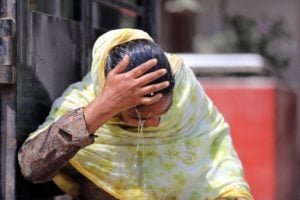
Crippling heatwaves are sweeping across South and Southeast Asia. In the southern state of Kerala in India, two people have died reportedly due to high humidity coupled with heatwave conditions as temperatures hit 42 degrees Celsius. In the last few weeks, Indian politicians campaigned during near 40C temperatures. As India goes to the ballot between now and 1 June, some politicians have blamed heatwaves for a low turnout.
The India Meteorological Department (IMD) typically issues heatwave warnings if the maximum temperature of a weather station reaches at least 40C in the plains and at least 30C in hilly regions, with a departure of 4.5-6.4C from the normal maximum temperature.
But a new study shows that even on days where there is no official heatwave warning, the threat from heat remains. “Heat stress is usually 1−4C higher on heatwave days than on non-heatwave days,” the study titled ‘Excess Mortality Risk Due to Heat Stress in Different Climatic Zones of India’ found. “However, the [heat] stress on non-heatwave days remains considerable and cannot be neglected,” says the research conducted by multiple authors affiliated with research institutes and colleges across the India, as well as one from Germany.
The authors showed the association of a newly formulated India heat index (IHI) with daily all-cause mortality in the three cities which were chosen for their differences. Delhi is semi-arid, Varanasi is humid and subtropical and Chennai tropical wet and dry. The researchers used 42 years (1979−2020) of meteorological data to examine vulnerability to heat stress in India and developed climate-zone specific and percentile-based human comfort class thresholds. Values exceeding the 90th percentile were classified as ‘sweltering’, while those below the 25th percentile were ‘comfortable’.
Heat and death
The study found that during ‘sweltering’ days, all-cause mortality risk was enhanced by 8.1% in Varanasi, 5.9% in Delhi and 8.0% in Chennai, relative to ‘comfortable’ days. Across four age groups, the impact was more severe in Varanasi, with a 3.2-7.5% increase in mortality risk for a unit rise in the IHI, compared to Delhi (2.6−4.2% higher risk) and Chennai (0.9−5.7% higher risk). The authors also observed a 3−6 day lag between heat stress and mortality in these cities.
The study shows the statistical “exposure-response relationship between the IHI and mortality in the three cities”. But medical doctors, including experts from the World Health Organisation, insist that heat cannot cause illness or death, and that it can only aggravate existing conditions such as high blood pressure or diarrhoea. They say these are the conditions that cause illness or death, and that is why a doctor writing a death certificate will not write heat stress as a cause of death.
Asked to comment on this, study co-author and chair of the Centre for Atmospheric Sciences at IIT Delhi Sagnik Dey told Dialogue Earth, “Heat is a risk factor, causing diseases which cause death. Therefore, in the death certificate, it’s not mentioned. Similar is the rationale for ’smoking’ or ‘air pollution’. Smoking cannot kill people – smoking can cause cancer or heart diseases or stroke, which kill people. So, you will never find ’smoking’ as the cause of death.
“In epidemiology studies, we link the risks to deaths or disease [morbidity] – the interpretation is the deaths from all possible causes attributable to that risk factor. This is standard practice.”
Policy implication
The authors say the heterogeneity they found in heat stress impact across diverse climate zones in India should lead to the development of an early warning system that keeps these regional variations in mind.
IMD heatwave warnings differ across climatic zones in the country. The researchers say the index they used will improve these warnings. Asked what the improvement will be, the components of the index used in the study and the relationship between this index and the wet bulb globe temperature (WBGT) used in some countries to add parameters important to human health, Dey said, “IMD does not use any specific index. They provide heatwave warning. The indices are to quantify the stress when someone is exposed to heat and should consider relative humidity, wind and direct radiation along with temperature.”
“All existing indicators were developed based on data from developed countries. We did earlier studies to find that none of the indices match with each other in terms of comfort classes. We tweaked WBGT to represent Indian climate conditions better, but as of now, it is done based on statistics. Epidemiological studies are required to fine tune the thresholds. There is a discussion going on how to integrate IHI into the learning system.”
Asked to explain why heat stress should be different in different areas, Dey told Dialogue Earth, “India has six climate zones, and there is no reason to believe that the comfort thresholds should be the same. We know that heat stress is not just temperature, but many other factors are relevant. So, logically, the risk should also vary. In our analysis, we showed evidence that this is indeed the case. Other studies also concur with the fact that the risk is very different in dry heat [what we found in our arid or semi-arid regions] vs humid heat [we found in subtropical humid or other climate zones].
“What we should do in the future is conduct epidemiological studies across the diverse climate zone and validate the statistical-based thresholds and fine tune it.”
K J Ramesh, the former head of IMD, said that because there is heterogeneity in heat stress across India, the IMD and National Disaster Management Authority have city-level heat action plans. “Those are being followed and are saving lives. We’re learning by doing. I wish this had been mentioned in the paper.”
He added, “Heterogeneity can be at various levels and can have major impacts. In one of the years between 2015 and 2017, it was found that infant deaths in certain hospitals in Telangana had gone up significantly in midsummer. Upon checking, it was found that all these hospitals had their maternity wards on the top floor. Now they have been asked to shift those wards. These micro-level differences are important.”
He also disagreed with the study drawing a relationship between PM2.5 pollution and heat stress. “PM2.5 and other pollutants rise in the atmosphere and get dispersed in the summer.”
Asked what construction workers and others who had to be outdoors should do to reduce heat stress, Ramesh said, “They should not work between 1 and 4 pm. They can start earlier, at 6 am.”