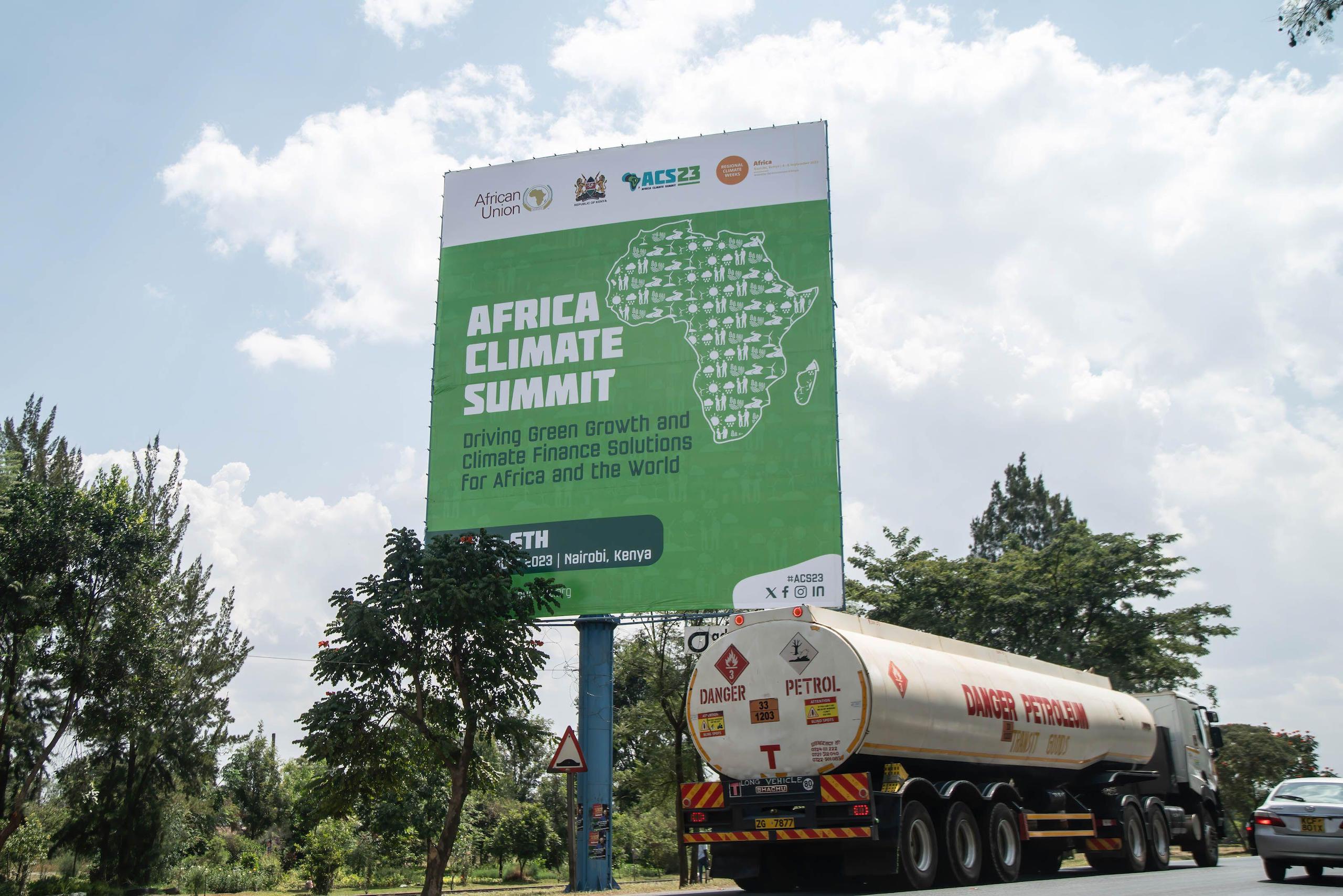
“We must view green growth not just as a climate imperative, but also as a fountain of multi-billion-dollar economic opportunities that Africa and the world is primed to capitalise on,” said the Kenyan president William Ruto at the opening of the first Africa Climate Summit in Nairobi on 4 September.
Organised in tandem with Africa Climate Week, the summit attracted over 20 heads of state and government, along with thousands of representatives from civil society, academia and the private sector.
Co-hosts Kenya and the African Union framed the summit as a chance for Africa to move away from its image as a climate victim. Instead, the opportunities on the horizon for the continent as it attempts to mitigate and adapt to climate change were brought to the fore.
The Nairobi declaration – signed at the summit’s end – emphasised the Paris Agreement’s assertion that no country should have to choose between development and climate action.
Ruto was ebullient. He urged African governments to increase investments in renewable energy, green industrialisation, climate-smart agriculture and nature conservation. This, he said, would accelerate global decarbonisation, fuel sustainable development and create jobs.
Representatives from academia and civil society were more cautious, citing the lack of financing and rising debt burdens as major obstacles to African economic development and climate resilience. The declaration recognised this too, calling for debt management mechanisms to be refined and the establishment of “a new financing architecture” sensitive to Africa’s needs.
The shackles of debt
In recent years, the burden of debt servicing has increased, due to the economic impacts of Covid-19 and rising interest rates.
According to research published in August, servicing external debt will consume an average of 12% of government spending in Sub-Saharan African countries between 2023 and 2027; in Angola, Zambia, Benin and Ghana, it will be at least 25%. These figures were calculated by Debt Relief for a Green & Inclusive Recovery, which is a collaboration between SOAS University of London, Boston University and the Heinrich Böll Foundation in Berlin.
In Sub-Saharan Africa, 600 million people cannot access electricity. The continent’s transport networks and industrialisation lag far behind the rest of the world. Huge investment is needed to propel Africa’s development in a climate-resilient way.
At COP15 in 2009, developed countries agreed to provide US$100 billion per year in climate financing to developing countries by 2020. The failure to meet this target further constrains Africa’s climate resilience efforts.
Calls are therefore growing for private-sector involvement. But Rishikesh Bhandary thinks private investors are deterred by the very high “cost of capital” of projects in Africa; a lot of money is needed before profits materialise, says Bhandary, assistant director of Boston University’s Global Economic Governance Initiative.
The result, Bhandary says, is chronic underinvestment: “When climate impacts happen, the fiscal and financial consequences are more severe due to a lack of resilience-building. That simply helps to perpetuate the vicious cycle between debt distress and climate vulnerability.”
Reforming finance for climate resilience
The Nairobi declaration proposes the establishment of “a new financing architecture that is responsive to Africa’s needs including debt restructuring and relief”. This would be achieved in part by developing “a new Global Climate Finance Charter through the UN General Assembly and [climate] Conference of the Parties processes by 2025”, states the declaration. Bhandary says multilateral development banks (MDBs) must therefore respond by scaling up their work in developing countries.
Bhandary welcomes the World Bank’s roadmap for change announced in January. “However, the shareholders of MDBs also need to inject them with fresh capital, so that they can provide larger volumes of finance on terms that are attractive to developing countries,” he adds.
Fadhel Kaboub says Africa is owed a climate debt: “Climate reparations include external debt cancellation, transfer of technology and research and development, capacity building and grants.” Kaboub, who is the president of Denison University’s Global Institute for Sustainable Prosperity, sees climate resilience loans to African economies as a separate issue.
Kaboub says now is the time for multilateral finance reform: “The Bretton Woods Institutions [the World Bank and the International Monetary Fund] are geopolitical instruments of control and manipulation … reforming them is virtually impossible. I would rather see the global south design a coherent comprehensive vision for south-south cooperation, complete with trade, finance, and investment policies on its own terms, then welcome cooperation and partnership from the global north on fair, equitable, and transparent terms, under a new model of multilateral cooperation.”
Africa’s external debt is a symptom of deeper structural problems, says Kaboub, namely food and energy deficits, and low-value-added manufacturing.
New thinking on debt
New ideas to relieve Africa’s debt burden and promote climate resilience are emerging. The Pan-African Parliament considers so-called “debt swaps” to be a potential solution to climate financing. These deals see a creditor nation reduce the debt owed by the government of a developing country. In exchange, the debtor financially commits to climate mitigation or adaptation projects, or nature conservation.
This August, Gabon and The Nature Conservancy (TNC) announced a deal to refinance $500 million in national debt for marine conservation efforts in Gabon; the Bank of America and US International Development Finance Corporation provided assistance. This 15-year initiative is now in doubt following Gabon’s recent coup, but elsewhere, Kenya and Eswatini have expressed interest in this financing model.
Raising finance
A notable feature of the Nairobi declaration is a proposed global carbon tax to fund climate action in developing nations.
This idea has received mixed reactions: Mohamed Adow says such a tax would not be enough to dissuade polluters. Adow, who directs the Power Shift Africa thinktank in Nairobi, says fossil fuel extraction should be curbed with stronger legislation. This, he says, would channel investment into green energy and ultimately make it more affordable.
“Let’s push polluters out of the market” he says, adding that “the Africa Climate Summit declaration should have stated that the [carbon] tax is for adaptation, and not decarbonisation.”
Carbon markets are another controversial climate finance mechanism that featured prominently at the summit. President Ruto said Africa possesses huge opportunities for carbon trade. He called restoring and expanding Africa’s natural carbon sinks “an unparalleled economic goldmine.
“They have the potential to absorb millions of tons of CO2 annually which should translate into billions of dollars, improved livelihoods, and millions of opportunities across the continent.”
Rishikesh Bhandary says carbon markets could accelerate climate action while bringing climate investments into developing countries. Carbon market projects need to be larger-scale to reduce costs, while the costs of buying and selling carbon credits need to be lowered, he adds.
Carbon markets, however, are a controversial subject. For example, Kaboub disagrees with Bhandary’s assessment: “Carbon markets are a neocolonial device designed to allow the historic polluters to continue polluting the planet at the lowest possible cost. These polluters use their dominant market power to transfer the cost of the permits onto their customers, many of whom are in the global south.
“They displace the most vulnerable people, small farmers and pastoral communities, by privatising millions of hectares of African land. It is unfortunate that our leaders have accepted this false solution that was not designed by Africans or for Africans. It was designed by polluters and speculators to serve their interest.”
The G21
A few days after Africa Climate Week, the African Union was admitted to the G20 (now G21) group of leading economies. This could present an opportunity for Africa to play a leading role in the global green transition, and press its climate finance and debt agenda.
Solomon Ayele Dersso hailed this development. It is an opportunity for African nations other than South Africa to amplify their voices, says Dersso, a commissioner of the African Commission on Human and Peoples’ Rights.
Joab Okanda tells China Dialogue that the African Union should use its G21 status to push wealthy, polluting members to cut emissions. A senior advocacy advisor for the charity Christian Aid, Okanda wants the union to advocate for “reform of the global financial architecture”. He says this should include debt relief to enable climate-related action, such as achieving at least 300 gigawatts of renewable energy capacity in Africa by 2030.
On the other hand, Okanda is quick to acknowledge the challenges that the union must navigate in the G21, such as maintaining a consistent agenda despite the pan-African body’s regularly switching chair: “Being at the table is one thing, but deciding what is served and how it is served is another.”
The continent’s most immediate challenge, however, is COP28. The Nairobi declaration includes a commitment to drive Africa’s climate agenda forward at the climate negotiations, which take place this November and December in Dubai.