


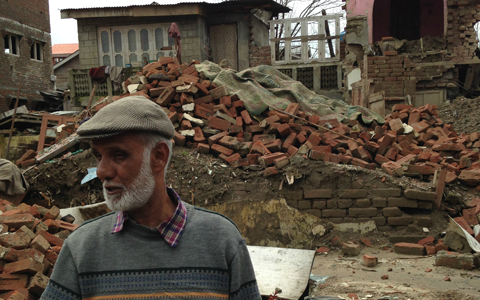

If there is any positive fallout of the flood in Kashmir in September 2014, it is the change in public perception about property insurance. Everyone now wants to insure his or her home against disasters.
The flood wrought havoc in this conflict-hit Himalayan region last year, but only around 1.5% of the damaged property was insured. And that small percentage consisted mostly of shops and factories. Home insurance was negligible. So was agricultural insurance.
Residents say there were two reasons why they had not taken out home insurance earlier. First, lack of credibility of insurance firms, so that people were not sure their claims would be honoured. Second, Islam prohibits property insurance. A large majority of residents of the Kashmir valley are Muslims.
“People in this part of the world were sceptical about insurance companies as they never thought that the insurance companies would pay for their losses,” Adil Nisar, a financial expert who works as a senior manager with HDFC Bank in Jammu and Kashmir’s summer capital Srinagar, told thethirdpole.net.
“Since the people now witnessed that those who had insured their properties were paid by the insurance companies, they have started trusting the firms. Besides, people feel that climate related disasters have now become a reality. This making them look for risk cover,” he added.
Religious prohibition on insurance was another reason for reluctance.
“Insuring properties with profit-making companies is total violation of Islamic principles. Islam has a better alternative for helping people to rebuild after disasters. This is called Taqaful (or community help),” Mufti Nazir Ahmad, a religious scholar in the seminary Darul Uloom Rahimia, told thethirdpole.net. “This system is in vogue in countries like Egypt and Saudi Arabia.”
Residents however say that since there is no well-organised Taqaful system in place in Kashmir at an official level, it is hard for them to rely on community help.
“I would be the first person to withdraw my insurance policy if we have a well-organised community help system in place. But, we are aware that it is not possible for us unlike the countries where Islamic rule is in place,” said Majid Nakash, a resident of Srinagar who has recently insured his home.
According to Nakash, he suffered a loss of around Rs 500,000 (USD 7,936) in September 2014, with flood water damaging a major portion of the ground floor of his house and the compound wall.
Spurt in insurance policies
A big reason why people are worried about the next flood is that there is hardly any flood control infrastructure in place. The state government is still struggling to muster funds for post disaster rehabilitation. Then, if it manages to get the millions it says it needs to build flood control infrastructure, the construction itself will take over a decade. Scientists say one effect of climate change is to make floods, droughts and storms more frequent and more severe.
Insurance companies report a sharp increase in the number of home insurance policies. Mustafa Kamal, a top official of Bajaj Alianz in Srinagar, told thethirdpole.net that his company has recorded a 50% increase in the number of policies till May 31, adding that they are expecting this increase to go beyond 500%.
Ravindra Koul, senior manager with United India Insurance, said that his company has recorded a 30% increase in the number of policies so far, as more people come forward for insuring their assets like homes and business outlets.
“With the spread of awareness about insurance among the educated class, the growth rate in insurance policies all across India is only 10% this year while Kashmir has recorded a 30% increase because of previous year’s disaster,” Koul said.
He went on to say that the disaster has also made people aware about various aspects of property insurance – most importantly the valuation aspect. People associated with business, he said, were already insuring their business outlets, but they had no idea about valuation.
What is noteworthy, Koul observed, is the fact that a lot of people are now coming forward for insuring their residential houses, a phenomenon which was little known in this region.
“The biggest change we are now witnessing is that about the valuation,” Koul said. “Now people are not opting for poor valuation of their properties to cut down on premium payment; they even pay thousands of rupees for insurance valuation for getting strong liability coverage and are willingly paying heavy premiums.”
According to Koul the insurance companies paid only around Rs 1500 crore following last year’s disaster, but the figure would have risen manifold if a good percentage of homes were insured, and if the insured properties had been valued properly. Total losses due to floods in Kashmir were declared officially in excess of Rs 100,000 crore.
Munich Re, a risk management major, in one of its surveys has observed that the property insurance scenario all across India is quite dismal. It issued figures in October last year which showed that despite India’s high vulnerability to climate-related disasters, the country is recording quite low insured losses.
As per the survey, India was at the third slot in the list of most affected countries by climate-related events in 2013 with over 7,000 deaths and was at number seven in terms of economic losses, yet it was nowhere in the reckoning in terms of insured losses. Experts are advising the Indian government to offer tax reduction to those citizens who opt for house insurance.
No crop insurance
Last September’s flood virtually wiped out Kashmir’s major cash crop, apple. With water still standing in many of the orchards seven months after the flood, farmers stood to lose not just a season’s crop but also apple trees that were three to four decades old.

It also brought home to everyone that hardly any of the orchards or their produce had been insured, though farmers had taken huge loans against the season’s produce and many were now in danger of going bankrupt.
Asked why they had not insured their orchards or at least their season’s produce, most orchard owners did not have an answer, except to say they had not thought about it. One orchard owner said he had investigated the procedure, but found it to be full of red tape. He now owed the local bank Rs 60 lakh and was wishing he had persevered some more to get his crop insured.