


As developing countries are confronted with more damage and in some cases, permanent loss, from climate change, they are pushing for compensation from historic polluters
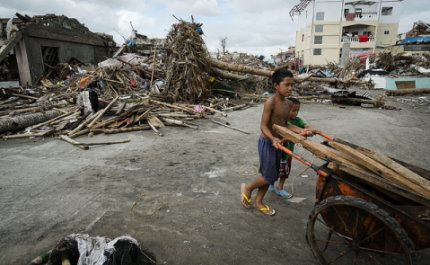
‘Loss and damage’, a relatively new stream in the negotiations in tackling climate change, took centre stage during the recent climate talks in Warsaw, once again highlighting the rift between developed and developing countries.
The “Warsaw International Mechanism for Loss and Damage,” adopted nearly 24 hours after the summit was originally scheduled to end, is intended to help “developing countries that are particularly vulnerable to the adverse effects of climate change.”
In last year’s conference in Doha, governments agreed in principle to establish an international mechanism to deal with loss and damage. This principle was brought to the fore again at the talks in Warsaw by a proposal presented by the group of the Least Developed Countries (LDCs) and the Alliance of Small Island States (AoSIS). This won the full backing of the G-77 plus China bloc in what several observers considered an exceptional show of unity.
“The proposal is a principle that loss and damage has now become so important and so different from adaptation and mitigation that it deserves to be treated separately in its own right,” said Bangladeshi scientist Saleemul Huq who has been advising the LDCs, in particular on the issue of loss and damage. “It’s a principle. We’re not even talking about compensation … At the moment, in Warsaw, it’s about an institutional arrangement. It’s not the end, it’s the beginning. It’s the beginning of discussion on loss and damage.”
And for the US this is a reason to worry. An official briefing document leaked to The Guardian and The Hindu newspapers indicated the Americans’ concern of a possible focus on compensation for various damages caused by climate change.
“We always knew the US was against us,” Harjeet Singh from Action Aid International told chinadialogue. “It was not news for us.” The US listened and were engaged in the discussions on loss and damage, he added, but when it seemed the talks were at a deadlock, the G-77 top negotiator walked out in protest at developed countries’ refusal to commit to reaching an agreement.
A key stumbling block has been the location of the proposed mechanism and its structure. Members of the G-77 group demanded it be established as a separate body, a third pillar, arguing that loss and damage cannot be considered part of adaptation. The US resisted, and eventually, after the closing plenary session was suspended for a ‘huddle’ between the American and Fijian delegates (representing the G-77), the decision was made that the new mechanism would be established under an adaptation framework adopted in Cancun in 2010, but will be reviewed in 2016.
Action Aid International criticised the outcome as “too weak to tackle the enormous impacts already occurring due to climate change.”
Others suggested that perhaps expectations were too high. The decision was “the biggest compromise for both sides,” Wael Hmaidan, director of Climate Action Network International, told chinadialogue. “This was basically the only possible way.”
Many questions need answering about the ability of the new mechanism to address the toll of climate change. Some revolve around issues of liability, and what constitutes a climate change-induced damage or loss, though other issues remain.
“We want finance, technology transfer and capacity building to be incorporated in this arrangement,” said Voltaire Alferez, the national coordinator of the Filipino NGO “Aksyon Klima Pilipinas”.
Yet some commentators have argued that this body needs to be established before its operationalisation can be discussed.
Moreover, it remains to be seen how the new mechanism would influence action on the other pillars of adaptation and mitigation (emissions cuts).
“We don’t think it comes at the expense of adaptation and mitigation. In fact, it reinforces the need for mitigation. The less mitigation we have, the more loss and damage we’ll have; the more mitigation the less loss and damage we’ll have,” Huq explained.
“We want both mitigation and adaptation to increase so that we minimise loss and damage. But we cannot bring it down to zero.”
For countries already bearing the brunt of the unfolding climate crisis, the Warsaw International Mechanism should offer vital help in coping with it. Nevertheless, the agreement on recognising the need to address loss and damage might not represent an achievement for the international community.
“The fact that we have to talk about loss and damage is negative because the only reason we’re doing it is we failed to mitigate and we failed to adapt,” Huq said.