In our pursuit of narrowly defined economic growth, we are pushing the ecological balance beyond safe boundaries. This can have terrible consequences, as was revealed in Pakistan last year. A third of districts in the country are still dealing with the outcomes of the flooding, and 33 million people have been affected.
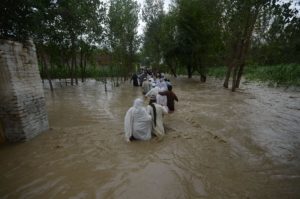
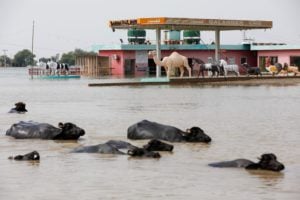
Between June and August 2022, Pakistan endured the worst floods in its 75-year history. A prolonged heatwave in the spring, accompanied by a drought and followed by a ‘monster monsoon’ ultimately morphed into the wettest August since 1961. A combination of glacial melt, warming of sea surface temperatures in the Indian Ocean, La Niña, and poor management led to a disaster on a scale never experienced before.
Fields turned into inland lakes as Balochistan and Sindh provinces received 726% and 590% more rainfall than average, respectively. Around 75 glacial lake outburst floods (GLOFs) were reported in the Hindu Kush-Karakoram-Himalayan region of northern Pakistan.
The most astonishing feature of Pakistan’s 2022 floods was their origin, having sprung from the Koh-e-Suleman mountain range, which ordinarily do not experience the South Asian monsoon. This is a worrying indicator of a geographical shift in the region’s monsoon patterns.
Measuring, and mismeasuring, loss and damage
Initial estimates of loss and damage resulting from the 2022 Pakistan floods stood at over USD 30 billion, distributed across infrastructure, agriculture and various cross-cutting sectors. Meanwhile the total needs assessment for recovery and reconstruction added a further USD 16.3 billion in estimated costs.
However, this analysis is misleading as it fails to reflect loss and damage beyond direct costs. The intangible reality – the non-economic losses and damages pertaining to our natural capital – along with the opportunity cost of unemployment, lost income and migration, remain largely ignored. Most importantly, the USD 30 billion estimate is a serious undervaluation, and does not account for the damage done to natural ecosystems, and their contributions to well-being and economic activity. These include pollination, carbon sequestration, and climate regulation, all of which have been disrupted by the floods.
Since we do not ‘pay’ nature for these services, they are often overlooked in economic calculations. Globally, these ecosystem services are worth an estimated USD 125-140 trillion annually, more than one-and-a-half times the size of global Gross Domestic Product (GDP). And yet they rarely figure in the economic calculations that dominate our planning processes.
GDP is an outdated metric that ignores the health of ecosystems and the critical role of ecosystem services
If not managed properly, by 2050 Pakistan’s annual GDP could decline by an estimated 18-20% as a result of climate risks and environmental degradation. And yet this is again a limited way of approaching the challenge. Correlating climate risks, losses and damages with GDP is misplaced. GDP is an outdated metric of measuring growth, as it fails to account for the inclusive wealth of a nation. In particular, it ignores the health of ecosystems, and the critical role of ecosystem services in supporting human and economic well-being. This limits its ability to track and assess human well-being, and relying on GDP results in misguided growth and development pathways.
In a post-disaster scenario, the case for moving beyond GDP becomes even stronger. Rehabilitation efforts such as rebuilding houses, bridges and roads inflate GDP growth rate in the short term. GDP counts only what is built, not what was lost. This creates an illusion of prosperity. However, in real terms the nation may be much worse off, as the land degradation, deteriorating water quality and biodiversity loss resulting from a disaster can result in a lower contribution to the economy from nature. A decline in the healthy functioning of ecosystems and society results in lower productivity, while leaving all species on Earth more vulnerable to future climate shocks.
New metrics can help a green recovery
Without transformative change in how economic growth and well-being are measured, Pakistan risks blinding itself to the fact that it is growing ever poorer and more vulnerable to future shocks from climate change, recessions and pandemics. Indices such as the Gross Ecosystem Product and the Living Standards Framework, being piloted in China and New Zealand respectively, have shown great promise in tracking and enhancing happiness and well-being across all demographics. This could be explored in the context of Pakistan.
The suffering caused by the 2022 floods brought Pakistan’s climate vulnerability to global attention. At a conference in Geneva in early January, the international community pledged over USD 9 billion to help Pakistan’s flood recovery, in line with the Resilient Recovery, Rehabilitation and Reconstruction Framework. As harmonious as this may seem, almost 90% of these commitments are reportedly multilateral aid in the form of loans, which will be rolled out over the next three years. Pakistan already has a huge debt burden, which includes USD 23 billion of external debt repayments due and a USD 10 billion current account deficit forecast for the 2023 fiscal year. Accumulating more debt is far from ideal.
In this scenario, reshaping these funds into debt-for-nature swaps can be explored, where a portion of the debt is cancelled or reduced by the creditor in exchange for the debtor investing in nature. Similarly, nature performance bonds can be leveraged. This is a type of performance-based debt instrument, where the debt is pegged against measurable targets and nature-based outcomes such as ecosystem restoration. These tools accelerate access to climate finance while tackling the growing sovereign debt crisis, and can enable developing states like Pakistan to achieve green growth and enhance biodiversity.
The recent colossal floods, followed by health, energy and economic crises, have left Pakistan in a predicament. But they have also presented it with the opportunity for a green recovery. This is a chance to recharge the country’s aquifers, enhance its stock of natural capital and leapfrog towards a green economy. In this age of adaptation, investing in green infrastructure and nature-based solutions such as inclusive early warning systems and ecosystem restoration can enable green growth, and create a nature-positive, megadiverse and climate-resilient Pakistan.