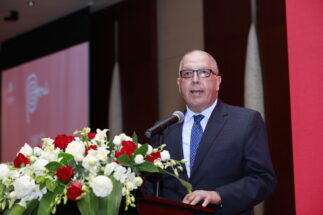
The sight of any president singing solo in public is certainly not a common one. Nevertheless, at the close of the annual meeting of the African Development Bank (AfDB), Dr Akinwumi Adesina, its vibrant president, serenaded the audience with a rendition of a 1972 classic by Johnny Nash. “It’s gonna be a bright, bright, sunshiny day,” he told the bank staff, governors, members and observers who had gathered in Accra, Ghana from 23 to 27 May.
While Adesina’s performance may have been intended to stir up feelings of optimism and hope at the bank’s first in-person annual meeting since the start of the Covid-19 pandemic, the song’s iconic lyrics also pointed to a major focus of the bank’s deliberations: the sun, the weather and the climate.
Under the theme of “Achieving Climate Resilience and a Just Energy Transition”, the meetings were an opportunity for African governments and key stakeholders to discuss the progress the continent has made towards addressing climate change. They were also a chance to identify the current gaps and challenges in action, as well as to secure much needed climate financing. With the COP27 climate negotiations to be held on African soil this year – in Sharm el-Sheikh, Egypt – for the first time since 2016, climate action is a particularly salient issue for the bank to focus on.
But were there actually any new developments on climate change to support the level of optimism seen at the meeting?
Misplaced optimism
Adesina and his senior team were positive about the Glasgow Climate Pact that closed last year’s UN climate negotiations. COP26 brought a US$1.5 billion pledge to protect the Congo basin, a $356 million Adaptation Fund and a $413 million pledge of new funding for the Least Developed Countries Fund. But not all on the continent share this optimism, with many expressing disappointment at lagging political will and action. One of the main frustrations seen at the Glasgow conference was the inability of wealthy nations to fulfil their long-standing pledge to provide $100 billion a year of climate finance – by 2020 – to assist vulnerable countries, the majority of whom are on the African continent. A recent study reported an ongoing annual gap in this finance, falling around $20 billion short of the $100 billion mark.
This lack of funds is not due to a lack of ambition on the part of recipient countries: 53 of 55 African countries have signed and ratified the Paris Agreement, submitting their Nationally Determined Contributions (NDCs) and signalling their intent towards climate action. Furthermore, according to the AfDB’s most recent African Economic Outlook, launched during the annual meeting, between $1.3 trillion and $1.6 trillion will be needed up to 2030 to implement the continent’s climate commitments and NDCs. According to UN Environment Programme estimates, across the continent, the costs associated with climate adaptation alone could hit a massive $50 billion annually by 2050. Yet, Africa receives only 3% of global climate funding. In short, African countries need far more finance for green development and climate resilience. And the frameworks and mechanisms put in place to date – including at COP26 – are far from adequate. Hence, a potential role for the bank.
How AfDB should respond
From observations and the discussions we at Development Reimagined had in Accra with the AfDB and other participants, it seems the bank’s answer to these issues contains three key elements. In our view, all are critical in the lead up to COP27.
First and foremost, the AfDB could play a role in raising new climate finance for Africa. Indeed, in general, new and innovative financing mechanisms – to provide concessional loans for green financing and foreign direct investment (FDI) – are ever more critical. In Nigeria, for example, our analysis shows that the country has an average annual infrastructure investment need of $53.5 billion to $70 billion to meet the Sustainable Development Goals (SDGs), including funding towards climate action. The AfDB has a special role in pooling and minimising costs and risks of new debt for green infrastructure in and across countries on the continent. One option is to use special drawing rights (SDRs), which were discussed in a side event at the Accra meetings.
Special drawing rights are international reserve assets created by the International Monetary Fund (IMF) and used by its members, with their value based on a basket of currencies: the US dollar, the euro, the Chinese yuan, the Japanese yen and the British pound. The IMF allocates SDRs among its member countries, who can exchange them for freely usable currencies. SDRs are a great potential source of liquidity for member countries. However, of the IMF’s most recent allocation of SDRs in 2021, worth US$650 billion, only 7% were allocated to Africa.
The AfDB has support from several African leaders, including Ghana’s President Akufo-Addo, for channelling SDRs towards the bank, including for its climate programmes. With the continent attracting less than 3% of global private sector climate finance, the mobilisation of private finance, including the issuance of green bonds is essential. The AfDB argues that if SDRs were to be channelled into the bank, they could leverage at least four times the initial capital.
Second, the bank was keen to stress its relationship with other cross-African initiatives and agendas, such as the African Continental Free Trade Agreement (AfCFTA), founded in 2018 as a means to boost green industry on the continent. It is important to recognise and strengthen the opportunities that African countries have in developing local manufacturing of environmental goods (such as solar panels), as a means to not only increase renewable energy uptake across the continent but also reduce reliance on imports, and increase intra-Africa trade. This need for local manufacturing has been made particularly evident during the Covid-19 pandemic. Although it is not clear whether the AfDB has the mechanisms to drive this yet, the bank could design new instruments to do so.
Lastly, the AfDB was very clear about its interest in supporting African countries both on a country basis and collectively, in order to create and incentivise an environment conducive to renewable energy investment, alongside what has come to be known as a “just transition”. Though the continent will look to advance renewable energy resources, President Adesina underscored that this will likely need to be combined with natural gas to guarantee security and stability of energy, especially as the continent endeavours to achieve the SDGs, the African Union’s Agenda 2063 for development, and net zero emissions.
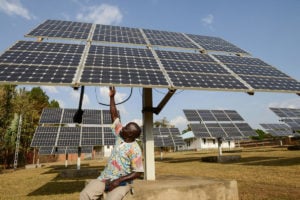
However, in our view, even in the recent African Economic Outlook, the estimates of the energy required to meet Agenda 2063 remain unclear, and most likely underestimated. That said, the bank is in any case striding ahead with new initiatives on this front. At the annual meeting, it showcased its work on launching the Alliance for Green Infrastructure in Africa, a new solar project in Ghana, and support for Egypt in launching an initiative focused on energy transition in Africa ahead of the COP27 conference.
Strengthening partnerships
While the AfDB’s annual meeting was packed with high-quality analysis, ideas, initiatives and even singing and dancing, there was one key player largely left outside the room – China.
China is an AfDB member and has a relationship with the bank dating back to 1985, with the $2 billion Africa Growing Together Fund being the most practical outcome of this. In Accra, however, Chinese representatives only participated in the meeting virtually, due to continuing domestic Covid-19 restrictions. Yet, China could have a massive impact on the three agendas for the AfDB we outline above. In November 2021, it committed to channel $10 billion worth of SDRs to Africa; China is the world’s largest manufacturer and exporter of several innovative environmental goods and technologies; and it is a major source of energy finance for Africa, with the continent being the recipient of 20% of Chinese policy bank energy financing between 2008 and 2020.
Over the coming months, the AfDB has an opportunity to coordinate with China around what African countries want and need with regards to practical climate outcomes. It could also use its connections with China to design unique opportunities for Chinese stakeholders to engage in African countries, including engaging Chinese companies in renewable energy projects and environment-related public–private partnerships. An announcement on 13 June by the bank’s Director of Renewable Energy and Energy Efficiency Department, Daniel Schroth, that the AfDB is seeking support from China on renewable energy projects hopefully represents a start to this process.
As the African continent strives to cope with the lingering impacts of Covid-19 on supply chains and fiscal challenges, the impact of the Russia–Ukraine war and ensuing sanctions, as well as the impacts of climate change, homegrown African solutions and stronger leadership are more important than ever. At the annual meeting in Accra, President Adesina and his leadership demonstrated that African-led institutions are ready to double down on understanding African needs and expressing them collectively. As Africans prepare for COP27 in Sharm el-Sheikh later this year, African officials at all levels must not forget the role of strengthening partnerships with different development partners – particularly China. Through our own leadership shaping strong partnerships, we can witness a “bright, bright, sunshiny day” for climate action and resilience on the continent.