


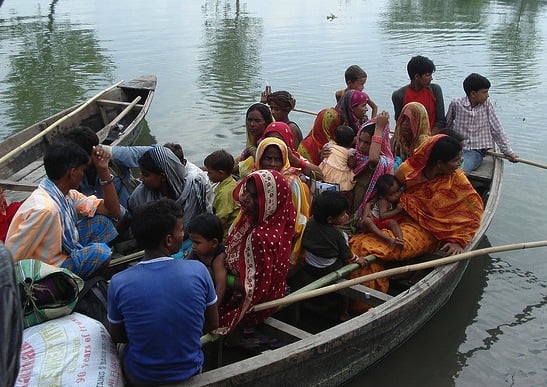

Over 100 people have been killed in floods in Nepal in the last week and 130 people are still missing. Following heavy rains in the Himalayas, floods in the same cross-border rivers have killed up to 28 people in India and displaced thousands more. Rivers in large parts of western Nepal and three states in India – Uttar Pradesh, Bihar and West Bengal – are flowing above the danger marks.
According to Nepal’s Ministry of Home Affairs, about 20,000 families have been displaced by the swollen rivers and are now in various relief camps. “Severe floods that mostly affected the western part of the country left thousands of people homeless and caused loss of property worth millions. Rescue and relief operations are underway,” said Jhankanath Dhakal, undersecretary at the Ministry of Home Affairs.
According to Dhakal, security forces were unable to reach the affected areas immediately as floods destroyed roads in many places. However relief packages were dropped from planes. On Monday, Nepal’s Prime Minister Sushil Koirala urged everyone to support flood victims as the nation was facing large-scale natural disasters.
The Meteorological Forecasting Division of the Nepal government said on Monday some of the rivers are now going down, as the rainfall eased.
Indian officials are accusing Nepal of opening barrage gates upstream, while Nepali officials point out that most barrages in their country are under Indian control.
In downstream India, the official figures reveal that so far in Uttar Pradesh alone 97,292 people have been affected due to floods, with 11 casualties. In Bahraich district – one of the worst affected – around 35,000 people have suffered.
The government has put some relief measures in place. Over 600 boats and 30 motor boats have been deployed in various rivers to rescue flood victims.
According to the latest bulletin of the Uttar Pradesh Flood Control Department, water levels in five rivers are above the danger marks. The Rapti river has reached a record high of over 105.41 metres in Balrampur district, which is 79 centimetres (cm) above the danger level. In its latest statement, the Indian government’s press bureau called the level “unprecedented”.
The Sharda and the Ghaghra, a major tributary of the Ganga in eastern Uttar Pradesh, swelled over one metre above safe levels. Further downstream in Bihar, the Ghaghra and the Kosi were also flowing above the danger mark.
As for the Ganga – India’s longest river – it was flowing at 179 metres in Bulandshahar in western Uttar Pradesh, 26 cm above the safe level. Further downstream in Bihar, on Monday the Ganga was flowing 96 cm above the danger mark at Dighaghat, on the outskirts of state capital Patna. Even further downstream in Farakka, just before the bigger branch of the Ganga enters Bangladesh, the river was well above the danger level.
Large cities in the Indian plains – such as Varanasi and Allahabad – have seen their floodplains along the Ganga being inundated over the last few days, and the swollen river has entered some low lying areas in some cities.
The recent heavy rains in the Himalayas have occurred in a monsoon season in which the overall rainfall in South Asia is still significantly below average. And the latest rainfall has often come in heavy bursts that do not really allow the water to percolate underground before it all flows away.
Flood damage exacerbated by human activity
D.S. Pai, Head of long range forecasting at the India Meteorological Department (IMD) in Pune, told the thirdpole.net that cloudbursts at this time of the monsoon were normal and there was no anomaly. “Monsoon shows inter-seasonal variability. Between 10th and 15th August, the monsoon trough passes through central India. The monsoon trough has now reached closer to Himalayas and so there is heavy rainfall in the region while the rainfall has decreased in central India.”
He however pointed out that flood damage has worsened due to several human factors. “Population has increased and land utilisation has changed because of urbanisation and cropping of agriculture. These are aggravating the disaster.”
The IMD forecast says that the monsoon trough will shift to the eastern part of the Himalayas and heavy rainfall is expected in Bihar, Jharkhand, Assam and the north-east including Sikkim and eastern parts of Nepal this week, while rainfall in the western parts of the Himalayas will decrease.
Earlier this month, a landslide in Sindhupalchowk district in another part of Nepal had killed 156 people and blocked the Sunkoshi River. The landslide created a lake with over eight million cubic metres of water, endangering vast areas downstream in Nepal and India. Efforts to unblock the landslide and drain out the water have only been partially successful. Officials have said the risk for the downstream people is still high.