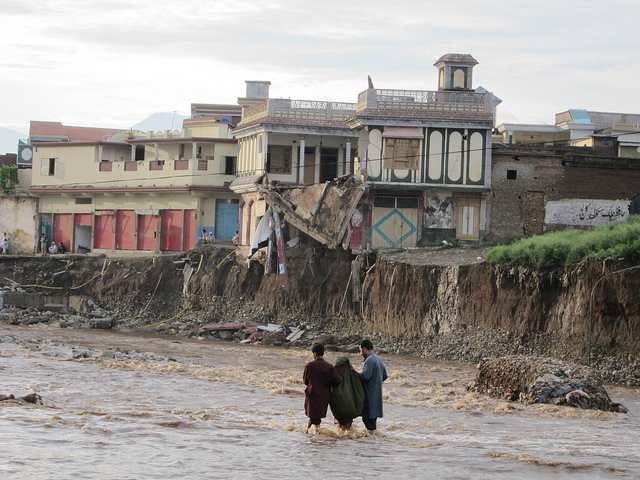
A high court in Pakistan has set a legal precedent – both at home and internationally – by ordering the government to enforce its own climate change policy and establishing a climate change commission to oversee the process.
An individual farmer, Asghar Leghari, brought a public interest litigation case against the government in the Lahore High Court on 31 August. Leghari, who relies on agriculture for a living, argued that the government had not taken steps to develop the required resilience to climate change as set out in the 2012 National Climate Policy and Framework. Quoting from the policy, the farmer stated that climate change threats have led to “major survival concerns for Pakistan, particularly in relation to the country’s water security, food security and energy security.”
Judge Syed Mansoor Ali Shah noted that climate change “appears the most serious threat faced by Pakistan” and ordered representatives from government ministries and departments to appear before the court and explain what progress had been made under the framework to meet the challenges.
Days later, government representatives told the court that 734 action points had to be addressed by various interested parties. Out of these, 232 must be completed by 2016. The joint secretary of the Ministry of Climate Change admitted that, “by and large the response of various departments … has not been positive.” Representatives of the irrigation, agriculture and forestry departments, Ministry of Water and Power, Federal Flood Commission, Ministry of Foreign Affairs and others also failed to show that tangible progress has been made in delivering adaptation measures.
In light of this apparent inaction, the judge observed that “climate change is a defining challenge of our time…it is a clarion call for the protection of the fundamental rights of the citizens of Pakistan…like the right to life which includes the right to a healthy and clean environment and right to human dignity.”
Invoking fundamental rights and constitutional duties, the judge called for existing environmental jurisprudence to be fashioned to meet the more urgent and overpowering needs of climate change. He also became the first judge to recognise the principle of “climate change justice”.
The judge directed each ministry and department to nominate a focal person who would work with the Ministry of Climate Change and ensure the implementation of the framework.
The judge also ordered the establishment of a Climate Change Commission to monitor its effective implementation.
Under the judge’s instructions, the commission will be chaired by eminent jurist and environmental lawyer Parvez Hassan and comprise representatives of the government, international environmental NGOs, environmental lawyer Saima Khawaja and counsel for Asghar Leghari. The court has adjourned the matter until 5 October.
Open door for climate litigation
This case is the first time the Pakistani judiciary has taken up a matter relating to climate change. Whilst the commission’s role is to review policy implementation, the court’s orders go much further than mere administration. It has established the principles upon which the concept of “climate change justice” can be developed in our legal system. The door is open now for citizens to hold their elected representatives legally accountable for inaction on climate change.
This case follows hard on the heels of the successful Urgenda case brought against the Dutch government, and shows that courts will increasingly be used to enforce political accountability and ensure climate justice in the future
The Copenhagen Accord reached at UN climate summit in Copenhagen– one of the largest gatherings of world leaders in history – referred to climate change as “one of the greatest challenges of our time.” Across the world, there is growing acknowledgement of governments’ role in addressing climate change challenges. US President Obama has made it the mission of the remainder of his presidency to place climate change centre-stage in American politics. A recent Papal encyclical speaks of a “revolution” necessary to avoid runway global warning. There is even an Islamic Declaration on Global Climate Change – a fatwa on greenhouse gas emissions and their consequences.
Pakistan is one of the countries most vulnerable to climate change but, despite having a national climate policy, no one appears to care. It has required a court of law to summon the authorities for us to see their hand-wringing and poor excuses for inaction.
Roots of paralysis
This is not entirely without reason. Pakistan’s national climate policy was announced in 2010, the eve of the 18th constitutional amendment. That political milestone devolved the subjects of environment pollution and ecology to the provinces, and has made climate concerns as much a provincial matter as a federal responsibility. But until then, environmental regulation in the provinces never rose above issuing clearances for projects and controlling polluting industry. Climate change, adaptation, mitigation, UNFCCC, COP all remain foreign terms to the provinces.
Following this, the government abolished the Ministry of Environment and established a Climate Change Ministry until 2014, when austerity measures led to its budget being slashed and its status downgraded to a division. In 2015, the division was upgraded again to a ministry under senator Mushahidullah Khan. Whilst the minister remained active and vocal on climate issues until his recent resignation only months before the UN climate summit in Paris, the ministry’s ability had been limited by lack of resources and the fact that most climate adaptation was, in fact, now a provincial matter. A recent study, conducted jointly by WWF and Lahore University of Management Science (LUMS), found that none of the provinces had any climate adaptation policy to speak of.
Challenges ahead
The framework, prepared in light of the vulnerabilities identified in the national climate policy, sets out appropriate adaptation actions at the federal, provincial and local levels. It is a remarkable document that lists out the measures that need to be undertaken to provide the adaptation and mitigation measures necessary to meet the climate challenges. The only thing missing are price tags. And this is where enforcement of policy becomes questionable and the job of the Climate Change Commission challenging.
Urgent climate adaptation for a developing country like Pakistan means spending money that may already have been committed elsewhere. At present, with local government elections around the corner and another general election not too far off, public spending for climate adaptation is not a priority.
The challenge for the commission will be to identify climate adaptation initiatives that provinces can take up as development projects. The challenge before the court is to navigate a course of climate awareness and policy implementation that does not offend the perceived mandate of the federal and provincial governments.