The remote but beautiful Pallas valley in Kohistan district in the Khyber Pakhtunkhwa province (KPK) with its rich flora and fauna is also home to bees. The honey harvested by the locals provide livelihood for the local community, but over the last few years honey production has dropped precipitously.
Until two years ago Abdullah, aged 50 and father of five, from the Palas valley worked as both a labourer and a honey entrepreneur. A month’s labour in the in Manshera district of KPK labourer would earn him an average of PKR 14,400 ($137) a month. But in the months of May to October he would return home to Kohistan and tend to his bees. During these four months he would earn as much as PKR 100,000 ($952), more than twice what he earned otherwise. Abdullah’s father and grandfather also took part in the honey collection, and sold honey to the Ayurveda experts and traditional medicines traders.The honey business runs in Abdullah’s family. He spent his childhood playing in the forests where he would later collect honey. He learned how to extract honey quickly because if the bees sense danger, they start to consume the honey themselves. In early years Abdullah could gather up tens of kilos of honey, and he remembers that in 2012 he managed to sell more than 150 kilogrammes. Now, however the honey supply has dwindled massively.
Loss of forest, declining bees
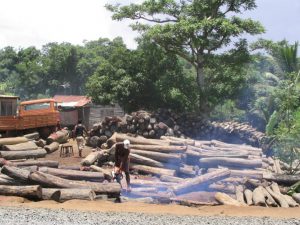
One reason for the decline of natural honey production is the rapid deforestation in the area. Abdullah has seen the forest shrink before his eyes. “In my experience,” he said, “the tree from which I collected honey one year was not there the next year. This happened over the last ten-fifteen years and during the same time my collection of honey reduced every year.”
While deforestation might have reduced honey production, but the unseasonal rains of the last few years have completely destroyed it. The rains have killed the flower blossoms from which the bees collect the nectar to make their honey. This has meant that even people who raise bees at home, such as Surbland Qureshi, a local farmer who also raises bees, production has fallen. “A few years back,” he said, “during the honey season I found my all my boxes full of honey and would get 80 to 120 kilogrammes of honey, but this year I found just 5 kgs honey from one box and other was empty”.
Soaring prices, low production
Consequently honey prices have soared in Pakistan. Wild honey, usually available at between PKR 1,400 to 1,600 a kilo is now selling for between PKR 2,200 to 2,600. Home farm honey prices used to range from PKR 800 to 1,200 per kilo but now they fetch between PKR 1,400 to 1,800 per kilo.
According to Mr Kamaluddin, the project director of the NGO Hashoo Foundation Pakistan, which works in the Kashmir and Gilgit-Baltistan areas of Pakistan, confirms that honey production has reduced by up to 40% indicating that major changes in the environment have occurred. This correlates closely to the work of experts who say that the changes in habitat and biodiversity, coupled with increasing use of chemicals and pesticides, have led to a sharp decline in bee populations in the Hindu Kush Himalayan region. Pakistan is not alone in this regard, with bee populations suffering decline across the world since 2006. As 90% of plants depend on insects to pollinate and reproduce, the drop in number of bees has impacts beyond the production of honey. In China some farmers have been forced to hand pollinate plants.
In Pakistan, though, the concern right now is the drop in production of honey. According to the Pakistan Beekeepers Association, there are 35,000 beekeeping farms in Pakistan. This season was the worst ever for them in recent history. Sher Azam, the association’s secretary general said that two things have done great damage to the production of honey. The first was the unchecked and illegal cutting down of berry trees upon which the bees feed, and second was the rains. Pakistan, which had become a significant exporter of honey, is now turning down orders because it cannot fulfil them.
Dr Rashid Hussain of the National Agriculture Research Centre’s (NARC) Honey Bee Research Institute explained that Pakistan has, “three indigenous species Apis dorsata, Apis cerana, and Apis florae (known as wild bees), mostly found in the Himalaya region of Pakistan.” These are already endangered species, and they have now declined even more. Dr Hussain suggests that while there are many factors involved in this decline, the most important one is climate change. In the 1990s the berry-honey season would last from mid-August to mid-October, because this is when the berry trees would flower. With the change of temperatures brought out by climate change, this season has been reduced to just one month, between mid-September to mid-October. If even this season is interrupted by rains, the bees have nowhere to go.