



[nivoslider slug=”pakistans-first-female-architect-pioneers-disaster-relief”]
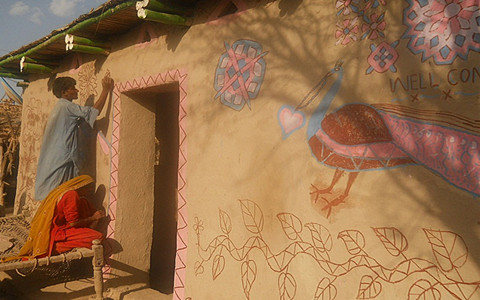
Yasmeen Lari has built over 40,000 low-cost shelters using just mud, lime and bamboo. “You don’t need wood, cement and steel to build strong homes,” she says.
Lari was the first woman to qualify as an architect in Pakistan and now directs local humanitarian NGO the Heritage Foundation. Her team of architects and engineers started experimenting with new materials in disaster relief after the great flood of 2010 submerged a fifth of Pakistan, left 2,000 people dead and hundreds of thousands of people homeless. Their shelters in Sindh Province, says Lari, have since withstood year after year of flooding.
Last year she visited Darya Khan Sheikh, a village on the banks of the Indus River, which the Heritage Foundation helped to rebuild after the 2010 devastation. “The village was flooded with up to four feet of water but the houses were intact, their grain and water was safe,” Lari told thethirdpole.net. “Only a little plaster had come off the walls.”
Established by Lari in 1980, the Heritage Foundation’s original mandate was conservation of cultural sites. But it turned to post-disaster reconstruction after a 7.8 magnitude earthquake devastated Pakistan-administered Kashmir and the adjoining North West Frontier Province in 2005.
The materials used by Lari’s team are local, cheap and have a low-carbon footprint. “Mud is recyclable and it’s everywhere; bamboo is very strong and environmentally sustainable and you can get a new bamboo crop every two years,” she explains. “Lime is the only material that requires small amount of fuel to heat it, but twigs are enough and so there is no need to chop mature trees or burn any fossil fuel.”
Lari has designed some of Karachi’s biggest buildings – her signature glass and granite edifices have a distinctive mark, though she says she wouldn’t build much of it again.After more than 30 years as a commercial architect Lari gave it up in 2000 to devote her time to writing. “I am no longer tied to what the client wants; it has freed me,” she says.
Her new clients are the poor and disenfranchised. “I have always maintained that they need to be given the same degree of importance as is given to corporate clients,” she says. Her aim is to teach villagers how to “make their buildings long-lasting”.
“You cannot come out of poverty if you keep re-building every year. The only way forward is to build the technical capability of communities and improve their earning capacity so that they can fend for themselves when disaster strikes,” she says.
Unsustainable disaster relief
With increasingly erratic weather patterns the world is growing more vulnerable to extreme weather events and Pakistan is one of the world’s most vulnerable countries. Paradoxically, those coming forward to provide humanitarian aid after extreme events promote construction with steel and cement thereby increasing carbon emissions and contributing to the climate change that triggers these events.
Lari argues the current model of disaster relief work will have to change: “There are scores of NGOs and international organisations that come with good intentions to rebuild but in the process leave a huge carbon imprint.”
Disasters affect communities’ food security and education as well as infrastructure, and the response should reflect this, believes Lari. Her team is working with 12 villages of between 100 to 300 people in two districts of Sindh, Mirpur Khas and Tando Allahyar, to make everything flood resistant. They are building safe shelters, eco toilets and raised earthen platforms to place grain, potable water, livestock and fodder during floods. The organisation is also training people to grow vegetables on rooftops, make compost out of human and livestock excreta, purify water with sunlight and make organic soap.
“We ensure the community is motivated enough to send their kids to school, empowered to pressure the teacher to turn up, and that if there is a government health facility, its dispensary is not only equipped with drugs but that absenteeism of the staff is duly reported,” she says.
Focus on women
Empowering women is at the centre of this strategy, and perhaps the reason for the project’s quick success.
For many villagers, says Lari, the most prized structure is the raised stove and small outdoor kitchen area designed by the Heritage Foundation. “People don’t know what a woman goes through while cooking,” says Lari. “It’s our most popular product and has been transformative for the family.”
The design team, she says, took time to really understand the needs of village women. The twin burner stove is fuel-efficient and the attached chimney allows smoke to leave the house. “Because it is built on a raised platform, it automatically gives the woman an elevated position, as if she is sitting on a throne,” says Lari. Crucially, the height also protects the stove from flood waters.
Best of all, there are now trained stove makers in each village. These “barefoot entrepreneurs”, as Lari calls them, teach others for a charge of Rs 200 (US$2). Local women have also learned how to make mud bricks. “We are happy because the construction is better and the techniques are shared and adopted; they are happy because they are making money in the process,” says Lari.