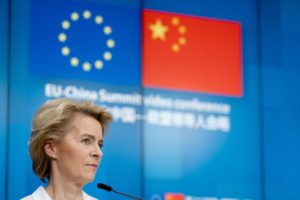
To coincide with London Climate Action Week and the release of our latest report, China Dialogue hosted a discussion on 18 November about the relationship between the European Union and China. With a host of encouraging commitments such as carbon neutrality pledges surfacing, the question is not the direction, but the speed and credibility of these plans. Are they backloaded? Will they be delivered? Can the EU and China separately exercise leadership and together accelerate global mitigation efforts? Our panellists addressed these crucial questions and explored how climate fits into the wider geo-strategic landscape.
Panellists:
Isabel Hilton (chair) – CEO, China Dialogue
Dong Yue – research fellow for international climate affairs, Energy Foundation China
Jennifer Tollmann – policy advisor on climate diplomacy, risk and security, E3G
Dr Chen Ji – principal and ETC China lead, Rocky Mountain Institute
Nis Grünberg – senior analyst, Mercator Institute for China Studies (MERICS)
Some interesting excerpts
Dong Yue:
06:03: The Covid-19 pandemic has disrupted international cooperation […] but it also reminded us of the importance of resilience against global risk and the protection of climate, nature and health as an integrated matter.
09:05: Something that might be overlooked [in relation to China’s climate commitments] is the fact that the Ministry of Environment and Ecology announced its intention to incorporate climate-related indicators into China’s central inspection system on the environment […] We expect this measure to mainstream carbon emissions and make the peaking of carbon emissions a top level key performance indicator for local leaders.
34:01: Even by themselves, countries will be moving forward with economic measures for climate action: electric vehicles, the development of renewables, new financial standards to take into account real concrete climate risks, as well as the development of low-carbon industry. I think that in turn these real economic sectors developing growth and jobs, will be an engine for cooperation between the major economic regions.
Jennifer Tollmann:
14:07: On the cooperation front some of the types of leadership that we can really see the EU and China cooperating on are things like debt. Debt is going to be the biggest challenge of next year, particularly in determining whether developing countries can afford the luxury of a green recovery or whether this is something that only the G7 can afford […] And this is something where China – as the largest creditor in the world – is really key, and Europe is very keen to engage on this.
28:51: I don’t think we can ring-fence climate anymore in the way we have in the past, because it is now an economic issue and it verges into things including connectivity, digitalisation, innovation and IP – all of the sticky issues that are going to be affected by [climate]. But also the political space for European leaders to cooperate with China on anything is very much determined by the public perception of China’s actions on things including human rights and including rule of law. I think it’s going to have to remain a dynamic relationship. [Climate] can certainly become a bit of a golden thread for cooperation when that political space exists, but it is going to be impacted by these geo-strategic issues.
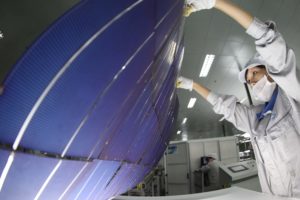
44:40: Cooperation on technology innovation is going to continue to be very difficult. Europe continues to be very scarred by the experiences around the solar revolution and so there are sensitivities around technology cooperation. But there is a recognition that in standard setting and in regulatory innovation there is a strong possibility of alignment, including around things like methane leakage, green hydrogen, sustainable finance. I think that’s where the overtures are going to need to be.
Chen Ji:
19:28: At the international relations level, with increasing voice for de-globalisation due to the pandemic and the trade conflicts among major economies, China actually has a pressing desire to secure Europe as an essential partner in globalisation […] Carbon neutrality is one of the few topics that the two regions have the most commonality. China therefore has a diplomatic incentive to collaborate with the EU on leading the global efforts for addressing climate change.
21:49: A heated area is green hydrogen: once the hydrogen economy comes into shape it will provide millions of new green jobs. But some voices, particularly from the European side, worry that this kind of emerging industry will repeat the story of solar PV in which European companies were overtaken by Chinese counterparts and lost the market share […] What EU and China governments need to do is to jointly create the market and help accelerate expansion of the market through collaboration and technology innovation.
36:25: The essential piece during the 14th Five Year Plan is to stop the new coal capacity for the power sector. It’s extremely essential for China moving towards the carbon neutrality goal and even towards the 2030 peaking target. Once you install those capacities, they will take at least 40 years to retire the coal fleet and there will be a strong locking effect there.
Nis Grünberg:
25:54: The window of opportunity here is to use the buoyancy that the green agenda and climate pledges give to this issue [of climate] right now, to facilitate and to institutionalise the most ambitious common targets and a common roadmap between China and the EU […] I’m concerned about the increasing tensions with the EU facing a strong China, a China that will not change on values, but will take more leadership in areas of technology and business.
49:27: To me, the next issue is whether there is a Just Transition Mechanism for the world. Do we need to develop some kind of redistribution mechanism so that sustainable energy investments become the economically rational choice? I don’t think there’s any good answer to this yet, but it would be useful to sit at a table more on global investments and standards.
58:08: I think we will see more doubling down on domestic technology in the next Five Year Plan […] I think it is really key that we leverage the high-level cooperation and the buoyancy of climate action right now to protect what we have in terms of energy cooperation and technological cooperation and science and research.
Copyright notice
This video is released under the Creative Commons Attribution Non-Commercial No Derivatives licence. For a copy of the video file, please contact: [email protected].