


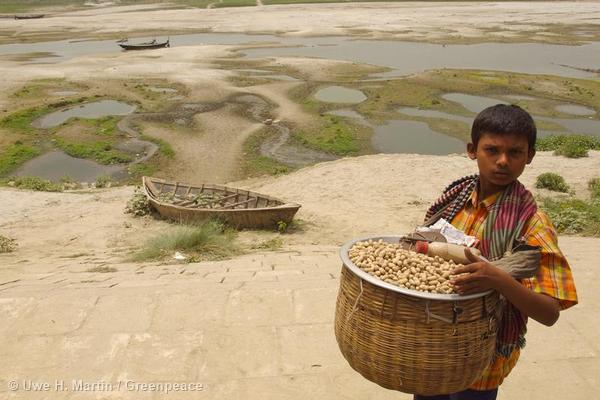

Once a common sight on the now-shrinking riverine stretches of Bangladesh, the gouna nouka, or goods-carrying boats, have become relics of a pastoral age with urbanisation and development fast replacing a river-centric, agro-based economy.
Like the gouna nouka, a number of other kinds of boats have been developed in the region. But few exist now as a riverine civilisation fades, and with it the many beliefs and rituals that developed around the rivers and boats.
“Those days are gone when we eagerly waited for the festive time of nouka puja (boat worship) that was held just ahead of the monsoon. That worship is rarely held now as boats are no longer significant in the daily lives of people,” said 65-year-old Akhil Sarder, who lives near the Kaliganj river in the country’s south-western district of Satkhira.
“People would bring different types of boats to the banks of the river and worship the river and the boat to pray for longevity and safety,” Sarder, who has been performing nouka puja since his childhood, said.
Changing lives
Like the boat worship, other rituals performed by different communities, including Hindus and Muslims, are disappearing or rapidly changing as rivers dry up across the country.
“Besides common rituals like the Ganga puja, bhasan yatra, nouka puja, bera bhashan and Barunii snan (bath), many other rituals of different sections like the fisher-folk and agrarian communities have been disappearing by the day due to abnormalities of water streams in the rivers of Bangladesh,” ethno-ecological researcher Pavel Partha told thethirdpole.net.
The Hindu communities in northern Bangladesh, especially those living by the Teesta river, for instance, have found that the location of their annual sacred bath has been shifting constantly. “Over the last few years, my family and I have been travelling 15 kilometres from my home to join the sacred bath. In my childhood, we would have to go just 400 metres away,” said 70-year-old Khoka Ram, who lives on the bank of the Teesta in Lalmonirhat district.
Local organisers had to stop the festival at the original venue because there was so little water in the river during the festival period.
Other people from the minority Hindu community in the area have also either changed the location of the ritual or stopped it completely with water drying up in the Teesta. The bathing ritual is part of the Ganga snan dedicated to the river deity Ganga, worshipped by many Hindus.
The original venue of the widely observed bathing ritual on the Shitalaksha river in Langolbond has also changed. Over the last 10 years, the ritual has moved from the original banks of the river to several hundred metres inside so devotees can get enough water to bathe in, said a member of the festival organising committee.
Many families, in fact, have been forced to conduct rituals at canals and ponds. Moni Bala, who lives near the Teesta, is one of them. “We are performing the puja in canal water as the river has completely dried up and this specific ritual needs water,” she said.
Ground realities
According to the Bangladesh Water Development Board (BWDB), the length of inland waterways in the country is 24,000 kilometres. Of this, a large portion remains unused during lean season due to inadequate depth.
For instance, the scheduled navigation route from Mongla port to Morelganj and other destinations through Ghosiakhali canal in southern Bangladesh has stopped due to siltation for the last five years. This also poses a threat to the Sundarbans, the world’s single largest mangrove forest.
“A huge number of vessels (more than 500), including large vessels and oil tankers, have been navigating inside the Sundarbans (Mongla-Joimonir Gol- Harintana-Supoti canal to and from the Bay of Bengal) through the Shalle river illegally since 2011. This poses a threat to the mangrove forest because of the leakage of oil and the sound of the vessels,” said Yunus Ali, chief conservator of forests at the Bangladesh Forest Department.
Both natural causes and human interventions are responsible for the changes in the course of the rivers. According to the BWDB, the Ganga and the Brahmaputra rivers in Bangladesh transport 316 and 721 million tonnes of sediment respectively. These high sediment loads reflect the extremely high rate of erosion in their drainage basins.
Of the total suspended sediment load transported by these rivers, only 525 million tonnes are delivered to the coastal area of Bangladesh; the remaining 512 million tonnes are deposited within the lower basin, offsetting the subsidence.
Of the 512 million tonnes, 289 million tonnes are deposited on the floodplains and the remaining 223 million tonnes within the river channels. This raises the channel bed and leads to flooding during the monsoons.
Human interventions may expedite the changes along the river, which harm the environment, ecology and livelihoods, BWDB has said.
Hydrology expert Ainun Nishat blames human intervention and the lack of proper management for the drying up of water bodies.
Citing an example, he said artificial irrigation-fed boro paddy has replaced monsoon-fed aman paddy over the last two decades in the country, which requires a lot of water from nearby rivers.
According to the Department of Agricultural Extension (DAE), production of boro paddy in Bangladesh was 18.8 million metric tonnes in 2012-13, much more than the 12.8 million tonnes of aman paddy. The situation was the opposite even a decade ago.
“Most boro or vegetable farmers living near a river pump water from it to meet their irrigation needs. This has been playing an important role in drying up small and medium rivers,” Nishat told thethirdpole.net.
In addition, people have been drying up the rivers by lifting water to cultivate different types of crops, including vegetables on riverbed, to feed the gradually increasing population, he said.
Nishat also blames global warming, which has been changing the pattern of rainfall in the region causing irregular flow of water in the rivers.
Pavel Partha, co-coordinator at the Bangladesh Resource Centre for Indigenous Knowledge (BARCIK), said: “Most rivers have either dried up or have been encroached upon by so-called developmental aggression like large dams, hydroelectric projects, unplanned infrastructural investment on water and the anti-riverine attitude of the state.”
Discussing the role of unplanned development works, water experts also blame irregular and inadequate river management, including regular excavation of the riverbed, as reasons for the rivers drying up. These water bodies, till just a few decades ago, were being maintained by the local people.
India factor
Almost all rivers in Bangladesh flow from upstream India. The countries share 54 rivers. There are allegations that India bars the water from flowing downstream during the lean period, thereby causing water scarcity in Bangladesh.
Mir Sajjad Hoosain, former member of the India-Bangladesh Joint River Commission (JRC), cited the example of the Teesta. The Bangladesh portion of the river had received only 409, 500 and 550 cusecs of water respectively in February, March and April this year compared to the normal water flow of nearly 6,000 to 8,000 cusecs in these months.
The situation has changed in the last few years as India halted the flow upstream for its expanded irrigation needs, he told thethirdpole.net.
The former JRC member said the crisis could be solved by joint efforts of India and Bangladesh as both portions of the same rivers require adequate flow to save its ecology and culture.