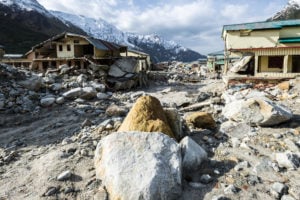
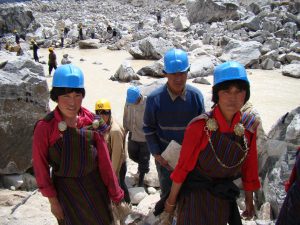
In the space of three months in early 2021, two glacial lakes in the Indian state of Uttarakhand burst their banks, with tragic consequences for mountain communities and ecosystems. In February, a glacial lake breach caused flash floods that surged through the Rishiganga River. At least 61 people were killed and around 143 were reported missing, and two hydropower projects and an important bridge were severely damaged. In April, in the same district, heavy rainfall and snowfall resulted in part of a glacier collapsing; 12 people died in the resulting avalanche.
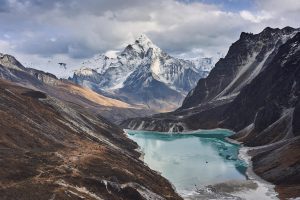
In the Himalayan region, climate-related disasters have compounded the public health crisis caused by the Covid-19 pandemic and led to an increasing frequency in the occurrence of what the scientific and environmental community call GLOFs – glacial lake outburst floods. A GLOF is the sudden release of water from a moraine- or ice-dammed glacial lake formed by melting glaciers on mountain tops, and can be prompted by an earthquake, avalanche or the accumulation of too much water. They are often extremely destructive.
The 2020 glacial lake inventory report by the International Centre for Integrated Mountain Development (ICIMOD) identified 47 potentially dangerous glacial lakes within the Koshi, Gandaki and Karnali river basins of Nepal, the Tibet Autonomous Region of China and India. These need to be closely monitored to reduce the vulnerability of settlements downstream. A 2019 study warned that the Himalayas, which hold about 600 billion tons of ice, are melting at twice the speed of that at the beginning of this century. It also revealed that glaciers have been losing as much as one-and-a-half vertical feet of ice every year since 2000. This adds to the water in glacial lakes, which may trigger glacial floods.
Limited warning systems, limited cooperation
To make matters worse, the implementation of GLOF early warning systems has been very limited in South Asia. Early warning systems involve the use of remote observation including satellite imagery and seismometers to sense tremors at an initial stage. Coupled with field data and mapping of past events, this identifies potential glacial lake bursts early on to minimise risk. These systems could further advance to include water sensors and a codified warning system, using smartphones and other technology, to alert downstream communities and ensure evacuation of the population.
In the Himalayan region, there are only three reported instances of sensor and monitoring-based technical systems being established to provide early warning of GLOFs – two in Nepal and one in China. The Central Water Commission of India has worked to identify the most dangerous and vulnerable glacial lakes, but both a robust early warning system and a framework for infrastructure development that doesn’t exacerbate future risks are still lacking. Lack of implementation is often a result of remote locations, fragile terrain and limited information regarding the risk scenario, leading to a lack of urgency.
In October 2020, India’s National Disaster Management Authority (NDMA) submitted a proposal to the Central Government for a comprehensive national GLOF mitigation project, with the Ministry of Jal Shakti. As of September 2020, Nepal had taken measures to reduce the water levels in two of its glacial lakes. In 2008, Bhutan was the first South Asian country to adopt an integrated method to reduce GLOF events under the UNFCCC National Adaptation Programmes of Action, and has been using low-cost techniques such as siphoning off water from critical lakes and enhancing the technology of early warning systems.
But while there have been efforts to establish warning systems within countries to deal with glacial floods, there is no linkage between these systems, even though countries share the same water resources. What is therefore needed as a priority is joint efforts between countries in the Himalayan region, before another climate-induced disaster leads to unknown human calamities.
Working together on glacial lakes
The areas countries could collaborate on include mapping potential risk zones, viewing the mountain terrain as one area; increasing the monitoring of glacial lakes; incorporating effective ground-based early warning systems at critical, often-unpredictable lakes; and – most importantly – increasing investment in glacial research.
For example, to manage glacial lakes structurally, India’s NDMA recommends reducing the volume of water in them. Methods include controlled breaching, pumping or siphoning out water, and making a tunnel through the moraine barrier or under an ice dam. These are useful recommendations and can be further examined in coordination with best practices already implemented in Bhutan, as well as other country-wide ideas.
Building transboundary cooperation on disaster management and preparedness in the region is not an easy task, largely owing to the political volatility of the region, paucity of data and deficit of trust. Best practices from other parts of the world can assist in establishing collective understanding and transboundary environmental governance.
In West Africa, the Senegal River Basin Development Organisation (OMVS), a regional cooperative management body, has had some success in fostering cooperation between riparian countries and mitigating conflict between newly independent nations. It has coordinated joint infrastructure development, shared ownership and rights to the river and integrated water management. Such bodies could be considered in South Asia, where existing treaties, such as the Indus Waters Treaty, are often susceptible to developmental nationalism and geostrategic calculation. They need to be upgraded to not only reflect the realities of demand on shared waters, but also the impact of climate change and other extreme and unexpected weather events. The current (minimal) cooperation between China, India and Bangladesh on monsoon data can be expanded to glacial research and early warning systems on critical lakes – which are significantly less contentious areas of joint management compared with water-sharing or integrated water management – and further expanded to include Nepal and Bhutan.
Calls for more integrated water management in the region have often received little political attention and will; perhaps these areas can be the starting point.
Natural disasters do not respect borders
Environmental vulnerabilities, which do not recognise borders, can be the drivers of cooperation in the region. There is also scope for South Asian countries to come together and cooperate at the river basin level to generate scientific knowledge and exercise joint policies. The European Flood Awareness System (EFAS), which controls the monitoring, forecasting and sharing of information across Europe in a common flood alert system, is one such example to consider. Existing initiatives like the Bay of Bengal Initiative for Multi-Sectoral and Economic Cooperation (BIMSTEC), the South Asia Subregional Economic Cooperation (SASEC), and the Bangladesh, Bhutan, India, Nepal (BBIN) Initiative can be considered as the entry points to foster regional disaster-risk governance, including on glacial floods.
Despite having an official policy since 2011 in the form of the South Asia Rapid Response to Natural Disasters (SARRND) as a cooperative disaster-response mechanism, no SAARC-level contingent has ever been deployed during emergencies in the region. The most recent example was during the Covid-19 pandemic, when the SAARC Secretariat failed to get South Asian countries with limited healthcare resources together to discuss public health measures and outbreak preparedness.
With growing evidence on the transboundary nature of disasters and climate risks, there is an urgent need for a comprehensive regional risk governance framework that is effective, and above all else safeguarded from the vagaries of other political tensions. The Southern African Development Community (SADC) framework is a regional mechanism that can be considered in this regard. It started small, primarily to foster economic cooperation and regional integration, but has grown to encompass areas including the environment, climate, water and wildlife.
A small start has been made. In September 2018, India, Nepal, Bhutan, Pakistan and Afghanistan launched the Hindu Kush Himalaya Glaciers and Mountain Economy Network to combat glacier and snow melt caused by climate change. A set of principles was agreed upon to improve the management of snow cover and glaciers that span the countries’ mountain ranges. Similarly, during the 2018 Asian Ministerial Conference on Disaster Risk Reduction (AMCDRR) governments reaffirmed their commitment through the Ulaanbaatar Declaration to further strengthen regional, sub-regional and national platforms on disaster-risk reduction.
It is time these political commitments went beyond statements and implemented frameworks that are inclusive, integrated and innovative, and can be implemented to build an effective regional disaster-relief mechanism.
This article received initial research input from Anamika Barua, research assistant at the Bangladesh Institute of Peace and Security Studies.