Only a few months ago, a headline like “United States sets tariffs of up to 3,521% on solar panels from Southeast Asia” could have been dismissed as satire. Today, it’s nothing special, one of many published amid an uninterrupted fusillade accompanying Donald Trump’s first 100 days in power. Yet it’s also part of something bigger, as axes of economic power shift, technological changes surge, and popular sentiments reconfigure and metastasise. Amid that fracturing world order, how should we consider the climate crisis?
As an unfolding and catastrophic reality, to be sure. Last year was the warmest on record, breaching for the first time the Paris Agreement’s target to limit global temperature rise to 1.5C above pre-industrial levels. From wildfires to tropical cyclones, extreme weather events in 2024 displaced the highest number of people since 2008, according to the World Meteorological Organization. Homes, livelihoods and natural systems were destroyed, compounding global shocks and stresses, from armed conflicts to rising food prices.
Yet from punishing tariffs and the risk of escalation in the US-China trade war, to Trump’s apparent designs on Greenland for its critical minerals – to paraphrase Michael Every, we can’t only talk about warming as lines on temperature charts. We need to talk about lines on maps. Addressing climate change means addressing it not in the world we would like to live in – where multilateralism and global governance really matter – but on this lawless planet of great power rivalry and zero-sum economic statecraft, where sharp economic measures are wielded for national political ends.
We can’t only talk about warming as lines on temperature charts. We need to talk about lines on maps
In February, the Munich Security Conference, which gathered global heads of state and government, listed extreme weather and forest fires, the destruction of natural habitats, and climate change generally as the aggregate “first, second, and third greatest” security risks facing countries. Despite this, global coverage of Munich focused not on the geophysical, but the geopolitical: in that case, US vice president JD Vance’s speech.
This may have signalled new fissures between Europe and the US, particularly regarding Russia and its war on Ukraine, but it also confirmed a broader pattern: the aggressive securing of supply chains, the rejection of multilateralism, and the upending of the last vestiges of consensus around development and diplomacy. For climate, these realities and how they bear on government decision making are crucial to understand, particularly given the centrality of China’s developmental state and its role in economic globalisation.
Competition
Back to those tariffs. If they were unimaginable, perhaps this is only because important climate conversations – around the intersection of geopolitics, economics and trade, with US-China relations at the centre of it – were siloed or downplayed. As trade tensions escalated through the first Trump and then Biden administrations – lest we forget the 100% tariff on Chinese EVs introduced in 2024 – Dialogue Earth reported on how China rerouted a significant amount of its low-carbon technology production, much of it for export, through Southeast Asia.
While some of this emerged in reaction to sanctions and tariffs (and Chinese companies reportedly continue to find ways to ship goods via third countries), it was clearly longer term and strategic from a Chinese perspective. Consider the words of Huang Yiping, dean of the Institute of South-South Cooperation and Development at Peking University, who suggested last year that the Chinese government should implement the equivalent of a Marshall Plan for clean technology – stimulating demand for Chinese manufacturers’ products, absorbing overcapacity, and supporting green transformation and growth in a virtuous cycle.
Such an approach is consistent with the Chinese government’s strategic, patient and long-term nurturing of low-carbon innovation – an approach rooted in national self-interest and one that has led to undisputed Chinese dominance of those sectors. Increasingly, China’s green production is not for export to rich countries: today, half of China’s solar modules, wind power technology and EVs are exported to the Global South rather than developed markets. The country seeing the largest increase in Chinese exports of wind power equipment between 2020-2024 was South Africa; for Chinese EVs in the same period, it was Brazil.
Still, Huang’s Marshall Plan would represent an expansion of ambition. It would require considerable financial support, such as lending from large state-owned policy banks that was characteristic of China’s approach to overseas development in the first decade of the Belt and Road Initiative, from 2013-2023, but today has waned considerably. Investments over that period, most of them in large, conventional infrastructure projects, totalled more than USD 1 trillion.
Today, the outlook is changing. China’s investments in the Global South have become greener, including to comply with largely voluntary guidelines and (mostly) with the coal-exit pledge announced unilaterally in 2021; the average deal size is smaller, reflecting the country’s own economic downturn; commercial lenders play a more important role, and the focus is becoming more strategic, concentrated on sectors such as renewable energy, transition minerals, and ICTs – an approach sometimes known as “small but beautiful”.
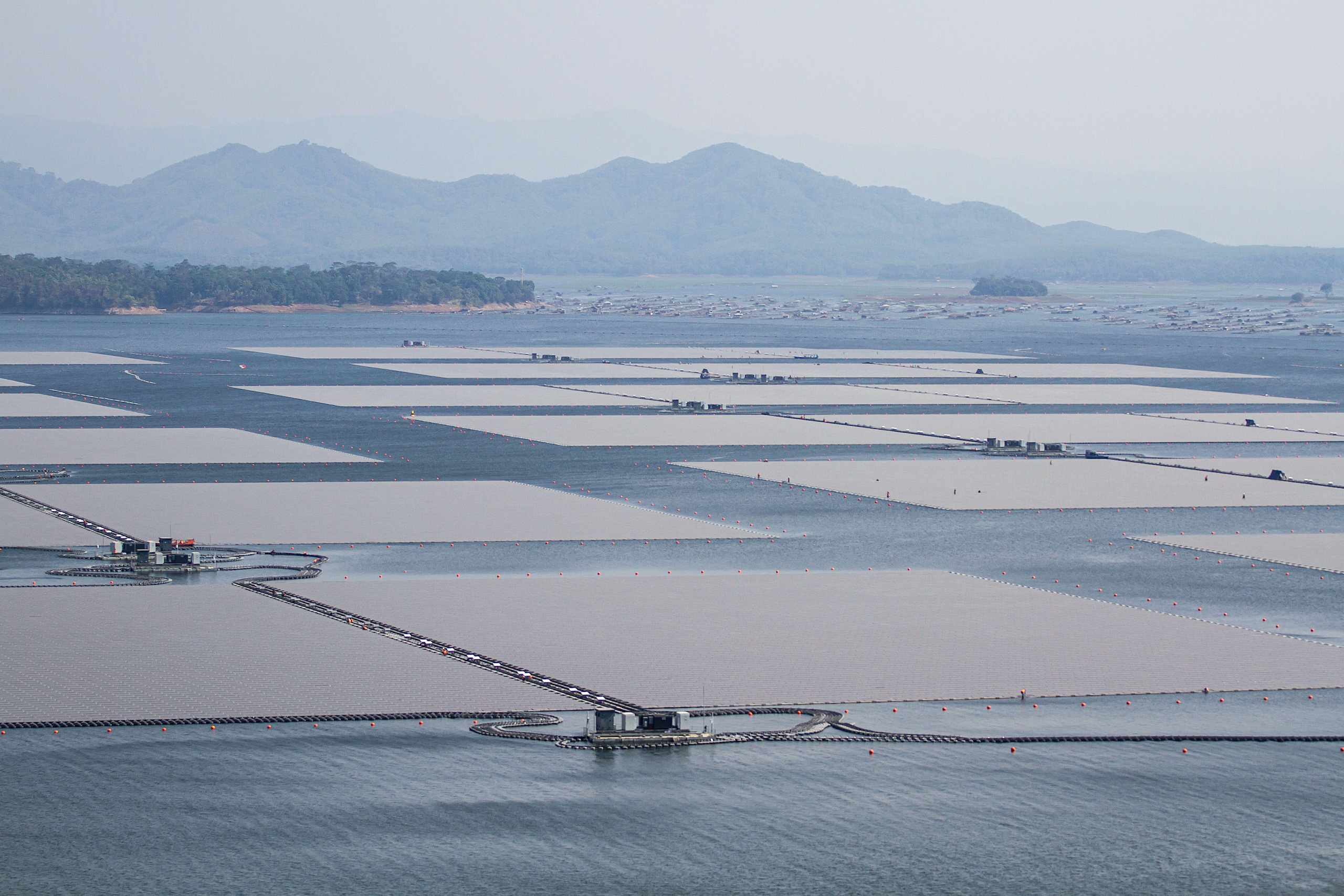
The US hardening, then, was fuelled not only by mounting calls to protect its manufacturers and workers from foreign competition, or a president who calls tariffs “the most beautiful word”, but also by intensified strategic competition over the energy technologies of the future and the components they require. So when a US Department of Commerce investigation found that Chinese solar firms operating in Cambodia, Malaysia, Thailand and Vietnam were receiving subsidies and “being dumped into the US market”, it is unsurprising that the response was sharp.
Nor is it surprising that Chinese leader Xi Jinping hit back, repeating that “there are no winners in a trade war”. But Xi’s response did not end there. In mid-April, he visited Vietnam, Malaysia and Cambodia in his first overseas trip of the year, not only to reassure Southeast Asian partners of China’s support amid the Trump-induced chaos, but also to deepen the country’s economic, political and security relationships in the region, building again on a longer-term geopolitical project around China-centric regional integration, seen in the Lancang-Mekong Cooperation framework. This included a raft of new deals – 45 in Vietnam, 37 in Cambodia and 31 in Malaysia – around infrastructure, green production, supply chains and more.
Similarly, Xi didn’t lose time in positioning China not only as champions of continued trade and integration, but also climate cooperation. In April, he appeared at a virtual UN summit ahead of the COP30 climate talks in Brazil, implicitly referring to the US as he reaffirmed that “China’s actions to address climate change will not slow down despite global political developments”, and emphasised his country’s continued commitment to the Paris Agreement – a treaty once underpinned by US-China cooperation and made possible partly by the falling price of low-carbon technologies that China’s industrial policy helped to realise.
New nexus
What does this mean for climate progress? First, that understanding its future in emerging markets – those making crucial decisions today about their economies, whether on the African continent, in Latin America, or Southeast Asia – requires a closer watch on trade, finance and geoeconomics, with a particular focus on China and the stakes of emerging and heightening US-China competition. Second, that in an increasingly fractured and disordered world, if the hope for coordinated global action embodied by institutions such as the UNFCCC, for example, feels ever more distant – that’s because it is.
Yet, forces of decarbonisation – seen in continued deployment and competition around renewable energy, EVs and more – are afoot. To a remarkable degree, the power of the nation state, and the technological forces it can help to unleash through aggressive action, are also undisputed. In this context, climate strategies that take as their starting point not multilateral consensus and planetary governance but a state-centric approach – with an emphasis on national security, border tariffs, and industrial policy – become increasingly relevant.
Take, for example, the approach proposed by two US Republican senators in April. The Foreign Pollution Fee Act proposed by senators Bill Cassidy and Lindsey Graham has found support not only from climate groups, but also from industry seeking protection for US manufacturing in competition with China. “There’s a nexus between climate, national security, economic security and energy policy,” said Cassidy. “If you set up a policy which simultaneously addresses this nexus, then you can achieve all four. And that’s the goal of this policy.”
If this sounds consonant with China’s approach, it’s because it is. China’s national energy strategy is dynamic, but has never abandoned a focus on security, defined in terms of self-sufficiency for national security, rather than interdependence and imports for flexibility. In sum, we can take seriously Xi’s words to oilfield workers in 2021 that the country must “ensure that its ‘energy rice bowl’ remains in its own hands”, and note that China at the same time seeks to transform, particularly through renewables, into an “electrostate” that substitutes molecular fuels with electrons.
A new world of climate politics is emerging. It does not mean an end to global decarbonisation, but foregrounds the role of the state, international trade and its discontents, and the geopolitics that runs through that, rather than the multilateral fora of the last decade. In this new world, what role does China, a developmental state at the heart of global energy transitions, trade and production, play? As its economy slows and countries demand greater commitment to value addition and technology transfer, might China redouble its efforts in a “Marshall Plan” based on green production? Or, as Trump and the “vibe shift” sees a dramatic rollback in global commitments and focus on ESG, will Chinese financial institutions and companies beat a similar retreat?
Working out answers to these questions is now central to understanding the new world of climate politics. The urgency of doing so couldn’t be more important.