


The earthquake that blighted Nepal on April 25, killing thousands and razing dozens of heritage structures, highlights yet again the importance of being prepared for a disaster.
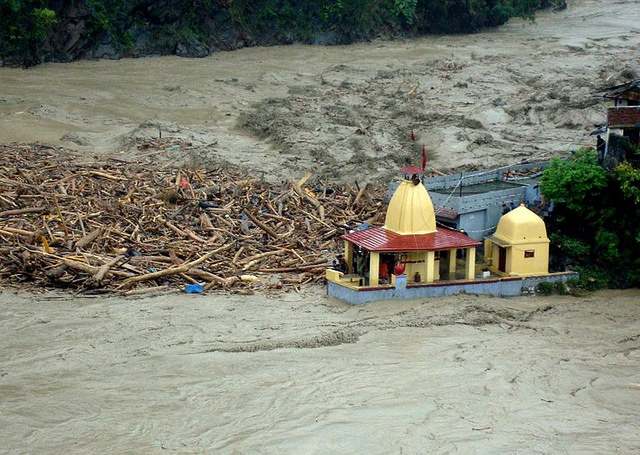
Another such catastrophe had unleashed widespread devastation across the north Indian state of Uttarakhand in 2013 when floods affected almost all rivers flowing down the central Himalayas.
Over 100,000 people were trapped and had to be evacuated by the Indian Army from across the 37,000 sq km, one of the largest such operations undertaken in the country. The mountains of Uttarakhand – also known as Devbhumi (or Land of the Gods) due to the many Hindu temples and pilgrimage centres dotting its landscape – remained cut off from the rest of the country for weeks. Property worth millions was ruined – insurance companies put the cost of claims at about $170 million.
Safety fears
Those fears have returned to haunt many as the Kedarnath pilgrimage, part of the four-destination Char Dham yatra, that involves a trek up to 11,755 feet to the sacred portals of the Himalayan shrine, got underway last week. The Kedarnath shrine, located near the Chorabari glacier, draws thousands of devotees each year between May and September.
Despite its vulnerability to natural disasters, the scenic state lures millions of tourists every year, mainly pilgrims or adventure seekers. However, due to safety concerns following the floods in 2013, tourist inflow plummeted to 21 million in 2014 from 28 million in 2012, according to state government figures.
The devotees’ lurking fear about the safety of the pilgrimage has galvanized the state machinery to protect its religious tourism industry, the state’s mainstay. “After the devastation of 2013, we took into account nature’s warning and have put in place various measures to ensure a safe and enjoyable journey for all pilgrims visiting the state. We are well-prepared to tackle any untoward incidents,” Uttarakhand Chief Minister Harish Rawat said last week.
Rawat announced the implementation of a three-tier protection system to check floods, four new helipads at pilgrimage sites and biometric registration counters at entry points on all pilgrimage routes. Five base camps, 48 wayside amenities and 12 night shelters for the devotees are also being installed.
State neglect
Following the 2013 catastrophe, a committee set up by the central government created a billion-dollar reconstruction corpus for a period of five years, to be funded jointly by the central government, World Bank and the Asian Development Bank.
Despite such endeavours, experts feel that the 2013 devastation will probably reduce the number of visitors to Kedarnath and other Himalayan shrines this year. “The measures being implemented currently can’t suddenly undo years of neglect in the state where the government is known to wake up only when the situation is calamitous,” says ecologist Vikram Soni.
According to Soni – who works with non-profits on non-invasive solutions for the planet – the Himalayas need special care as they are not only the youngest but also the highest mountains on the planet. “The mountains are steep, but also very weak and fragile, mainly made of amorphous shale, held together by forests of sal in the foothills, pine, oak and conifers. They are susceptible to injury and once injured, it’s almost impossible to stem their bleeding.”
The Kumaon and Garhwal regions of what is now Uttarakhand had 80 km of roads when India became independent in 1947. Today they have around 35,000 km. “This indiscriminate rollout of roads has little planned drainage and is invariably blasted through,” Soni said. “There is a shale bleed every few km on most roads. Such bleeds never recover and this has been a continuous process for over half a century.”
The expert emphasized that Uttarakhand was also paying the price for rampant construction of dams which divert water through huge tunnels under the hill to run turbines and then back out to the river. This needs huge infrastructure networks of roads and tunnels, accomplished by blasting which makes the region even more vulnerable, he added.
In one of its first reports on the Uttarakhand floods, the National Institute of Disaster Management blamed “climatic conditions combined with haphazard human intervention” in the hills for the disaster. Despite having a separate Disaster Management Ministry, the report noted, the state administration has carried on relentlessly to bolster tourism at the cost of the ecosystem.
In April 2013, a Comptroller and Auditor General Report observed that the Uttarakhand State Disaster Management Authority, which was formed in October 2007, had not yet met. Nor did it have mandatory “rules, regulations, polices or guidelines”, prerequisites for the authority to have functional existence.
A study by experts at the Indian Institute of Technology, Roorkee, found that Uttarakhand’s traditional construction styles had gradually been eroded by unplanned multi-storied buildings which are wreaking havoc on the mountains. Coupled with the region’s natural vulnerability to flash floods, this makes all structures highly susceptible to being swept away by torrential rains or floods.
Tourism as jeopardy
Experts say promotion of the state as a tourist destination is jeopardizing sustainable development. Exponential growth in infrastructure and transport vehicles ferrying tourists is especially disquieting. The number of vehicles registered in the state jumped from about 83,000 in 2005, to 180,000 in 2012, according to official data. Scientific studies have established a direct causal relationship between a spurt in tourism and higher incidence of landslides.
Road construction has had another undesirable fallout – the state is getting rapidly losing its green cover due to indiscriminate tree cutting. Other activities such as building construction, mining and hydroelectric projects are worsening the situation.
The National Mission for Sustaining the Himalayan Ecosystem – one of the missions under the National Action Plan on Climate Change – had made a recommendation for protection of areas around Uttarakhand’s four main pilgrimage sites, Gangotri, Yamunotri, Kedarnath and Badrinath, by creating buffer zones.
The mission document said construction of roads should be prohibited for a radius of at least 10 km from protected pilgrim sites. Frenetic construction work continues in total disregard of the guideline.
“The construction boom in Uttarakhand has also encouraged rampant illegal mining of sand and boulders from riverbeds, which causes a river to change course,” explained Shashank Shekhar, professor in the department of geology at Delhi University.
“The state government needs to regulate the construction activity in the seismically fragile Himalayan region and also monitor the number of pilgrims to the Himalayan shrines for better management. Involving and training all stakeholders for disaster management is urgently required.”
Soni paints an apocalyptic picture if environment protection rules continue to be flouted. “The government is so taken in by economic growth that it has forgotten that the health of the Himalayas and its rivers are our lifeline.”