



After hard-fought negotiations that continued more than a day beyond schedule and sometimes stalled for hours over a single word, a global deal on climate finally emerged in Warsaw last weekend. But at best, it can termed a baby step in countering climate change, clearly insufficient as greenhouse gas concentrations in the air are increasing rapidly, while weather-inflicted disasters are getting more frequent and more severe.
Both developed and developing countries have made compromises on key climate negotiation issues to keep afloat a semblance of united action to counter climate change and to stay on schedule for an expected 2015 deal for stronger action planned after 2020. But doubts and debates remain. The United Nations Framework Convention on Climate Change (UNFCCC) – which organised the annual climate summit in Poland’s capital – has stated that the Warsaw deal would “keep governments on a track towards a universal climate agreement in 2015.” UN Secretary-General Ban Ki-moon also called the result “an important stepping stone” towards a future global climate pact.
A deal on how to compensate developing countries for the loss and damage caused by climate change effects had been the major focus in Warsaw, prodded by the massive destruction in the Philippines caused by Typhoon Haiyan the week before the summit. But due to consistent opposition from developed countries led by the US and Norway, this deal proved the most difficult. Finally a new “Warsaw international mechanism for loss and damage associated with climate change impacts” was created to provide expertise, action and possibly aid.
Developed countries managed to resist a completely independent mechanism with financial independence – as demanded by developing countries – and kept the mechanism under the Cancun Adaptation Framework, at least for now. Developing countries were not happy, and spent hours trying to get rid of the word “under”, but finally accepted it in exchange for a phrase in the final text which said loss and damage are sometimes “more than” what can be handled through adaptation.
Developing countries had gone to Warsaw determined to get money from developed countries to deal with climate change, but came away empty handed, apart from a draft text that merely urged developed nations to set “increasing levels” of aid as well as “a review” every two years. As of now developed countries have committed to providing US$10 billion every year until 2020 when the amount will be increased to US$100 billion per year. Right now, a Green Climate Fund set up at an earlier summit has hardly any money.
Developed countries had major frustrations too. They wanted a clear roadmap to a deal in 2015 under which all countries – developed and developing – would commit to control greenhouse gas (GHG) emissions after 2020. GHG emissions are warming the air and changing the climate. But under pressure from large developing countries led by China and India, the word “commitments” to control emissions was changed to “contributions”. That makes it voluntary rather than mandatory.
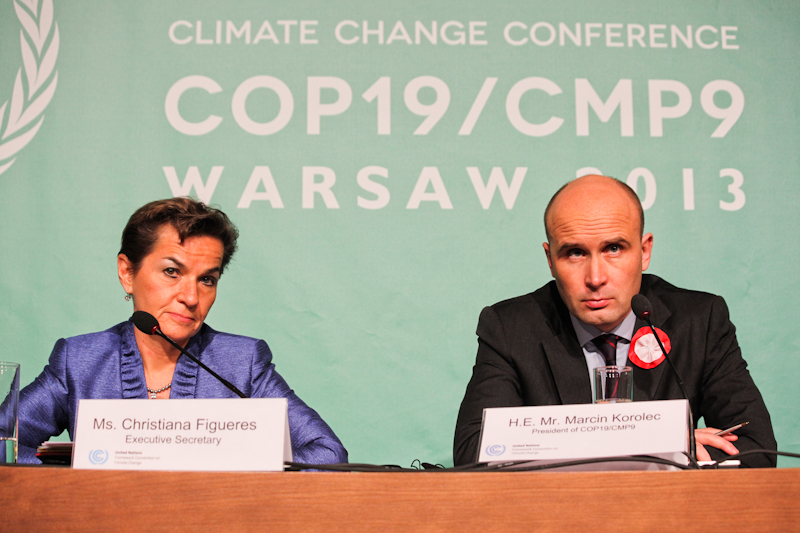
Still, “Warsaw has set a pathway for governments to work on a draft text of a new universal climate agreement so it appears on the table at the next UN Climate change conference in Peru. This is an essential step to reach a final agreement in Paris, in 2015,” said Marcin Korolec, president of the 2013 conference.
Governments have been asked to work domestically to finalise their intended national emission control contributions towards the 2015 agreement. The final draft saw agreement on various other climate sectors but little headway in actual terms.
“I know it’s difficult when nearly 200 countries, vastly different in character, interest and status, are involved in a deal but I wish the countries could have been more proactive when the greenhouse gases are still increasing and the future of the world is at stake,” said a climate expert in Warsaw.
“It is the barest minimum that was supposed to be achieved at Warsaw on loss and damage anyway,” said Harjeet Singh of the NGO ActionAid.
Chandra Bhushan of New Delhi-based think tank Centre for Science and Environment (CSE) alleged that developing countries gained little from the climate talks and differentiation between developed and developing countries had been further diluted. “Without any clarity on finance the proposed loss and damage mechanism has been a hollow one; long-term finance (also) continues to remain an empty shell,” he said.