![<p>An aeriel view over glaciers in the Karakoram Mountain range [Credit: NASA Johnson]</p>](https://dialogue.earth/content/uploads/2017/08/9776750541_3979baa359_o-1024x675.jpg)
In most alpine areas, scientists are concerned that global warming and retreating ice will swell glacial lakes and increase the risk of floods downstream. In the Karakoram Mountains of northern Pakistan, the remote Shimshal Valley has the same concerns, but for a somewhat different reason.
Several of the glaciers that flow into this valley surge, meaning that they cycle through periods when they flow forward several times faster than usual. As the valley is narrow, surging glaciers regularly dam the river that runs through it, creating flood hazards. Floods occur when water pooling up behind the tongue of the advancing glacier suddenly breaks through the natural ice dam and cascades down the gorge.
Several glaciers flow into the Shimshal Valley perpendicular to the flow of the river, and they have little room to move before they intersect with the water. In recent decades, the four glaciers most prone to blocking the river have been the Khurdopin, Yukshin Gardan, Yazghil and Malungutti.
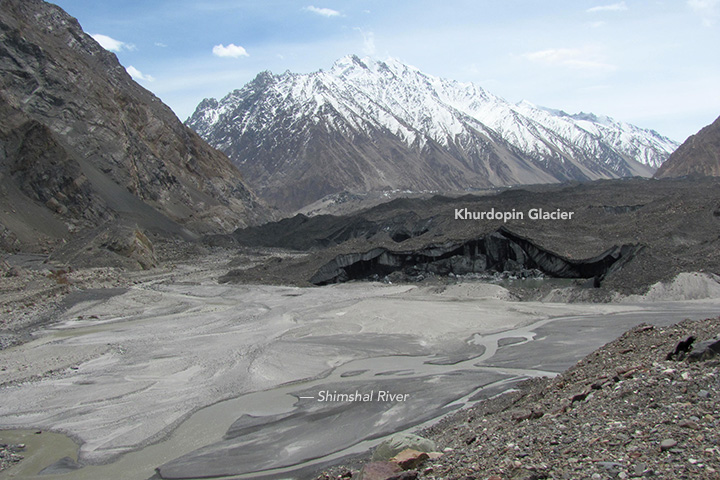
Of these, Khurdopin has surged most recently. After years of little movement, the glacier began a rapid advance in October 2016, accelerating to a rate of roughly 20 meters (65 feet) per day by the spring of 2017 — one of the fastest rates observed for a glacier in this region. As ice and sediment pushed into the river, a sizable lake pooled up in March 2017.
Jakob Steiner of Utrecht University and the Mountain Hydrology Group has been monitoring the growth of the lake using imagery collected by Landsat 8 and Planet Labs, a commercial satellite company. By July 2017, the river had carved an outlet through the glacial debris before the lake could grow extremely large, but Steiner’s group continued to keep a watchful eye because of how much debris the glacier pushed into the river. The surge increased the thickness of the end of the glacier by as much as 80 meters (260 feet), according to Steiner. The photograph above, taken by Waheed Anwar of Focus Pakistan, shows the tip of the sediment-coated glacier pushing into the river on May 15 2017. The camera is pointed upstream toward Khurdopin glacier.
Read more: Experts explore reasons for glacier collapses in Tibet
The rapid draining of even a relatively small lake can have dramatic consequences downstream. In late July 2017, the size of the lake dropped from 100,000 square meters to about 40,000 square meters in a few days — a rapid enough change to produce a flood downstream that damaged bridges, farmland, and a key road. By August 3 2017, the lake had completely drained. The flooding and road damage left hundreds of people stranded in the Shimshal Valley awaiting evacuation by helicopter.
Historical records show that surging glaciers have triggered at least 20 of these glacial lake outburst floods over the past century, making the valley one of the most vulnerable in the Karakoram Mountains. Past floods have caused damage with such frequency that villagers in the river towns of Pasu and Shimshal established a beacon warning system. In the spring, more than 30 outposts were set up on visible hillsides along a 90-kilometre span of the gorge. When a flood occurred during the night, the outposts lit a series of bonfires to warn people downstream. During the day, they used the sound of gunfire to pass the message. The system has been replaced with cell phones, but the service is spotty enough in this valley that floods still sometimes take people by surprise.
Surging glaciers are not the only cause of flood hazards in this area. In the nearby Hunza River Valley in 2010, a massive landslide blocked the river and created a large lake. Though the lake now flows over the dam, the possibility that this natural dam could eventually breach elevates flood risks for towns and villages downstream.
This blog first appeared on NASA Earth Observatory.
![A flood affected resident of Jakhalabandha, Assam on the south bank of the Brahmaputra being evacuated on a raft on August 13, along with the family's livestock [Image by Biju Boro]](https://dialogue.earth/content/uploads/2017/09/Jakhalabandha-flood-300x200.jpg)