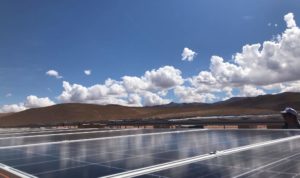
Researchers have found the costs of solar power to be lower than local grid power in all 344 Chinese cities they studied, even without subsidies. And in 76 of those cities, the price of solar power is equal to or below coal-fired power.
The competitiveness of solar varies from city to city mostly because of differences in sunlight, coal prices, power market prices and solar investment costs.
The researchers, from Sweden’s KTH Royal Institute of Technology, calculated the costs of large (more than one megawatt) distributed solar power generation – where power is produced at or near the point of use – and compared these with local grid-power prices and the price which coal-fired power generators sell electricity to the grid. (Local grid prices include generating and distribution costs, profits, government funding and surcharges. While generator-side prices entail generation costs and generator’s profit.)
Unsubsidised renewable energy is increasingly matching the cost of fossil fuel energy in what’s known as “grid parity”. At this tipping point, far more investment will in theory flow into clean energy. Investment in renewables is no longer simply the “moral choice”, made for climate and environmental reasons, but it many cases the most profitable way to go.
Tao Ye, deputy head of the China National Renewable Energy Centre, cautioned that some of the variables in the researchers’ calculations are uncertain. Coal-power generators may have some scope to lower the price of the electricity they sell to the grid, undercutting solar. Also, obtaining land or rooftops for solar panels can increase costs.
How the government helped solar
The major early goal of China’s solar sector was to supply power to rural areas and reduce poverty. Now, after three decades of growth, China has twice as many solar panels installed as any other nation. The decreasing costs of new solar are in large part due to supportive government policies. Since 2000, the Chinese government has put more than 100 pro-solar policies in place.
For example, in 2013 and 2014 the State Grid and the National Energy Administration removed some of the barriers small-scale solar generators faced in starting up and expanding. Concentrated solar farms, which use mirrors to focus sunlight, were provided with subsidies, and distributed solar generators received subsidies. Such incentives rapidly increased China’s installed capacity from six gigawatts (GW) in 2011 to 170GW by 2018, of which 29% was distributed solar.
In fact, incentives for new solar proved so popular that the central government decided to slash them in 2018. This rocked the sector, but led to more independent growth.
Tao Ye said: “20% of the new solar capacity added in 2019 has been at grid parity or better; the target for 2020 is over 35%.” And with the grid struggling to take power from concentrated solar farms in western China, distributed solar closer to power markets in the more developed east has become more popular. In 2017 alone, 19.4GW of additional distributed solar power capacity was installed – as much as in the previous three years combined.
What are the difficulties on the supply side?
Unstable power generation is viewed as a bottleneck holding back the long-term development of renewables. Zhang Shuwei, chair and chief energy economist at the Draworld Environmental Research Centre, thinks that’s no reason for the grid to decline to take renewable power. Renewables were always about reducing emissions not balancing the power system, and the role of the grid is to handle those fluctuations and uncertainties, he said.
Another bottleneck is land availability. That’s why distributed solar, which can utilise rooftop space, is regarded as having the potential to save companies huge amounts of money – especially large power consumers such as technology parks, industrial firms and data centres. But current policies hamper development of rooftop solar installations as property rights are unclear and companies struggle to find ones to use.
Another obstacle to renewables development is that companies cannot currently choose where to buy their power from. Li Jian, energy director with GDS Services, an operator of large-scale data centres, said that businesses hope market reforms in the power sector will allow energy users of various types and sizes to participate directly in the power market, and choose where they source their power.
![Huge amounts of electricity are created in Kinnaur, but most villages have to deal with extended power cuts [image by: Subrat Kumar Sahu]](https://dialogue.earth/content/uploads/2019/03/electricity-300x169.png)
![CO2 emissions by type of coal plant [Source: NRDC]](https://dialogue.earth/content/uploads/2019/03/graph4_cropped-300x183.png)