Bill McKibben is an American environmentalist and founder of the campaign group 350.org
chinadialogue: Why have US environmentalists moved away from their initial support for shale-gas exploitation?
Bill McKibben: More data has emerged on many fronts. One, the extent of damage to water supplies has become clearer, and also the threat of associated damage like earthquakes. Protesters in Youngstown Ohio recently chained themselves to fences to try and stop more wastewater injection into wells there, because on New Years Eve it triggered a whole swarm of earthquakes.
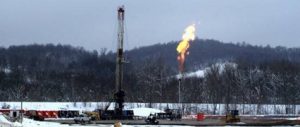
Two, the methane that leaks from the fracking process [used to extract the shale gas] has been estimated in some studies to be high enough to make it worse for the climate than burning coal. Three, even if no methane leaks, widespread fracking seems likely to undercut the push for renewables, and the International Energy Agency has said that a gas-dependent world would still have 660 parts per million CO2, a figure that is much too high.
cd: Many have linked the US problems to poor regulation, while a recent report from the UK’s Royal Society has said fracking is fine as long as it follows strict rules. Is regulation the crux?
BM: No, I think the crux of the problem is that this is one more carbon-based fuel. Also, that there’s incredibly large amounts of money behind it. Increasingly in the US, the biggest oil companies – Exxon especially – are buying up these leases and starting to produce more gas. And of course they have enormous power over government policy.
cd: So what approach do you think China should take to fracking? Would you recommend a moratorium?
BM: I think it’s a chance to learn from the experience of the west. I’d recommend examining it closely. My home state, Vermont, has just enacted a ban on the practice, in part because of concern about our water. I know that China is deeply concerned about its water supplies. [See "Will China exploit its shale gas?" for more on the debate within China]
cd: Some claim coal accounts for as much as 20% of China’s water use. Fracking also uses water and Chinese reserves are concentrated in the arid far-west. So how should we analyse the water footprint of fracking vis a vis coal?
BM: This is a case-by-case question, dependent on the geology. With fracking, you are left with large quantities of wastewater to dispose of, which has proved very tough in the United States. In the US, there have been streams where every fish died, and rivers where hundreds of thousands of people were told to find alternative sources of drinking water. Local sewage-treatment plants have been overwhelmed trying to treat the wastewater.
cd: Even so, people have argued that shale-gas could provide an interim solution for China as it seeks to wean itself off coal. Could this work?
BM: I think it’s pretty clear that what we need is an all-out push towards renewables, and here of course China has become a leader. The potential was illustrated in Germany last month, when one day the country generated more than half its power from solar panels within its borders.
cd: Is there a reliable way of estimating how much of the shale-gas reserves are in fact extractable and at what cost, financially or environmentally?
BM: The estimating process seems very shaky. In the US, one study will say we have “100 years of gas” and the next says “it’s actually 20 years”. A problem, of course, is that the estimates are often driven by commercial needs, as companies try to sell off the drilling leases they’ve acquired.
cd: Gas appears to have changed the energy discussion in the US – people are starting to write about exporting energy again and the return of America as the world’s major power. Is this just another gold rush or are these arguments sound?
BM: They seem to me to miss the real point, which is that our number one job as regards energy now must be to avoid global warming. In that sense, the rise of unconventional forms of energy has been a real distraction. But it’s coming at an odd time, as weather events are making more Americans worried about climate change. So, it’s hard to tell how it will all work out.
As I’ve said, I don’t think [unconventional gas] is that transformational. It’s one more way to avoid actually having to grapple with our central need, the transition to a renewable energy society.
Homepage image by The Aspen Institute