In the southwest corner of Britain, where the mighty River Severn flows into the Atlantic Ocean, a small but significant battle rages over energy and the legacy we leave for future generations.
For a thousand years people have trudged down the long lane that leads through windswept coastal farms to the headland of Hinkley Point, where a fresh water spring bubbles up beside an ancient burial mound. Within living memory villagers believed the water had curative powers and was protected by the spirits of the mound. But in the 1960s two nuclear power stations, Hinkley A and B, were built on the site. The Neolithic mound was fenced off, the lane became a driveway for nuclear workers, and the sacred well was covered by their car-park.
Read also: Nuclear waste: the 270-tonne legacy that won’t go away
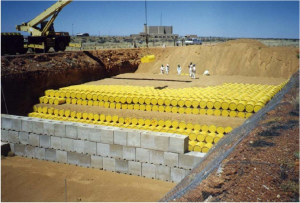
Now the two stations are at the end of their operational lives, but central government is supporting plans for French energy giant EDF to build a massive new nuclear plant on adjacent farmland. For the government, it looks like a way to cut carbon-dioxide emissions while still expanding the power supply. For those of us who live in Somerset county, it looks like a massive new hazard on our doorstep, a Fukushima waiting to happen, a bottomless drain on public funds and a future radioactive waste dump for our grandchildren.
If it is built, it will only be because it has been steamrollered over us. So the lane is seeing another kind of traffic now, as police vans monitor coach-loads of protesters opposing the plan with blockades, trespass and illegal camps.
Public consultation “a sham”
Because the government declared a “National Policy” to build 10 new nuclear plants in Britain, with Hinkley C as one of the likely sites, most local officials feel powerless to resist. They pressured the reluctant landowner into selling the land, then gave EDF permission to begin ripping it up before the project has even been given the go-ahead. Ancient oak woodland has been felled, historic buildings have been demolished and precious wild-life habitats destroyed to make way for the biggest building site in Europe.
Meanwhile, government created a new “consultation process”, replacing the old democratic form of public hearings with a National Planning Inspectorate. They will record your objections – so long as you submit them correctly in writing and don’t question the safety, toxicity, cost or necessity of nuclear power and its radioactive waste products. This reduces local representatives to showing their resistance through wrangles over bits of road widening or costs to the public purse. People believe that the decision has already been made and the consultation is just an expensive sham.
In the wake of the Fukushima disaster, 10 of us dodged security guards in February 2012 and entered the proposed development site to occupy an abandoned farm. We claimed squatter’s rights, raised anti-nuclear banners and flags, talked to the press and TV, broadcast on the internet and invited others to visit us. After three weeks, EDF took us to the High Court and asked the judge for an injunction to forbid all protest at Hinkley C. They didn’t get the blanket ban they wanted, but did get an eviction order against the people at the farm. Some of us will now face prison if we are seen going back on the site.
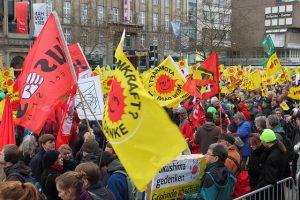
None of this has stopped a growing tide of protest. A blockade by 1,000 people in the spring was followed by mass trespass and disruption to site preparation this autumn. Although the police were mobilised in force, they mainly stood by and chatted pleasantly while filming us, as it is their job to intervene only if there is violence or property damage. They have enjoyed watching us repeatedly outwit the private security guards and dogs patrolling the site.
Read also: Chinese nuclear industry goes global
Many of the police are on our side in their hearts. They are local people themselves, with families who would face evacuation and contamination if there were a nuclear accident, and with children whose great-grandchildren will have to take care of the highly toxic radioactive waste dump which will be remain long after Hinkley C has stopped generating electricity. Recently at a roadblock one officer explained to me that the sea at Hinkley Point has the second highest tidal range in the world and is an ideal place to harvest marine energy – but state investment is lacking. Where nuclear is concerned though, the government now says it may underwrite the construction and fix the electricity price for EDF if that is what it takes to secure enough corporate or foreign state investment to keep the project afloat.
The British state has a historic attachment to nuclear power as a source of nuclear weapons material and a centralised power system that requires secretive control. While no one seriously doubts the need for urgent and rapid action to cut carbon-dioxide emissions to prevent climate change, MPs have questioned the way the decision to use such hazardous technology was made when renewable energy options of wind, sun and wave-power also exist. They believe that nuclear industry lobbyists have corrupted the democratic process. Even at a local level, the press rely so heavily on money from EDF’s advertising that they have effectively become propaganda sheets for the Hinkley C project.
Economic and environmental “blackmail”
Thanks to our protests on the one hand and the reluctance of investors to commit on the other, the nuclear edifice has now begun to crack. Eight of Britain’s 10 planned new-nuclear projects have stalled. But it is still an uphill struggle to challenge such large-scale construction when it has full government backing and a supposedly “green” justification. Local people feel trapped. Their resistance is softened by cash handouts from EDF to the community – a kind of legal bribe – and the promise of jobs. One local teacher told me she wanted to visit our camp but felt she couldn’t as EDF had given money to her school.
Economic and environmental blackmail makes people reluctant to speak out. “Don’t tell anyone in the village I was here,” said one man who brought supplies to our farm occupation, and he was typical of many. But through direct action and social media, campaigners are making local resistance more visible and inspiring self-confidence. At a recent rally in nearby Bridgwater town, we showed that there are alternative ways to cut CO2 while creating a million new “green” jobs. We also brought survivors from Fukushima to remind workers of the terrible cost communities must pay when nuclear goes wrong. As a former senior engineer from the Hinkley B plant explained to the rally, such human mistakes are always possible when there is strong financial pressure to cut corners in construction and no genuine public scrutiny.
Climate change is global, and tackling it will require global solidarity. Globally also, Fukushima has reawakened ordinary people to the hazards of nuclear power. We have had visits from Indian and European campaigners, and we know that our common future lies in the hands of the larger so-called “emerging economies”, not with us. But hopefully we can play a small part here by successfully rejecting new-nuclear in Britain, while acting to leave our descendants a world which is as clean and safe as the world our ancestors left for us.
Theo Simon is an environmental campaigner and musician with UK band Seize The Day