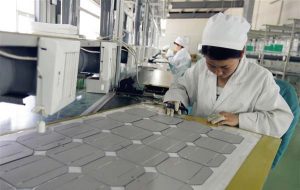
Washington think tanks are busily arguing that no one can stand up to Chinese mercantilist policies which promote standardised products at the expense of innovative new ventures competing in market niches.
But is China really the ogre that is destroying "the global energy innovation ecosystem"?
There would appear to be some prima facie support for such an argument when we look at US and European companies that have been developing innovative new solar PV cells.
They have had to succumb to Chinese competitive pressures in the past year.
Solyndra in the US had to declare bankruptcy. German Q-Cells had to sell off its CIGS subsidiary, Solibro (CIGS stands for Copper, Indium, Gallium, Selenide — alternative materials to silicon). Chinese power producer Hanergy snapped up the firm.
These are two cases where the firms were developing new CIGS "thin film" solar cells that would operate at slightly lower efficiencies, but much lower material costs, thereby promising decisive cost advantages.
There is no denying that the business promise of these kinds of solar cells was undermined by Chinese mass production of first-generation crystalline-silicon solar cells.
The Chinese indeed have driven the costs of the standardised products down so fast that the newer, lower-cost CIGS cells never had a chance to establish themselves in the marketplace.
Chinese support for renewable energy is determined, serious and relentless.
It is being pursued not primarily for reasons to do with climate change, but as a national energy security policy, to allow China to build its energy system without impinging on other countries’ fossil fuel entitlements and thereby threatening war.
It is a smart strategy that suits China. So how then should other countries respond?
The failure of tariffs and trade bans
The US government provides one way forward, by seeking to curb Chinese activities overseas and imposing trade sanctions (penalty tariffs) on Chinese-made imports of solar cells into the United States.
The EU, for its part, is threatening even broader sanctions, not just on PV cells but on modules and whole systems as well. Such tariffs are designed to curb sales of Chinese-made products abroad.
Both instruments are rather blunt, and already being circumvented by smart Chinese companies. They are building their manufacturing base in the US and are globalising their production activities and importing solar cells into the United States from non-mainland Chinese sources (e.g. Taiwan).
Moreover, the Chinese are perfectly able to impose the counter-tariffs on US exports of high-value PV components and materials, including pure-grade silicon (where the US currently runs a trade surplus with China).
These unanticipated consequences are likely to make the US trade sanctions relatively ineffective, while incurring severe displeasure from China, for which there will be a political price to pay.
The EU has also opted for a different competitive strategy.
The European market for solar PV systems was expanded through consumer subsidies, notably feed-in tariffs — in the expectation that German manufacturing industries would expand to supply the market.
As a market expansion strategy, this worked extremely well, allowing firms to benefit from cost reductions via the learning curve.
But, of course, it turned out that Chinese firms were the main beneficiaries in the absence of specific German industrial policies designed to grow a domestic market for German-owned and designed PV technologies.
Since Germany’s swing against nuclear power in 2011/12, there has been a revival of German industrial policies designed to boost what is left of the solar PV cell manufacturing sector, with (so far) positive results.
Ultimately, there is only one effective response to the serious competitive threat posed by China’s strong support for renewables and that is equally strong support for innovation and market expansion by Western countries.
Where is the West’s support for its own renewable industry?
China targets well-established and standardised technologies for rapid scaling-up and diffusion (such as first generation crystalline solar PV cells), and does so very effectively.
Other countries can place reasonable curbs on China’s imports (regulating that they remain below a certain threshold, in line with WTO stipulations), while actively supporting and building innovative alternatives to China’s standardised products.
It was open (and still is open) to the US, EU and Japanese governments to opt for policies to rapidly build the market for new, thin-film CIGS solar cells (through producer subsidies and government procurement, both allowable under WTO rules).
That would ensure that they achieve cost reductions that would keep them ahead of their first-generation crystalline silicon alternatives.
If the market for CIGS cells is grown fast enough, then CIGS technology will become the new dominant technology, with German, US and Japanese firms already occupying a strong position, and able to tweak the technology to drive further improvements.
Of course, Chinese firms would then switch to this new, dominant CIGS technology, driving costs and prices down as they do so — and so weaker German, US and Japanese firms would be driven from the market.
But stronger ones would maintain their position, particularly in supplying their domestic market, while they ramp up further innovative variations. And so the process will continue, from one technology generation to another.
Why don’t the US, German (EU) or Japanese governments pursue such an obvious counter to the Chinese competitive onslaught? In a word, because they are afraid of anything smacking of an "industry policy."
So powerful has the neoclassical objection to anything to do with promotion of some specific technology become (called "picking winners") and promotion of market expansion through government procurement (called "market interference") that policymakers are now afraid to propose anything along these lines.
The net effect of these ideological blinders is that they leave the field wide open to the Chinese.
This is the great-unanticipated consequence of the Western world’s turn to neoclassical ideologies — pushing privatisation and deregulation, and outlawing anything to do with industry policy. Why this was allowed to happen is another (and very interesting) story.
Think tanks like the Information Technology and Innovation Foundation valiantly struggle to portray "innovation" as the only way forward, and provide support for trade sanctions, under the guise that Chinese policies are "mercantilist" (and yet are no more so than those pursued by individual US states like California).
What they should really be supporting is a full-blooded counter to Chinese targeted industry promotion, through counter-targeting of new, innovative technologies and deliberate and determined market expansion, via instruments such as public procurement.
Then we would really see a flourishing of US renewable energy industries.
This article was first published by The Globalist