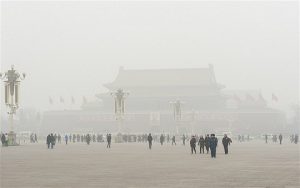
Vice environment minister Wu Xiaoqing has said more clean and renewable energy needs to be made available in the Beijing-Tianjin-Hebei triangle in order to reduce smog, according to a spokesperson from China’s Ministry of Environmental Protection (MEP), speaking at a press conference at China’s parliamentary gathering last weekend.
Unbelievably, he then went on to say that “central and western China are rich in coal and have more environmental capacity than the Beijing region. So we encourage those regions to produce synthetic natural gas to be used instead of coal in central and eastern regions. We also hope those regions will apply strict environmental standards to reduce pollution in central and western China.”
In other words: something’s gone very wrong with the environment in the east. There’s smog there because of coal-burning. To get rid of the smog we need to cut down on coal. Things in the west don’t look so bad, so we can use the coal there instead to make SNG, which is a bit cleaner, and send that east as a substitute for the coal. Problem solved, everyone cheers.
But the logic is flawed. Exporting the pollution will improve things in the east, but won’t it worsen things in the west? And more importantly, is turning coal into SNG in Inner Mongolia and Xinjiang and then sending it to be burned in Beijing actually more “clean” or “renewable” than just using the coal as fuel?
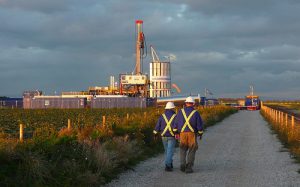
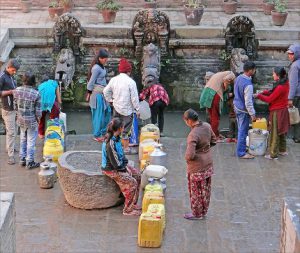
It takes six to 10 litres of clean water to produce one cubic metre of SNG from coal, with more waste water and carbon emitted than when coal is simply burned for electricity or heat. And this will happen in the north-west, in places like Inner Mongolia and Xinjiang, which suffer from water shortages and vulnerable environments.
The National Energy Administration has previously taken a cautious approach to SNG from coal and kept a tight rein on capacity. But last year, prompted by smog concerns, the NEA opened the gates and approved 15 SNG projects in a single year, while the next six months to a year are expected to see a wave of go-aheads for new nuclear power projects. In January this year NEA head Wu Xinxiong said that SNG output would reach 50 billion cubic metres a year by 2020 – a threefold increase on the earlier target of 16 billion cubic metres. And alongside Xinjiang and Inner Mongolia, other provinces including Shanxi, Liaoning and even Anhui are keen to take part.
Why no care for the west?
It’s not low-carbon, it’s not clean, it’s not renewable. It is uneconomic and inefficient. Coal has been disguised as “gas”, and the MEP’s stance of “strict control” in the east has been reversed for the west. Not only is it unconcerned about the overall environmental damage this will cause, it’s even spoken in support. It really is depressing.
And the logic behind the stance is even more worrying. The west still has environmental capacity – the attitude behind this term is that the air in the west isn’t bad enough yet, that there isn’t enough of a shortage of clean water, that the environment is not degraded enough. The aim is clearly not to improve the environment, but just to keep going until things are as bad as they can get. The MEP is just responsible for making sure all the waste water and gases emitted from those new factories meet the relevant standards.
The MEP is of course in a difficult position. It is excluded from budgeting and planning decisions, has no say in industrial output, does not dare be too strict with the polluters that are so important for local tax income, and generally does a difficult and thankless job. And it is these matters it cannot control which have created China’s environmental crisis. People ask why Beijing’s air is getting worse – look at how steel production has rocketed in Hebei in the last decade. Years of efforts to clean up air pollution in the region have been cancelled out.
At the Lianghui, premier Li Keqiang declared a “war on pollution” – a rare challenge and opportunity for the environmental protection sector. But a great leap forward in SNG production in the west is not the medicine needed. It is simply another pollution timebomb set ticking. This is no time to stand back and watch what happens. If it is to avoid picking up the bill for worse pollution in central and western China in the future, it is time for the MEP to say no to SNG.