Energy

China maps out development for the next five years

A summary of China’s greenest five year plan yet and its key environmental and energy targets
English
<p>(Image by dove lee)</p>

(Image by dove lee)

China has released its blueprint for the next five years. Early signs indicate its 13th Five-Year Plan is the most environmentally focused yet.

This complements the ​Chinese government’s broader goal of shifting to a more environmentally sustainable model of development and re-balancing the economy by moving away from investment in heavy industry towards consumer spending, services and innovation.

It also strengthens the commitments made by the Chinese government to transition away from fossil fuels, increase the share of renewables in China’s energy mix, and slow down its overall rate of energy consumption.

See also: Chinese NGO’s call for 13th Five-Year Plan to include climate adaptation.

The new targets will help China deliver its promise to reduce carbon intensity (the amount of carbon emitted per unit of GDP​) by 45%, an undertaking that was restated at the ​Paris COP21 climate summit in December​.

Ten out of the 13 mandatory targets contained in the final text relate to the environment, natural resources or ecosystems. ​

Of the targets relating to climate and energy, the most important four are:​

·         Reduce energy intensity (energy consumed per unit of GDP) by 15% compared with 2015

·         Reduce carbon intensity by 18% compared with 2015

·         Energy consumption ceiling set at 5 billion tonnes of coal equivalent (the current level is 4.3 billion tonnes)

·         The proportion of primary energy consumption derived from non-fossil fuels raised to 15%
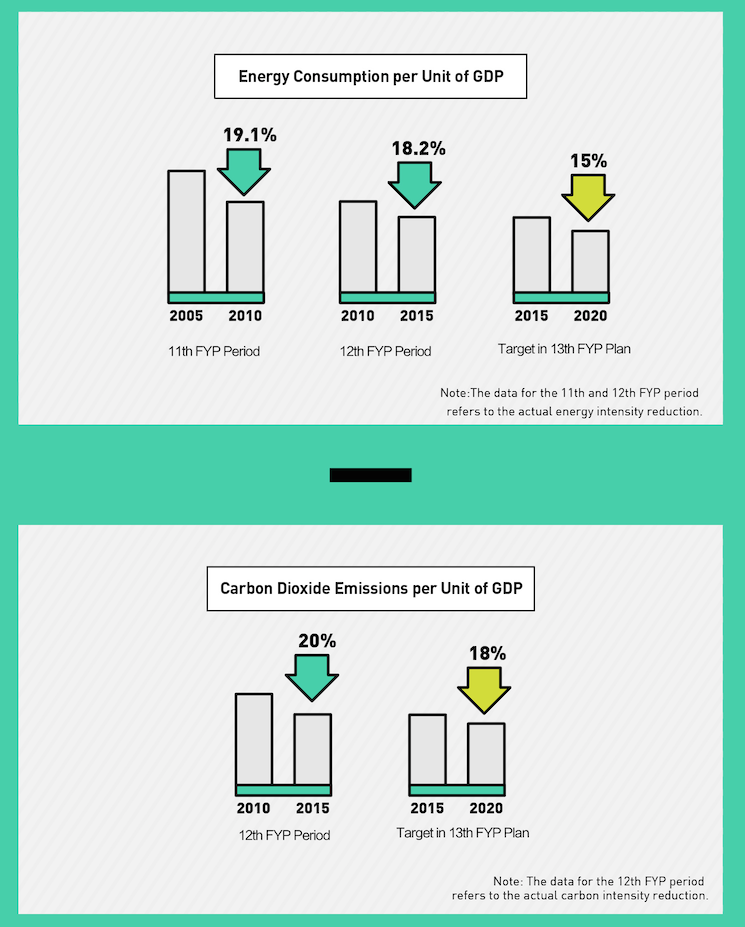
energy consumption per unit of GDP infographic

We asked Zhou Dadi, former general director of Energy Research Institute and vice chairman of China Energy Research Association, to put the new targets into context.

“The 18% carbon intensity reduction target indicates that China will reach the high end of its 2020 climate target of a 45% carbon intensity reduction (using a 2005 baseline).”

“I think overall, these are ambitious targets, especially when the drivers of economic growth and the structure of the economy are still in transition. However, I also think it is likely to overshoot. There will be a set of policies to follow that implement the targets. These will relate to pricing, taxation, energy standards and renewable energy portfolio standards.”

“The planning framework emphasises the development of nuclear and hydro power. This does not mean [other] renewable energy sources are not being prioritised. On the contrary, it undoubtedly means that non-fossil fuels are preferred and that coal will be weakened.”​

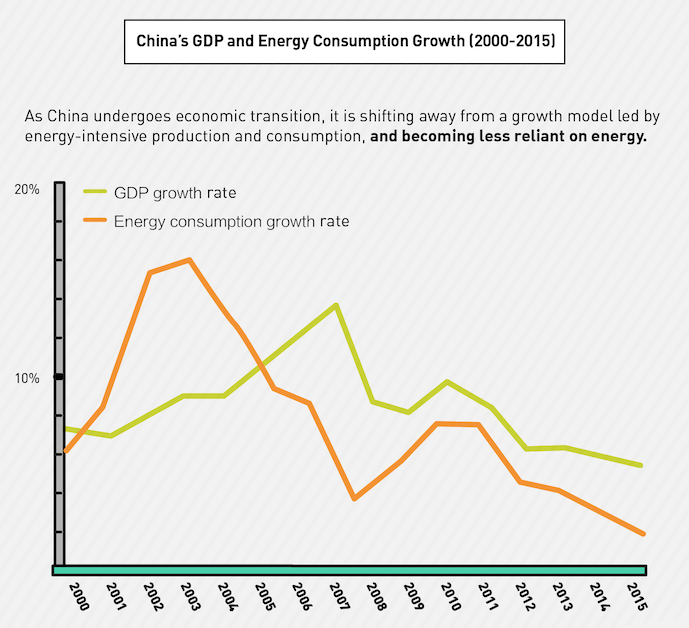
China's GDP and Energy Consumption Growth line graph. As China undergoes economic transition, it is shifting away from a growth model led by energy-intensive production and consumption, and becoming less reliant on energy

At a glance, the new plan is a continuation of the environmental protection efforts set out in the 12th Five-Year Plan (2011-2015), rather than a departure from it. In fact, both plans seem comparable in scope and scale. However, in certain aspects the latest plan goes further.

This is the first time in China’s history that a specific PM2.5 (the ​harmful particulate matter that contributes to air pollution) target has been included in a Five-Year Plan. Premier Li Keqiang indicated that the government will limit factory emissions of PM2.5 down to 25% of total output.

The premier also highlighted the ‘One Belt and One Road’ strategy as an important component of the country’s overseas development plan, which will give environmental enterprises new opportunities to “go global”.

To see chinadialogue’s full report on the 12th Five-Year Plan, please click here. ​

The full text is available in Chinese here. ​

With contributions from Monica Wang and Yu Jie
Cookies Settings

Dialogue Earth uses cookies to provide you with the best user experience possible. Cookie information is stored in your browser. It allows us to recognise you when you return to Dialogue Earth and helps us to understand which sections of the website you find useful.

Required Cookies

Required Cookies should be enabled at all times so that we can save your preferences for cookie settings.

Dialogue Earth - Dialogue Earth is an independent organisation dedicated to promoting a common understanding of the world's urgent environmental challenges. Read our privacy policy.

Cloudflare - Cloudflare is a service used for the purposes of increasing the security and performance of web sites and services. Read Cloudflare's privacy policy and terms of service.

Functional Cookies

Dialogue Earth uses several functional cookies to collect anonymous information such as the number of site visitors and the most popular pages. Keeping these cookies enabled helps us to improve our website.

Google Analytics - The Google Analytics cookies are used to gather anonymous information about how you use our websites. We use this information to improve our sites and report on the reach of our content. Read Google's privacy policy and terms of service.

Advertising Cookies

This website uses the following additional cookies:

Google Inc. - Google operates Google Ads, Display & Video 360, and Google Ad Manager. These services allow advertisers to plan, execute and analyze marketing programs with greater ease and efficiency, while enabling publishers to maximize their returns from online advertising. Note that you may see cookies placed by Google for advertising, including the opt out cookie, under the Google.com or DoubleClick.net domains.

Twitter - Twitter is a real-time information network that connects you to the latest stories, ideas, opinions and news about what you find interesting. Simply find the accounts you find compelling and follow the conversations.

Facebook Inc. - Facebook is an online social networking service. China Dialogue aims to help guide our readers to content that they are interested in, so they can continue to read more of what they enjoy. If you are a social media user, then we are able to do this through a pixel provided by Facebook, which allows Facebook to place cookies on your web browser. For example, when a Facebook user returns to Facebook from our site, Facebook can identify them as part of a group of China Dialogue readers, and deliver them marketing messages from us, i.e. more of our content on biodiversity. Data that can be obtained through this is limited to the URL of the pages that have been visited and the limited information a browser might pass on, such as its IP address. In addition to the cookie controls that we mentioned above, if you are a Facebook user you can opt out by following this link.

Linkedin - LinkedIn is a business- and employment-oriented social networking service that operates via websites and mobile apps.