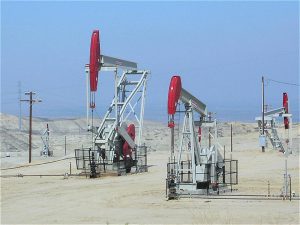
Ten of the world’s leading oil and gas companies met in London on Friday and announced plans to invest one billion dollars (6.8 billion yuan) in efforts to limit climate change, a move that was widely derided by environmental groups as inadequate.
The new joint-investment fund, OGCI Climate Investments, will invest over 10 years and is expected to lead to a reduction in carbon emissions of “a gigatonne or more,” according to the Oil and Gas Climate Initiative (OGCI). It will invest in four areas: carbon capture and storage (CCS), management of methane emissions, industrial efficiency, and transport efficiency.
The OGCI is led by the CEOs and chairpersons of 10 major state-owned and multinational oil and gas companies, and was established in 2014 to offer an industry response to climate change. It includes BP, Shell, China National Petroleum Corporation and Saudi Aramco, among others. Together, the companies account for 20% of global oil and gas production and 10% of energy supply.
“The creation of OGCI Climate Investments shows our collective determination to deliver technology on a large-scale that will create a step change to help tackle the climate challenge,” announced OGCI heads in a joint statement.
Taking emissions seriously
The timing of the announcement came on the same day as the formal entry into force of the Paris Agreement and just a few days before the meeting of governments in Marrakech, Morocco for the latest round of climate talks. Countries will this week discuss how to operationalise the pledge made in Paris to keep the global temperature rise to 2C or below.
To have a 50% chance of staying within a 2C limit requires global carbon dioxide emissions to not exceed 1,100 gigatonnes between 2011 and 2050. However, the United Nations Environment Programme last week released a report saying that emissions must fall by 25% on the predicted 2030 level, which amounts to 12-14 gigatonnes annually. In this context, a reduction commitment of one gigatonne from the OGCI over 10 years appears small.
Viewed in overall investment terms, the OGCI commitment also seems too limited. The International Energy Agency (IEA) estimated that global energy investment in 2015 was US$1.8 trillion, of which 45% was in oil and gas.
Environmental groups were quick to accuse the OGCI of lacking ambition. The new investment fund is “a drop in the ocean,” according to Jonathan Marshall, energy analyst at the Energy and Climate Intelligence Unit. “Investing US$1 billion over ten years averages to just $10 million per year per company involved,” he said.
The OGCI have said that the new fund is “just our starting point,” and will be leveraged through partnerships with other initiatives and the activities of OGCI members. “We will use the considerable convening and catalytic power of our expertise, facilities and networks to galvanize action both within our industry and beyond,” said an OGCI statement.
Too little, too late?
A major focus of the new fund will be reducing methane emissions, something the companies are doing anyway, and developing carbon capture and storage, and improving the efficiency of transport.
The transport sector is a particular concern for oil companies, with oil demand expected to fall and profitability to suffer. On November 1, Shell’s chief financial officer Simon Henry said on a conference call that oil demand is likely to peak before supply and that this could be as soon as five years away. One reason for this is the aggressive release timelines for zero emission vehicles announced by most major car manufacturers.
Almost all major car makers – representing combined annual sales in 2014 of over 65 million vehicles – have committed to zero emission vehicles. Volkswagen said it would target 20-25% of its vehicles to be zero emission or hybrid by 2025. Nissan committed to 20% by 2020, and Honda to 60% by 2030. Vehicle fuel provides at least 35% of gross revenue for the ten major oil producers, according to a new report by InfluenceMap.
There is also a growing push by cities to deal with air pollution from diesel and petrol cars, with a number of schemes proposed to restrict such vehicles from built up areas.
Whilst the OGCI’s focus on improving transport efficiency appears to be a defensive move to protect revenues, the focus on CCS should be welcomed. The IEA estimated CCS could account for 12% of the emissions reduction needed by 2050.
CCS could also help safeguard the long-term future for the oil and gas sector because it allows countries to burn a larger proportion of fossil fuel reserves, although typical assumptions suggest CCS will capture only 85-90% of emissions that are captured. The Sustainable Gas Institute estimated that without CCS, only 26% of fossil fuel reserves could be consumed by 2050, rising to 37% with CCS.
Despite its importance, deployment of CCS has been slower than expected, with the IEA commenting that “large-scale investment in CCS has yet to take off.” The IEA also noted that the longer the delay in implementing CCS projects at scale, the more difficult it will be for the technology to compete.
However, the high cost of CCS projects and the estimated hundreds of billions of dollars of annual investment required, means it is unlikely that the OGCI fund will make much of an impact unless it is joined by significant investment from industry and governments.