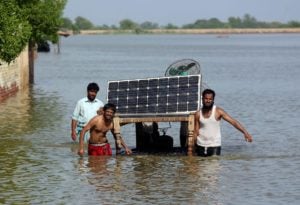
The rooftop of Vaqar Zakaria’s home in Islamabad is strewn with photovoltaic panels that he says have lowered his electricity bill to virtually nothing. This is countered by the stark contrast in his rising gas costs. “From a steady PKR 800 [USD 2.87] a month, it has risen to PKR 4,000 [$14.38] in the last six months,” he says, during a call with The Third Pole.
Zakaria, head of environmental consulting firm Hagler Bailley Pakistan, is fortunate to have a gas supply at home. His situation highlights a nationwide energy paradox where advancements in one sector are negated by crises in another. Gas in Pakistan is widely used for domestic heating and cooking, but across the country, the commodity is becoming increasingly scarce. As citizens consider alternatives, disparity widens with affluent households turning to expensive propane cylinders or electric stoves, while the poor burn wood.
“If only Pakistan had imported Iranian gas back in the late 1990s when there were no sanctions,” Zakaria said, recalling a time when prices were far cheaper “at just USD 2 per million British thermal units (MMBtu)”.
A participant in some of the early discussions, Zakaria remembers strategising over the proposed 2,775km pipeline that promised to link Pakistan’s energy supply directly to Iran’s abundant gas reserves. The long-term project, which came to be known as the ‘peace pipeline’, has faced significant delays due to geopolitical pressures, sanctions on Iran and financial hurdles within Pakistan.
Iran’s proven natural gas reserves, estimated at 1,203 trillion cubic feet (Tcf) as of December 2021, are second only to Russia.
In February this year, Pakistan’s caretaker government decided to dust off the 2009 agreement, approving the construction of the first phase or 80km stretch (of the total 780km pipeline) from the Iranian border to Gwadar, in Balochistan.
According to Hassan Nourain, the consul general of Iran in Karachi: “The network is designed to pass through Balochistan and Sindh provinces before entering Punjab. The pipeline from Iran will have an estimated capacity to funnel 750 million to around 1 billion cubic feet of natural gas per day [ft3/d].”
Meanwhile, Tehran has issued Islamabad a deadline: finish the pipeline segment by March 2024 or incur financial repercussions amounting to nearly USD $18bn — a sum that could prompt international arbitration.
“We are very reluctant to take this drastic step,” the Iranian consul general told The Third Pole, “but the gas company of Iran is a national company and belongs to the people of Iran. It invested USD $1bn years ago. Now, the Iranian parliament is pressuring the government to decide the fate of this project.”
Iran had already fulfilled its part of the agreement by completing 1,100km of pipeline from the South Pars gas fields to the Pakistan border. “By 2012, Iran had completed its construction and was ready to transport gas to Pakistan,” said the Iranian diplomat. In 2014, Iran also extended the deadline by an additional decade, on Pakistan’s request, he added.
But Pakistan is also feeling the pressure from the US. Last month, Donald Lu, the US assistant secretary of state for South and Central Asia cautioned Pakistan against importing gas from Iran, as it would expose it to US sanctions.
Pakistan is seemingly caught between the devil and the deep blue sea – build the pipeline and risk being sanctioned, or don’t build it and get slapped with a massive fineMicheal Kugelman, director of the Wilson Center’s South Asia Institute
In response, Pakistan’s Foreign Office spokesperson Mumtaz Zahrah Baloch made a case for national sovereignty; since the pipeline is being built within Pakistani territory, “we do not believe that at this point there is room for any discussion or waiver from a third party”, she said.
Nonetheless, the acting US mission spokesperson in Pakistan, Thomas Montgomery told The Third Pole “We advise anyone considering business deals with Iran to be aware of the potential risk of sanctions.” The US has been pushing Pakistan to seek green alternatives; through its development agency it has helped add almost 4,000 MW of clean energy to Pakistan’s grid since 2010.
Senator Mushahid Hussain Sayed, a senior member of the ruling Pakistan Muslim League, speaking in a personal capacity, highlighted the tension between national sovereignty and the US: “We invite its meddling by abdicating our own autonomy for decisions on our core interests.”
Despite the warnings from its longstanding ally, Pakistan’s defence minister Khawaja Muhammad Asif told The Third Pole that the energy infrastructure project would proceed, signalling Pakistan’s intention to assert its autonomy: “We will go ahead with construction of the pipeline,” he said.
Waiver favour
While Pakistan grapples with Iran’s deadline, the land in Gwadar earmarked for construction has yet to be acquired, according to government insiders.
Micheal Kugelman, director of the Wilson Center’s South Asia Institute in Washington, summarises the predicament: “Pakistan is seemingly caught between the devil and the deep blue sea – build the pipeline and risk being sanctioned, or don’t build it and get slapped with a massive fine.”
Ahmad Irfan Aslam, the former law minister in the caretaker government that greenlighted construction of the 80km section of the pipeline, points out Pakistan’s reliance on the US for “everything from economic bailouts to its security”. He warned any waiver request would necessitate complex negotiations.
“We cannot bear American sanctions. We will present our stance to the US,” Musadik Malik, Pakistan’s petroleum minister told journalists last month. “Iran has been told multiple times that we need their gas. We want to complete this project but without any sanctions.”
Montgomery confirmed Pakistan has yet to present a formal waiver request. With Pakistan in a tight spot, Aslam suggested exploring a deadline extension and seeking a waiver, which “would require support from both Saudi Arabia and the UAE.” But as tensions mount in the Middle East over the Israel-Gaza conflict, with new US sanctions against Iran announced on April 18, Kugelman said it was unlikely that the US would grant Pakistan a sanctions waiver to proceed with the project.
Economic feasibility
Pakistan has just 19.5 Tcf of proven gas reserves, sufficient for just 12 more years, based on current annual consumption levels.
“The only advantage to have Iranian gas is if there is a guarantee of firm supply at favourable rates,” said Haneea Isaad, an energy finance specialist at the Institute for Energy Economics and Financial Analysis (IEEFA). With existing Qatari gas contracts at USD 13/MMBtu and spot market prices “even lower at USD 8/MMBtu,” according to Isaad, the Iran-Pakistan pipeline would need to offer better rates to be economically viable.
“We are looking towards raising funds from international banks” said defence minister Asif. Emphasising compliance with international standards, he said: “We will not violate any international regimes.”
However, Zakaria warned securing investment may prove challenging: “Neither the development finance institutions nor the western and the Middle Eastern banks will lend for the project in view of US sanctions placed on Iran, which will also make it difficult for Pakistan to pay for the gas received from Iran,” he said.
Pakistan’s best bet may be to build the pipeline with financing from China or some other external source, said Kugelman. Among possible funders is Russia. Sayed told The Third Pole that, “Russia has offered to fund the initial USD $160m for the 80km of Pakistan-Iran Pipeline.” While Iran, said its consul general, “would be happy to provide technical and engineering support in building the pipeline”.
Pakistan faces a complex energy transition, marked by growing demand and discussions centred on the immediate challenges of costs, legal action and geopolitical dynamics.
As Pakistan prepares to host Iranian President Ebrahim Raisi on an official three-day visit from April 22, Isaad warned against viewing Iranian gas as a panacea for Pakistan’s energy needs, emphasising it is “another imported commodity and subject to geopolitical considerations and linked to global oil prices”.
Pakistan should instead focus on renewable sources like wind and solar, she said, suggesting a strategic shift that aligns with global energy trends. But “if it is needed for industrial use, like for the fertiliser sector, then we might have to wait for other alternatives such as green hydrogen and ammonia to become economically feasible.”
A reduced version of this story also appeared in the print version of Dawn, Pakistan’s largest English-language newspaper