With fast-growing energy demand and most of its electricity coming from fossil fuels, Ghana’s government is eager to develop renewable power.
Between the mid-1960s and mid-1980s, Ghana was heavily reliant on the Akosombo dam to meet its electricity demand. Then, as changing rainfall patterns lowered water levels, other, mainly thermal, sources of power were developed.
Now, a big push is underway to increase solar power generation, sometimes utilising reservoirs behind hydropower dams. The government wants 10% of electricity generation from solar by 2030. This is ambitious: foreign direct investment in the country has been falling, and excluding big hydro, less than 1% of generation is currently from renewables.
The Bui dam
In 2007, Emmanuel Appiah was a young graduate running an internet café. “I couldn’t afford to run it eight hours a day without electricity from the grid,” he said. “I lost my first business.”
Appiah was one of millions of Ghanaians who suffered during an energy crisis that lasted more than a year.
That year, President John Kufour announced several projects to increase the supply of electricity, including a new hydropower facility, the Bui dam.
“As we speak, there is a high-powered delegation in China to conclude an agreement with the Chinese Exim Bank for assistance towards the construction of this dam,” Kufour said.
The delegation returned to Accra with promises of loans totalling US$562 million from Exim Bank, covering 90% of the dam’s construction costs.
The controversial 400 MW project would take six years to complete. Located on the Volta River, it involved resettling fishing communities, a contested compensation scheme and the flooding of one-fifth of the Bui National Park. Warnings from conservation groups about the threat posed by the dam to vulnerable species, such as the hippopotamus, were largely ignored. The dam also failed to provide a lasting solution to Ghana’s energy woes, with the country suffering further severe load-shedding from 2012–2015.
Load-shedding is a means of managing the balance of demand and supply of electricity. Power distribution companies cut power supply to a proportion of consumers at certain times to reduce demand and so prevent wholesale blackouts. When national grids use load-shedding, consumers often have to turn to secondary power sources, such as diesel generators.
To plan and manage the dam, the government established the Bui Power Authority (BPA), an electric utility company. Working with Chinese contractors Sinohydro, BPA embarked on a steep “learning by doing” curve.
“We combed around to see whether there were any engineers and technicians in Ghana with experience in dam construction,” Fred Oware, former CEO of the BPA, told China Dialogue. “We didn’t get any, so for me the answer lay in training young engineers. We [employed] 30 young civil engineers to expose them to the experience of dam construction.”
Once the dam had been built, some Chinese technical experts stayed behind to assist in a skills transfer programme said Oware. In the end, the critical thing was to generate confidence in our local staff and technicians, and these programmes were to assist that effort,” he added.
The dam is now solely run by Ghanaians, Oware said. “This is a decision I am so proud of.”

But research published in 2021 by the South African Institute of International Affairs paints a different picture. “The BPA did not follow through on its commitments relating to skills development and technology transfer,” wrote the researchers. Similar findings were made by Oliver Hensengerth, associate professor at Northumbria University, in a 2017 paper.
From hydro newbie to solar leader
Hensengerth wrote, however, that while it is “questionable that the transfer has benefited Ghana in skills terms, it may certainly do so in terms of clean energy production.”
In 2019, the Ghanaian government released its Renewable Energy Masterplan. This blueprint for the expansion of renewables targets a total of 2,514 MW capacity by 2030, excluding large-scale hydro. That could bring renewable power to 10% of total installed capacity. Solar power is a prominent part of the target, accounting for 55% of projected capacity additions.
In 2020, a parliamentary act charged the BPA with “develop[ing] renewable energy and other clean energy alternatives in the country,” putting the 13-year-old utility at the core of Ghana’s renewables drive.
“Bui is taking the lead in the generation of solar energy in the country” said Oware, explaining that the company plans to build a total solar capacity of 250 MW in the next two to three years.
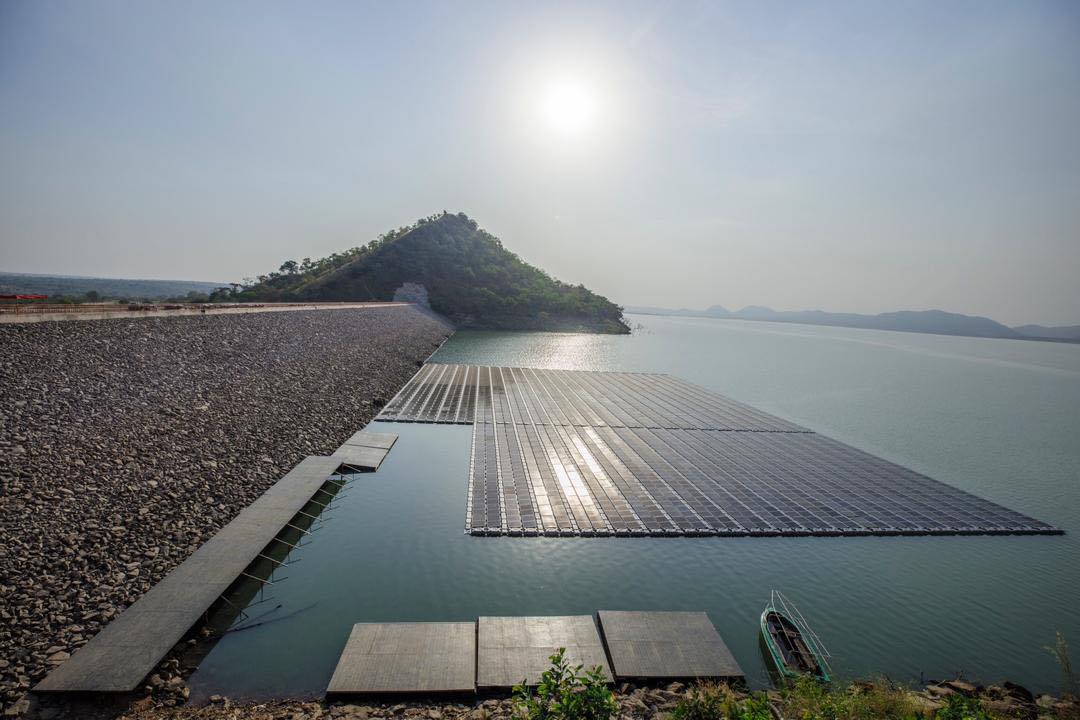
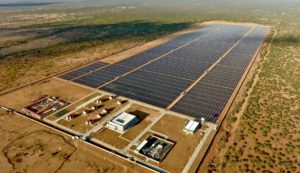
Peter Acheampong, deputy director of renewable energy at BPA, said the utility is building solar PV on the Bui dam reservoir. In the case of drought, the solar PV could support the dam’s electricity generation, he explained, calling it Ghana’s first hybrid hydro–solar plant to supply the national grid.
BPA has so far installed 51 MW of solar PV in Bui, including 1 MW of floating solar – a first of its kind in West Africa.
Threat of power crisis remains
Despite efforts by the state to develop the expertise of local engineers and increase investment in renewable energy, many experts believe Ghana risks going back to the load-shedding days of 2012–2015 if investment in generation capacity is not accelerated.
John Abdulai Jinapor, ranking member for parliament’s Mines and Energy Committee, has publicly expressed concern about the country facing another energy crisis.
The country has a peak demand of 3,469 MW against a dependable capacity of 3,861 MW, as of April 2022. According to the 2021 Outlook Report by Ghana’s Energy Commission, energy demand has been increasing at an annual rate of 10.3% for the past five years. This rapid growth is attributable to population increase, economic development and greater access to electricity in the countryside.
We cannot afford another massive load-shedding experienceEmmanuel Appiah
But BPA’s current CEO, Samuel Kofi Ahiave Dzamesi, insists the firm is “on course to deliver the intended 10% penetration by 2030”.
“We are now starting to expand the capacity by progressing to phases 2 and 3 of our project by constructing solar plants of 100 MW and 50 MW,” he told China Dialogue.
He revealed that BPA is currently acquiring land across northern Ghana for “solar projects between 50 and 100 MW” as well as constructing “small hydro plants of around 50 MW on small rivers” across the country. “We want to grow our capacity to 1 GW,” he said, referring to total installed capacity of both hydro and solar.
But with the country facing economic woes and a drop in foreign direct investment, how will such ambitious projects be financed? Energy analyst at Ghana’s University of Development Studies, Kojo Poku, believes Ghana can only meet its 10% by 2030 target with investment from the private sector. He warns that underinvestment in electricity distribution infrastructure is to blame for a 25% loss of all power purchased.
“The government currently is fiscally challenged and, for the foreseeable future, will unlikely lead huge investments in solar,” he added.
Today, Emmanuel Appiah runs a medium-sized printing business. Many such companies have a long-term strategy to generate electricity independently. “We cannot afford another massive load-shedding experience. That is why we have started investing in [rooftop] solar. Hopefully in the next five years, I should be completely off the national grid,” he said.
This article was produced as a result of a grant provided by the Africa-China Reporting Project at the Wits Centre for Journalism at the University of the Witwatersrand, Johannesburg, and China Dialogue Trust. The views expressed are the authors.