
Energy

Huge potential of geothermal energy in the Himalayas still largely untapped

China is already operating one plant, but vast amounts of geothermal energy still lie untapped in the Himalayan region
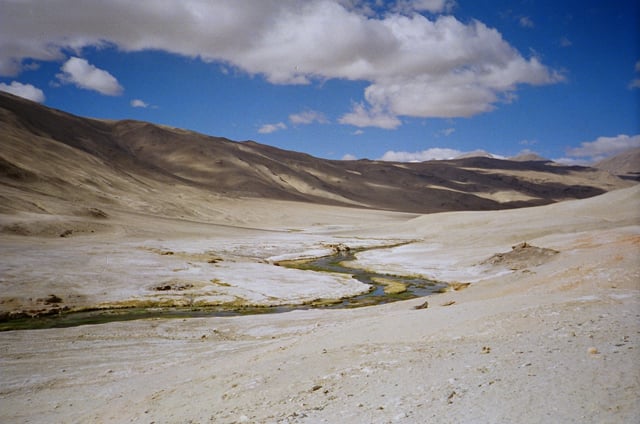
<p>Geothermal energy can reduce the use of fossil fuels for heating in the Himalayan winters. (Image by Matt Wan)</p>

Geothermal energy can reduce the use of fossil fuels for heating in the Himalayan winters. (Image by Matt Wan)

Hundreds of gigawatts of geothermal energy remain locked up in the Himalayas because of environmental considerations and lack of investment in research, say international geologists.


“I hope lessons from elsewhere in the world can help harness these resources in the Himalayas,” Geo Moore, a geologist at the Energy and Geosciences Institute, University of Utah, told a conference on sustainable resource development held last month in Leh, Jammu and Kashmir state, India.

Geothermal energy, derived from heat stored in the earth, is considered to be renewable energy. The world currently has 11.13 gigawatts of it installed in 24 countries with the US leading with 3.15 gigawatts. The Philippines and Indonesia follow with 1.90 and 1.30 gigawatts respectively.

China has, since 1976, been operating a 25 megawatt plant in Yangbaijan, Tibet, exploiting geothermal water at a temperature of 160 degrees Celsius. Moore says that while this is a good example, the pal in adjacent Jammu and Kashmir is even greater.

“The hottest and best known of the geothermal systems are in Jammu and Kashmir, which form part of the northwest Himalayan ‘geothermal province’ that extends through Nepal and Tibet,” Moore says. 

According to Jonathan Craig, honorary professor at University College, London, and the University of Jammu, the Puga hot spring area, located at the junction of the Indian and Tibetan plates in Ladakh, has the greatest geothermal energy potential on the Indian subcontinent.  

“A 20 megawatt geothermal plant at Puga could save three million litres of diesel burnt annually in the region at a cost of approximately US$ 2 million,” says Craig who has published a paper on the subject in Earth Science Review in May 2013. 

Such a plant, says Craig, would eliminate the need for traditional kerosene stoves and gas-operated heaters during winter and prevent the emission of some 28,000 tonnes of carbon dioxide.

Brinda Thusu, from the department of earth sciences, University College of London, says that Puga is the most promising geothermal field in India as it has hot springs, mud pools, and sulphur and borax deposits covering an area extending over 15 square kilometres.

Glacial mass balance calculations indicate that there is sufficient melt water available to recharge both shallow and deep reservoirs in the Puga geothermal field, Thusu said.

A version of this piece was first published on SciDev.Net    

Cookies Settings

Dialogue Earth uses cookies to provide you with the best user experience possible. Cookie information is stored in your browser. It allows us to recognise you when you return to Dialogue Earth and helps us to understand which sections of the website you find useful.

Required Cookies

Required Cookies should be enabled at all times so that we can save your preferences for cookie settings.

Dialogue Earth - Dialogue Earth is an independent organisation dedicated to promoting a common understanding of the world's urgent environmental challenges. Read our privacy policy.

Cloudflare - Cloudflare is a service used for the purposes of increasing the security and performance of web sites and services. Read Cloudflare's privacy policy and terms of service.

Functional Cookies

Dialogue Earth uses several functional cookies to collect anonymous information such as the number of site visitors and the most popular pages. Keeping these cookies enabled helps us to improve our website.

Google Analytics - The Google Analytics cookies are used to gather anonymous information about how you use our websites. We use this information to improve our sites and report on the reach of our content. Read Google's privacy policy and terms of service.

Advertising Cookies

This website uses the following additional cookies:

Google Inc. - Google operates Google Ads, Display & Video 360, and Google Ad Manager. These services allow advertisers to plan, execute and analyze marketing programs with greater ease and efficiency, while enabling publishers to maximize their returns from online advertising. Note that you may see cookies placed by Google for advertising, including the opt out cookie, under the Google.com or DoubleClick.net domains.

Twitter - Twitter is a real-time information network that connects you to the latest stories, ideas, opinions and news about what you find interesting. Simply find the accounts you find compelling and follow the conversations.

Facebook Inc. - Facebook is an online social networking service. China Dialogue aims to help guide our readers to content that they are interested in, so they can continue to read more of what they enjoy. If you are a social media user, then we are able to do this through a pixel provided by Facebook, which allows Facebook to place cookies on your web browser. For example, when a Facebook user returns to Facebook from our site, Facebook can identify them as part of a group of China Dialogue readers, and deliver them marketing messages from us, i.e. more of our content on biodiversity. Data that can be obtained through this is limited to the URL of the pages that have been visited and the limited information a browser might pass on, such as its IP address. In addition to the cookie controls that we mentioned above, if you are a Facebook user you can opt out by following this link.

Linkedin - LinkedIn is a business- and employment-oriented social networking service that operates via websites and mobile apps.