The sun glints off the blades of giant wind turbines in Turkana, a semi-arid county in Kenya’s Rift Valley. They slice through warm air above an ancient lake, conjuring a vision of East Africa overcoming energy poverty through renewables. However, less than 400 miles away, cramped shacks in Nairobi’s Mukuru slum are lit only by flickering kerosene lamps.
Though Kenya’s overall electricity access stands at 75% – the highest in East Africa – 12 million of its citizens still live without power. In Nairobi’s Kibera slum, tailor and mother of four Fatuma Hirdi explains how this stalls opportunity.
“Imagine trying to run a small tailoring business with only candlelight,” she said. “The lack of electricity severely limits my production and keeps me trapped in poverty. Beyond that, my children cannot study well, and I constantly fear for their health due to the fumes from the lamps I’m forced to use.”
Hirdi’s story is replicated many times over elsewhere in the region. While electricity now reaches over half the population of Rwanda (64%), Uganda (52%) and Somalia (50%), this has not been achieved in Tanzania (48%), the Democratic Republic of the Congo (22%), Burundi (12%) or South Sudan (5.4%), according to World Bank data.
In the African continent as a whole, 600 million people, or almost 50% of the population, are without electricity access. From this challenging landscape Mission 300 was launched in 2024, a plan to connect 300 million people to electricity by 2030 at a projected cost of USD 90 billion. The aim is for half of the new connections to come from the expansion of existing national grids, and the other half to come from renewable solutions such as wind and solar mini-grids, Reuters reports.
What is the status of Mission 300?
The funding is expected to come from multilateral development banks, development agencies, philanthropic funding and private businesses. The two main institutions behind the scheme are the World Bank Group, which has pledged USD 30 billion, and the African Development Bank (AfDB) which has pledged USD 18 billion.
In January 2025, the two institutions jointly convened the Mission 300 Africa Energy Summit in Dar es Salaam, Tanzania. At that meeting 12 countries, including the Democratic Republic of the Congo (DRC) and Tanzania, released “national energy compacts” with Mission 300 in mind. The compacts set targets and timelines for expanding energy infrastructure, building out distributed renewable energy and fostering private investment.
Distributed energy refers to a range of technologies that generate electricity at or near the place of use, mostly through solar panels but also wind power. Such systems may supply a single structure, such as a house, or can be part of a smaller grid connected to a larger electricity supply system, such as in a large industrial facility.
With this model, electricity no longer flows in only one direction, from the grid to the consumer. Instead, consumers can produce electricity for their own consumption, and also sell it to the market when they have a surplus, in some cases making a profit. This creates two-way flows and allows consumers to take control of their own energy demand.
Also announced at the summit were pledges from two other development banks. The Islamic Development Bank, which is headquartered in Saudi Arabia, promised USD 2.65 billion in project financing and a further USD 2 billion to insure projects. While the Asian Infrastructure Development Bank, headquartered in China, pledged USD 1-1.5 billion.
Will these substantial sums be put to the best possible use? Can Africa, and East Africa in particular, avoid repeating past mistakes where aid has sometimes translated into power lines without lighting?
Mohammed Adow, the founder and director of Powershift Africa, offers cautious hope: “The initiative, if utilised well, will improve economic growth, not just in East Africa but in the entire African continent.” But he also warns: “Mission 300 must confront the structural causes of Africa’s underdevelopment and financial dependency, not just offer another superficial fix.”
Adow and other critics argue that simply providing power without tackling issues like debt, an over-reliance on private capital, and a lack of local value addition could exacerbate existing problems. It could also further hinder true sustainable development.
John Mutua, director of economic regulation and strategy at Kenya’s Energy and Petroleum Regulatory Authority, emphasised that the initiative must break from conventional finance models in which loans have been given with high interest rates and strict repayment terms. Such loans are particularly challenging for startups with no track record or organisations with limited funding.
“Mission 300, while ambitious, must fundamentally alter how we finance last-mile connectivity,” Mutua says. “We need clever ways to mix different types of money (like government funds, charity donations and private investments) to make it less risky for private businesses to invest in projects that help everyday people at the local level,” he says.
For Mutua, there are three core ways to accelerate access: ensure energy is affordable; support off-grid solutions like mini-grids and rooftop solar for remote areas; and facilitate regional power pooling.
“The emphasis on off-grid solutions within Mission 300 is crucial. Grid extension alone cannot meet the 2030 target, especially in remote areas,” he explains. We must ensure robust standards and incentives for mini-grids and standalone systems, because these are the true frontier of accelerated access.”
East Africa’s energy landscape
The region has abundant clean-energy resources. Kenya, for example, already generates the vast majority of its electricity from renewables. Daniel Kiptoo, director-general of Kenya’s Energy and Petroleum Regulatory Authority, painted an optimistic picture of the country’s path forward:
“Kenya is uniquely positioned to lead Africa’s energy transition, with over 90% of our electricity already coming from renewable sources like geothermal, wind and hydro,” he tells Dialogue Earth.
“Our focus now is not just on generation but on building a resilient grid and expanding access to underserved regions. “We are also working to create a regulatory environment that supports private investment and innovation, particularly in off-grid and mini-grid technologies.”
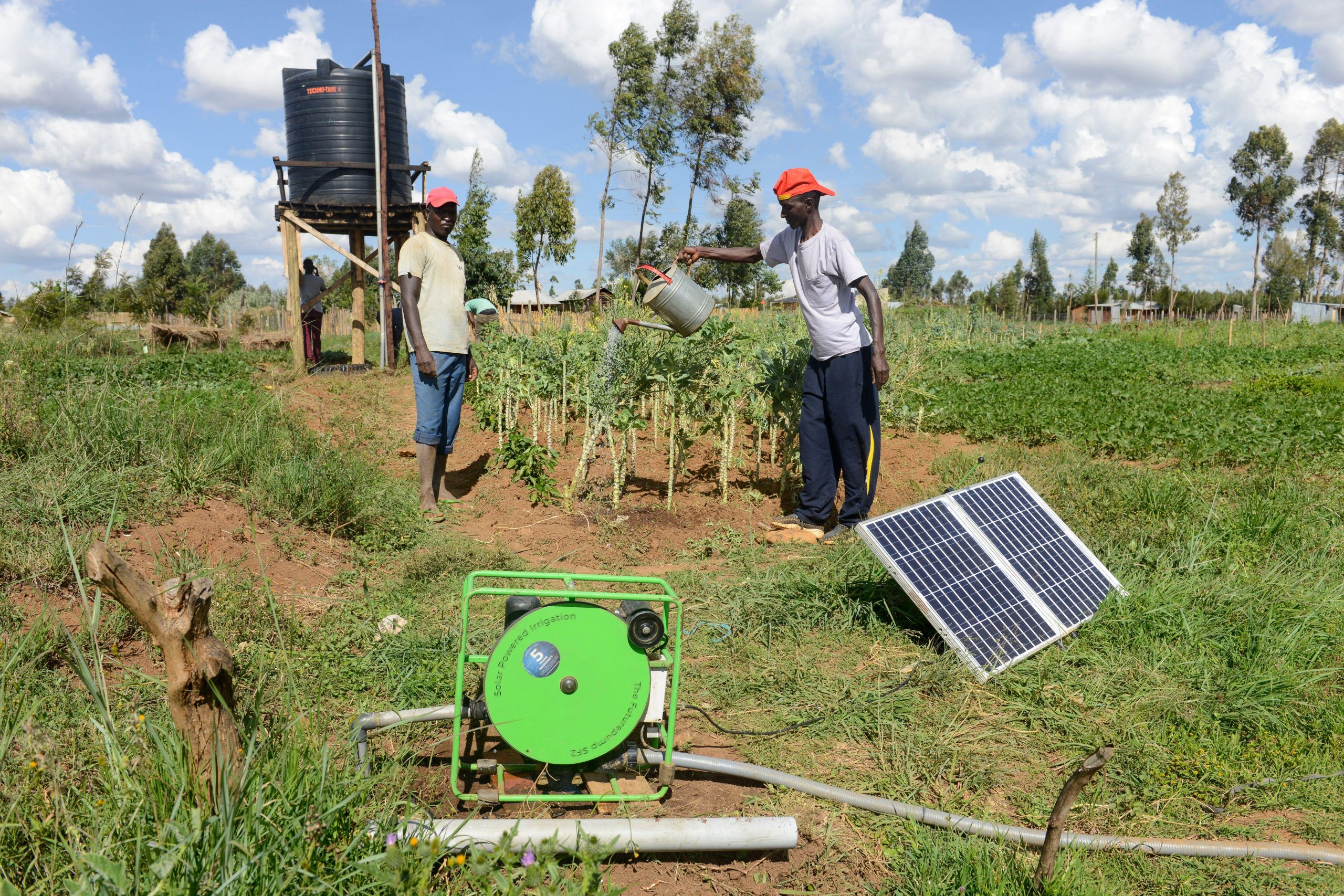
Neighbouring Ethiopia has finished building the Grand Ethiopian Renaissance Dam, which is expected to become Africa’s largest hydropower plant, while solar microgrids and rooftop panels are increasingly common in off-grid villages.
However, alongside this green surge, Uganda and Tanzania are steering toward exploiting their oil and gas reserves. Government officials argue that fossil fuels like gas can serve as a “bridge” toward renewables, fuelling infrastructure and revenue generation.
Critics are unconvinced. “We hear promises but we see more investment in oil pipelines than in solar farms,” says David Kibirige, an environmental activist in Kampala, Uganda. “Is this truly a bridge, or are we being led down the same old dirty path?”
“We should not repeat past mistakes,” cautions Mithika Mwenda, secretary general of the Pan African Climate Justice Alliance, a civil-society coalition based in Nairobi. “The world is rapidly moving away from fossil fuels. East Africa must prioritise clean energy to secure its future and avoid being saddled with stranded assets,” Mwenda says.
Regional efforts and challenges
The East African Community – of Burundi, DRC, Kenya, Rwanda, Somalia, South Sudan, Tanzania and Uganda – is attempting to navigate these challenges by promoting regional cooperation and harmonising energy policies.
The development of the East African Power Pool, which aims to connect national grids, is a crucial step towards facilitating cross-border electricity trade and ensuring energy security.
Significant hurdles remain, however. Policy inconsistencies, red tape, financial constraints and logistical difficulties often delay or derail crucial projects.
“It’s like we’re always taking one step forward and two steps back,” laments Samson Tsegaye, an energy policy analyst based in Addis Ababa, Ethiopia. “The policies look good on paper, but implementation is a nightmare. There’s so much corruption and inefficiency.”
Climate change adds another layer of urgency. “We are already seeing the impacts of climate change – droughts, floods, extreme weather events – and these are disrupting energy production and distribution,” warns Ivetta Gerasimchuk, a senior expert in sustainable finance at the International Institute for Sustainable Development (IISD).
“East Africa must prioritise climate-resilient energy infrastructure and invest in decentralised renewable-energy solutions that empower local communities,” she adds.
The region is being pulled between competing paths for its energy future. How it chooses to power its future could shape its development for decades.
In April, Mission 300 featured prominently in global development discussions at a World Bank roundtable in Washington DC titled “Expanding energy access in Africa: a call for collective action”. During discussions, Kenya’s energy cabinet secretary, Opiyo Wandayi, said: “Mission 300 represents a crucial shift in how global partners view Africa’s energy future. For Kenya, it’s not just about adding connections; it’s about building resilient, decentralised grids that empower communities and truly drive economic transformation, moving beyond legacy fossil-fuel dependence. The real success of Mission 300 hinges on sustainable financing mechanisms that reach the last mile.”
Wandanyi told Dialogue Earth: “We need to see more innovative blends of public and private capital, ensuring these investments translate into reliable, affordable power for every home and business, not just national grid expansion.”
East Africa is at an inflection point. Its wind farms, hydropower dams and solar panels signal a transition in progress. However, unpowered communities like Mukuru and Kibera underscore glaring gaps in who benefits from this progress. Whether the vision of a clean-powered future stretches from Turkana’s turbines through Nairobi’s slums depends on the grit of its institutions, the clarity of its funding and the accountability of those building it.