Back in 2017, Chang Fu installed his village’s first solar panel on the roof his house. He never imagined it would be the first step toward creating a “solar village” here in Shanxi province, central China.
Today, if you walk down the main street of Heshangju at noon, you’ll see wide expanses of rooftop panels shining in the sun. About 100 of the 600 households in the village have installed them, amounting to 5 megawatts (MW) of capacity, all hooked up to the grid. The street lighting is also solar powered. Heshangju has become a small power station in its own right.
A little less than 500 km away, the village of Zhuangshang has seen similar changes, plus energy storage so excess power can be kept for later use.
In 2021, with support from several bodies, Zhuangshang started piloting a power-systems approach called PEDF.
Photovoltaic solar is used as the main energy source alongside Energy storage. Direct current is prioritised in homes, for its greater efficiency over alternating current. And Flexibility is added, such as by running appliances at particular times, to balance supply and demand.
In 2023, Zhuangshang was named a “zero-carbon energy demonstration village” by the Ministry of Agriculture and Rural Affairs, the Global Environmental Facility and the UN Development Programme. It won an Energy Transition Changemaker award at the COP28 climate summit.
It was back in 2014 that China had started encouraging villages to try “distributed solar” – where power is produced near where it will be consumed. Both the prospects of those villages and the lives of their residents improved as a result.
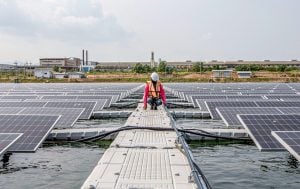
Growth has been rapid, from demonstration projects to large-scale roll-out and a diversification in approaches, such as expansion into agricultural and fishery contexts; solar panels can for example provide shade for animals sensitive to high temperatures such as crabs and sea cucumbers.
The process has been regionally different. Shanxi, already a big energy producer, is located in central China and has plenty of sunlight. Rural renewables here have benefited significantly from energy transition policies set by both central and local government. Shanxi is one of the better-performing provinces in terms of renewable-power development.
I work for a local think-tank called Shanxi Coshare Innovation Institute of Energy & Environment. In July last year, I visited ten villages in the province as part of my organisation’s “Sunlight Over Coal” project. The idea was to discover and share ordinary people’s tales of energy transition. We recruited ten volunteers and during our visits I saw how policy support, fair distribution of benefits and associated economic impacts made rapid development of distributed solar possible.
Solar villages are not all sunshine, however. After rapid deployment, rural renewables also face challenges such as declining subsidies and grid-connection restrictions. This article will show how various stakeholders are addressing these issues.
The three policies behind solar villages
Three central government policies in particular have supported rural distributed solar.
The first came into effect in 2014 and helped build a market for solar panels. The “solar power for poverty relief” policy included subsidies, tax breaks, guaranteed tariffs and grid services. These related to both distributed solar for poor households and, where suitable, to solar power stations in poor areas. It increased incomes for both households and villages.
In Shanxi, for example, more than 5,000 “poverty-relief solar power stations” had been built by October 2020, benefiting more than 9,000 villages and increasing incomes for over half a million residents. The benefits primarily take the form of a portion of revenue from electricity generation going to the village collective, or short-term jobs being provided in installing and maintaining solar systems.
The second policy arrived in 2018. With the market for solar-power equipment maturing and subsidies being phased out, a central government document made clear that the tariff for power from the poverty-relief projects would not change. This ensured continued help for those living in poor areas.
In June 2021, the third policy supporting rural distributed solar was announced – county-wide trials of rooftop solar. That prompted a wave of “whole village” roll-outs, managed by renewable-energy operators focused on a specific village or region. Zhuangshang is a good example. Today, the village saves the equivalent of 800 tonnes of standard coal per year, reducing carbon emissions by 2,450 tonnes, according to its government.
Trials have now been completed in 56 county-level administrations.
Better lives, more money
Our research found three ways that rural distributed solar works. In the first model, villagers spend CNY 40,000-100,000 on buying solar panels (about USD 6,000-14,000), making their money back over the next five to ten years mostly by selling power to the grid. In the second, the equipment is leased with funds from a “solar loan” from a bank. The third sees a company rent roof space for solar panels, paying the resident somewhere near CNY 1,000 (USD 140) a year.
The first two models require more investment from the resident and there are lending risks with the second. So, since the policy was released in 2021, the roof-renting model has been more common.
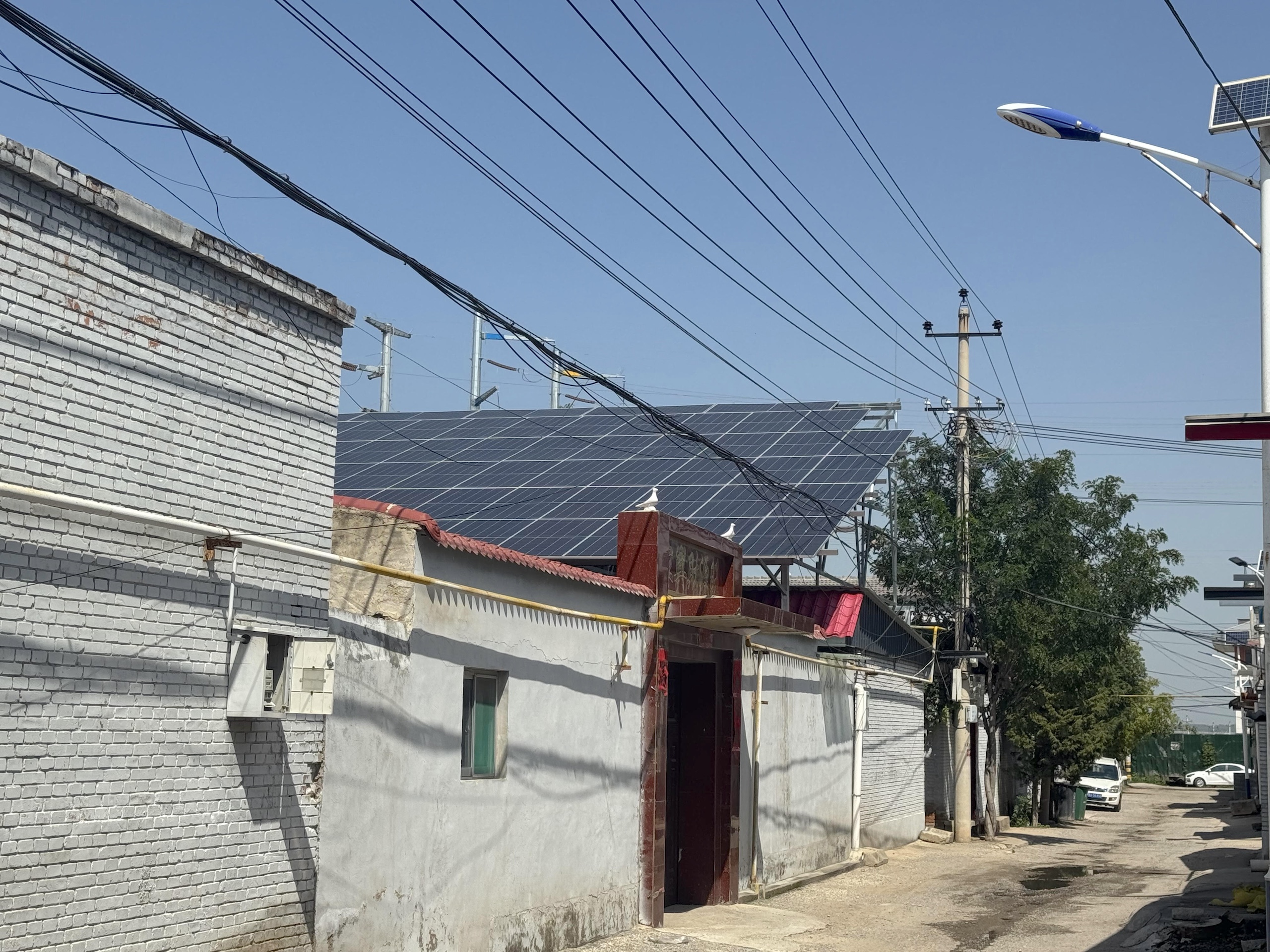
In Zhuangshang, for example, the residents benefit in two ways. Some use the power from their rooftop solar panels themselves. The majority, though, take the rent and let a company install its own panels and take any profit on the power sales.
Alongside the financial benefits, we found other more unexpected bonuses for the villagers. The first is better infrastructure. “The environment’s better,” said Ye Yanqin of Dong village, also in Shanxi. “Look, the road’s wider, and cleaner. You feel happier going out now.”
That’s not directly due to the solar panels. Rather, the companies installing them often improve local roads so they can get their vehicles in and out more easily. Those wider asphalt roads bring economic co-benefits. Local crops can get to market more easily and it’s easier to do business outside of the village.
Distributed solar also brings job opportunities. “When they were doing the installations, some of us did odd jobs for them, shifting materials, helping them clear up sites, security, cleaning and so on,” Ye said. “They paid 100 to 120 yuan a day. Once the panels are installed, they need maintenance now and then. But none of that is steady work.”
There have also been courtship-related benefits, or so one villager told us: “Now the village is famous, and our young folk find it easier to get a wife or husband!”
Challenges for solar villages
But solar villages aren’t all sunshine.
As distributed solar installations have spread, connections to the grid have become an issue. More places are setting limits. Once grid capacity is reached, new connections are restricted or simply not permitted. During our visits to the villages, we often heard how getting hooked up to the grid is harder than it used to be, with new installations obliged to wait for extra grid capacity to come online.
In Heshangju, latecomers are struggling to get their solar panels hooked up.
The generous subsidies and guaranteed tariffs are gone, and now the power has to be sold on the open market. The benefits are greatly reduced and the enthusiasm of villagers and operators alike has taken a knock.
The villages, though, are working to respond. Zhuangshang is using energy storage to make use of solar power it can’t immediately use. That is costly, however, and large-scale roll-out would be challenging. A single kilowatt-hour of energy storage requires spending hundreds of yuan on lithium batteries.
Talking to villagers, we found that alongside doubts about the profits to be made, there are other concerns and misconceptions – for example, that the panels emit radiation or will damage roofs.
In fact, there are rules in place to keep roofs safe. The roof must be made of appropriate materials able to take the weight of the panels. Space, shading, safety, neighbours, regulatory compliance – all these have to be considered. In many villages, the roofs on older homes aren’t strong enough for panels to be installed.
Another issue we found in our discussions with rural residents is that they can sometimes be slow to take new ideas on board. More time and communication is needed, hampering the roll-out of distributed solar.
Teach a man to fish
With grid technology improving, there’s potential for distributed solar to bring benefits beyond profits and a better environment. Hao Jiangbei, a renewable-energy expert, is trying to make one of those possibilities real in the Beijing village of Shiwanzi and its surroundings.
He thinks a route out of the grid bottleneck is for villagers to install their own solar panels and use the power themselves. Villagers with the necessary cash can choose and install the panels, making their money back in three to five years. If they’re generating enough power, they can even launch a suitable business – something cheap to set up but power-hungry, such as grain processing. The panels also allow for low-carbon heating during winter.
However, villagers need to work out the finances and be confident in knowing which small energy-storage system and inverter to buy – all of which requires study and training.
As the technology is not too hard to understand, those who can’t afford to do this themselves can still learn the skills and make money installing or maintaining equipment for others. Yet a lack of the required knowledge and other factors mean this is not a common choice. To improve the situation, Hao Jiangbei started running solar-installation workshops last year, showing people the potential of the technology and teaching them the electrical skills needed.
The decade of solar village development, along with the current situation and the possibilities for the future, remind us that the energy transition isn’t just about energy. As Huang Yating, a volunteer from Shanxi Normal University, wrote in her notes:
“For an ordinary villager like Ye Yanqin, the wind turbines up the hill weren’t a sudden life-changing miracle. But they did, through better roads, occasional work and benefits to the village as a whole, create a social safety net able to reduce risks.
“The energy transition is not an abstract macro-level policy. It is a smoother road, a period of temporary work, or the chance of a local job.”
Project volunteers contributing to the article include: Huang Yating, Zhang Li, Wang Xinyue, Lan Qingyu, Sun Jie, Li Xinyi, Wu Jinchang, Zheng Yangfan and Chuai Zhuoyang. Zhao Liang, founder of the NGO Airman, also contributed.