


China’s tragic record of sacrificing human lives for the profits of mining companies has now touched Tibet.
The 83 miners, mostly Han emigrants to Tibet, who died in the foreseeable collapse of the Gyama copper/gold mine (Jiama in Chinese) are the latest wasted lives across China. Most of the victims were from poor villages in Guizhou province. Even unskilled mine work requires literacy in Chinese, which few Tibetans have.
With indecent haste, the subsidiary of state-owned China Gold International that operates the Gyama mine announced that the landslide was natural. This rush to excuse themselves of culpability is not backed by any scientific monitoring of earthquake activity.
The fact is that this huge mine, despite extremely steep mountainous terrain, is open cut, avoiding the expense of tunnelling. The walls of an open pit mine are prone to collapse, especially in a young and unstable land such as Tibet which is still rising.
The mining company took a calculated cost-cutting risk, and the mine workers paid the price. Open pits mean much blasting to loosen rock, a risky strategy. Now the mine, if it is to operate as planned for the coming seven decades, will have to go underground.
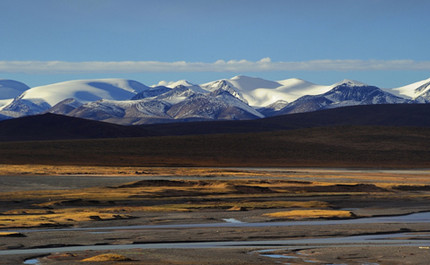
Gyama is just upriver from Lhasa, on the east flank of Mount Wangkur, rich in copper, gold, molybdenum and silver, also lead and zinc that, if profitable at the time can be recovered, and if not, dumped. On the west flank is Ganden monastic university, one of the three great monasteries on the outskirts of the holy city of Lhasa.
Below the Gyama mine and Ganden monastery is the Kyichu, the river that flows through Lhasa before reaching the Yarlung Zangbo, known internationally as the Brahmaputra. Scientific baseline studies of the chemical load of the river, by Tibetan and Finnish scientists, show there is naturally a high load of dangerous heavy metals, inevitable in a geologically young and unstable land. Any further runoff from mine tailings dams meant to withhold toxic metals from the river, would be ruinous, not only for Tibetans but also for hundreds of millions in eastern India and Bangladesh downstream.
Gyama is revered as the location of the palace of the last non-Buddhist king of Tibet, Songtsen Gampo, 14 centuries ago. He moved his palace downriver to Lhasa, establishing it as his new capital at the time of his embrace of Buddhism, and of his wives who came from the defeated kingdom of Zhang Zhung, from the Kathmandu Valley and from China.
The scale of this mine is far beyond anything seen before in Tibet. It could take seven decades to complete extraction, leaving behind waste dumps far bigger than the extracted metals. So steep is the terrain that excavated rock is sent on a conveyor belt, through a five kilometre long mountain tunnel to the ore concentrating plant 400 metres below.
In contrast to other state-owned mines, the Vancouver-based mining company China Gold International (CGI), and its subsidiary Huatailong, have been attuned to the importance of public relations. CGI has flown journalists from state media to Gyama, resulting in favourable coverage. Acutely aware that Tibetans greatly dislike large scale mining, interference with sacred landscapes and the toxic heavy metal pollution of Tibetan rivers, CGI has sought to distance itself from the uncontrolled gold rush of past decades and present itself as a socially responsible company attuned to Tibetan sensibilities.
Under the headline “A Mining Miracle”, news magazine Beijing Review told its worldwide audience that: “Mining company Huatailong helps restore a Tibetan region after private sector abuses.”
These days nearly all mining in Tibet is done by the same large state-owned mining companies that also invest heavily in extracting the same metals from Peru, Zambia, Congo or Kazakhstan. Since CGI is legally domiciled in Vancouver and listed on the Toronto Stock Exchange, it has reporting obligations and documentation on its mining plans, including Gyama, is available online. A report from September 17, 2010, details extraction plans and profit forecasts for coming decades. The day the news of the mining disaster broke, company shares plunged more than 13% and have since dropped further.
CGI and its parent China Gold Group are in a tight spot. If the landslide is to be passed off as natural, it makes highly questionable the capacity of mine waste tailings dams to withstand earthquakes and debris flows, and the many extremes of climate at an altitude close to 5,000 metres. If, on the other hand, the landslide was not natural, but due to cost cutting, cavalier blasting, and a desire for quick profits, CGI’s corporate strategy is in tatters.
CGI is strongly focused on global expansion, which requires access to loan capital, which depends on a good reputation. The company already has mines in Kyrgyzstan and Zambia, and says it is seeking targets in Central Asia, Southeast Asia, Australia, North and South America and Africa.
This disaster has brought into the open a strong sympathy, among China’s artists and shapers of opinion, that the land and people of Tibet should be spared intensive industrialisation. As more Han Chinese discover the charms of Tibet, bloggers are openly calling for restraint and compassion. Television director Zhang Ronggui said he was “strongly opposed to the development of heavy industry and mineral resources in Tibet” in a widely quoted Sina Weibo post. “It is the world’s highest and purest holy land, and I hope the government can leave a blue sky, clean water and white clouds for the next generation,” he wrote.
Well-known author Zhang Yihe, in a message to her 339,000 fans, said: “I don’t understand why we have to dig up gold in areas that are above 4,000 metres. Why must we also build dams on rivers, including the Yarlung Zangbo? Why don’t we leave something for the next generation?”
This outpouring of concern could be a turning point, coalescing a growing human connection between Han and Tibetans. A Chinese cultural anthropologist, Dan Smyer Yu has looked closely at those Han drawn to Tibet. He says: “Tibetan Buddhism particularly attracts those who have higher incomes and social mobility, such as media professionals, artists, filmmakers, entrepreneurs, mid- and high-level administrators, corporate managers, university professors, and Party members.”
They find in Tibet a treasure greater than the gold, copper, silver and molybdenum at Gyama. It is the mental treasure kept alive and embodied by Tibetans, who use the mountains not to extract metals but as places of solitude essential to the mind training sciences of Tibet.
Gabriel Lafitte is the author of Spoiling Tibet, published by Zed Books in September 2013; a comprehensive analysis of the impacts of mining across the Tibetan Plateau.
Image by Reurinkjan