


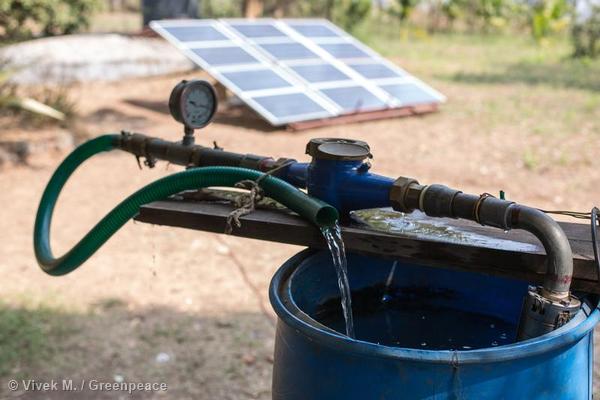
Arshad Khan recently converted his diesel-operated water pump to solar energy to save money on his monthly diesel bill. He grows wheat, vegetables, peanuts and sugar-cane on his 18 hectare farm in Attock district of Pakistan’s Punjab province.
“In April last year I decided to convert my tube well to solar energy after my diesel costs rose to 29,000 rupees (US$287) per month,” he said.
In Pakistan, there are over 1.1 million agriculture tube wells, with only 30% of them operated by electricity.
As the country faces a growing energy crisis, farmers are left with no option but to switch from diesel to solar energy to irrigate their crops. Tube wells consume around 2,000 million litres of diesel every year.
Khan is now encouraging other farmers in the area to install solar panels, pointing out the long-term economic benefits despite the initial expenditure of 1.8 million rupees (US$17,827).
National solar drive?
Pakistan’s government recently approved the use of grid-connected solar energy and rooftop solar installations and cut import taxes on solar equipment in a bid to boost solar power across the country.
In the next few months, Pakistan will add 100MW from the Quaid-e-Azam solar park in Punjab province to the national grid for the first time, with an additional 50MW to be added within a year. The project is part of Pakistan-China Economic Corridor, under which China will invest US$33 billion including in the energy and power sector.
But the country’s solar sector has a long way to go. “At the moment, generation of solar energy in the public sector is zero as all the projects are being done in the private sector,” said Asjad Imtiaz Ali, CEO of the Alternative Energy Development Board, a government organisation.
Chairman of Pakistan Solar Association, Faiz Muhammad Bhutta, recently urged the government to do more to spread solar power: he called for a 20,000-MW solar target by 2026, following the example of India’s National Solar Mission.
Despite plummeting oil prices, Asjad Imtiaz Ali believes Pakistan should continue to develop its renewable energy sector as a way of reducing its reliance on volatile fossil imports for electricity.
Almost half of Pakistan’s total electricity generation comes from expensive thermal energy sources and this means electricity prices have become unaffordable, according to the country’s 2013 National Power Policy.
Solar is the most viable and reliable energy source for agriculture, argues Dr Qamar-uz-Zaman, climate change and renewable energy expert with LEAD Pakistan, an NGO based in Islamabad. He believes farmers across the country should be encouraged to convert their diesel-operated water pumps to solar energy.
“Agriculture tube wells can be operated directly from solar panels as no batteries are required to store the energy for them,” Dr Qamar-uz-Zaman said, adding farmers can recover costs within three to four years by saving on diesel and electricity bills.
Costs too high
But few farmers can afford the initial investment. Around 85% of farmers have less than ten hectares of land and they cannot afford agriculture inputs like seed, fertilisers and pesticides, let alone the installation of solar water pumps to irrigate their land, said Muhammad Anwar, Chairman of Pakistan Kissan Ittehad, a private body representing farmers.
Government subsidies would help. “The government should give at least a 50% subsidy on installation of solar tube wells to small growers,” he said, “the agriculture sector is backbone of the country’s economy and the government must support it.”
Punjab chief minister Shahbaz Sharif announced the government would provide solar panels to small farmers at subsidised rates back in June 2012, but this promise has not yet materialised. “The agriculture sector is not on the priority list of the rulers,” he lamented.
Pakistan’s agriculture sector contributes a fifth of the country’s GDP and employs almost half of the labour force, according to the Pakistan Economic Survey 2013-14.
Large-scale farmers are installing new solar tube wells on their farmlands but small-scale farmers cannot afford the cost of around 1.5 million rupees (US$14,855), said Nauman Khan, chief executive officer of Grace Solar Pakistan.
He suggested private banks should finance the installation of the solar powered water pumps as they finance seeds, fertilisers and pesticides.
Pakistan should make the most of its 300 days of sunshine a year by installing solar panels on homes and tube wells, he said.