


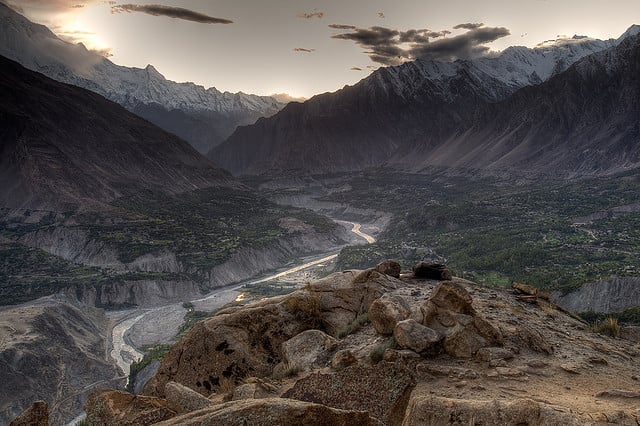
The desperation is rising for thousands of villagers in Pakistan’s Gilgit-Baltistan province who say they have sacrificed not just their land but also their culture for the controversial Diamer Bhasha dam that their government is determined to build at any cost.
“It is obvious that the dam will sink everything — from our properties to our social and cultural values. We have given up all of these for the sake of this dam,” Attaullah Khan, who heads the ‘Affectees Committee of Diamer-Basha Dam’, told thethirdpole.net.
The US$14 billion dam is slated to come up on the Indus river in Gilgit-Baltistan’s Diamer district, about 360 km upstream of Islamabad and 165 km downstream of the provincial capital of Gilgit. Environmentalists have pointed out that the dam would have consequences for the fragile ecology of the area and result in more landslides and flashfloods.
The dam will affect 32 villages with an estimated population of 30,350. It will produce 4,500 megawatts of electricity and store an additional 10.5 km3 of water to be used for irrigation and drinking.
The people’s view
The government’s indifference to their plight led them to Islamabad, said Attaullah Khan, who recently led an 18-member team to the Pakistan capital and met several ministers to press for revised compensation of their land. The other key points in the 32-point charter of demands include resettlement of those affected, allotment of homes in Islamabad and Abbottabad at nominal rates, construction of model residential colonies in Diamer as well as jobs in the project itself and education for their children.
They also threatened to block construction and hold a sit-in in Diamer and in Islamabad if their demands were not met.
“The Pakistani currency has devalued significantly compared to the dollar since 2010 when the agreement was signed and the price of our lands has also increased,” Attaullah said.
According to the agreement signed with the government, the entire compensation amount was required to be paid by December 31, 2013. However, a meagre amount has been paid for cultivated and uncultivated land but nothing yet for the pasture areas.
Following the meetings in Islamabad, the government has constituted a five-member ministerial committee to look into the issue. The committee in turn constituted a sub-committee, including the chief secretary of Gilgit Baltistan, the Diamer district commissioner and the managing director of the Water and Power Development Authority (WAPDA).
Hoping to hasten the bureaucratic process, Attaullah said the people had asked the government to resolve the issue of compensation within six months.
“We sacrificed our culture and even our graveyards in the larger national interest but the government did not honour its commitment,” said Muhammad Shafique from Thore village. “For a tribal man, nothing is more important than the graveyard of his ancestors,” he added.
Lal Mast Khan, another member of the ‘affectees committee’, said they even faced difficulties arranging marriages for their children because they could not build new houses. “Our young people are jobless. What is the government waiting for? Why can’t our people be accommodated?” he asked.
Federal secretary for water and power, Muhammad Younus Dagha, said in response that the government was working on the issue and had already transferred the compensation amount to the concerned departments for disbursing among the affectees. Some people, he said, wanted to get more and that was why they were agitating. The government, he added, was working to solve the issue in a transparent way.
Environmental implications
According to Shehzad Shigri, director of the Gilgit-Baltistan Environmental Protection Agency (GB-EPA), the evaporation of water from the massive reservoir behind the dam will change the local climate, resulting in more rain and snowfall and subsequently more flashfloods and landslides in the area. He added that the displaced people would move up the valley and this would exert pressure on forest and wildlife.
“Blasting during the dam construction will disturb the biodiversity, particularly the wild species in surrounding mountains and valleys,” Shigri told thethirdpole.net.
Asif Shuja Khan, former chief of the Pakistan Environmental Protection Agency (Pak-EPA), said that like other major dams, the Diamer-Basha dam too has many social and environmental implications both upstream and downstream.
Cost factor
According to 2013 estimates, the project will cost US$14 billion, significantly higher than the earlier estimated cost of US$8.5 billion dollars. This reflects the steady rise in costs due to the delay in construction. Though the foundation stone of the project was laid on October 18, 2011, construction is yet to begin. So far, the only work done is the demarcation of the dam area and building alternate highways to the dam site.
In 2012, the Pakistan Peoples Party-led government faced a serious setback when major sponsors such as World Bank and the Asian Development Bank (ADB) withdrew. They asked Pakistan to first get a no-objection certificate from India, a requirement for multilaterals for financing a project located in a disputed territory.
India claims that Gilgit-Baltistan is a part of Kashmir, a disputed territory which both Pakistan and India claim as their own. India has urged international donors not to finance mega projects in the area until the Kashmir issue is resolved. Pakistan rejects India’s claim saying Gilgit Baltistan had always been part of Pakistan.
The government of Pakistan arranged a road show in Washington this October to attract investors. But the Pakistan government is determined to go ahead with the project nonetheless. Federal Minister for Planning and Development Ahsan Iqbal told thethirdpole.net the dam will be built with Pakistan’s own resources even if the government failed to attract an investor.